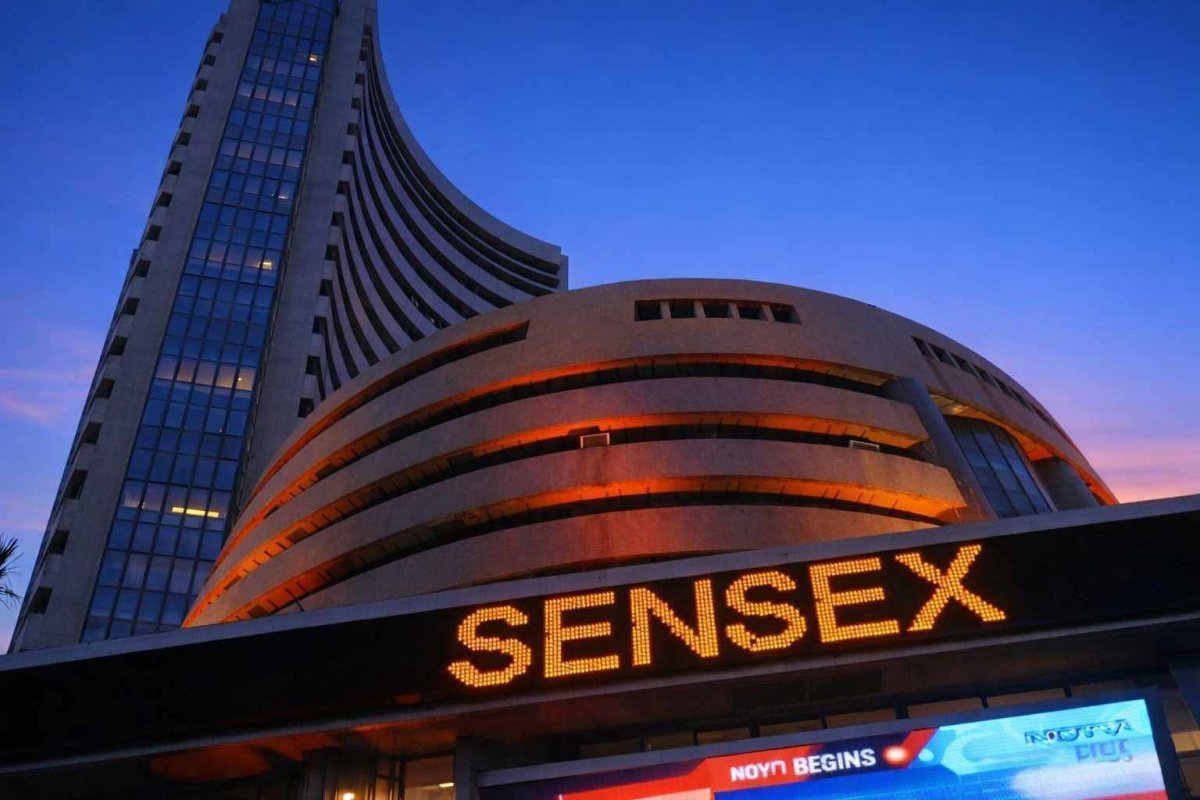
Indian stock benchmarks extended their losses on Thursday, as persistent strength in oil prices above $100 a barrel and a downgrade by HSBC weighed on sentiment. By early afternoon, the Nifty 50 was trading at 24,207.25, while the BSE Sensex stood at 77,799.23, extending the near 1% decline seen on Wednesday.
Brent crude remained above the psychologically important $100 mark, raising concerns about India's import bill and inflation outlook. HSBC downgraded Indian equities to "underweight," warning that rising energy costs could derail the earnings recovery. The rupee fell to a three-week low, breaching the 94 per dollar level, as foreign investors pulled $4.3 billion from Indian equities in April, bringing total outflows for 2026 to $18.5 billion.
Despite a positive domestic macroeconomic reading—the flash composite Purchasing Managers' Index (PMI) rose to 58.3 in April from 57.0 in March, signaling expansion in both manufacturing and services—the broader market remained under pressure. The focus has shifted to global risks, particularly the impact of sustained high oil prices on India's current account deficit and inflation.
VK Vijayakumar, chief investment strategist at Geojit Investments, noted that there is "increasing risk to global growth in general and higher risk to India's macros in particular" after Brent crude rebounded to $103. The energy-importing nation is particularly vulnerable to oil price shocks, which can widen the trade deficit and keep inflation elevated.
Sectoral performance was mixed. Financials and automakers led the declines, with ICICI Bank falling 1.6% and HDFC Bank down 0.8%. The Nifty Auto index dropped 1.3%. In contrast, pharmaceutical stocks climbed 2.3% after Nomura highlighted a 10.1% year-on-year jump in the domestic drug market for March. The pharma sector's defensive nature and strong domestic demand provided a safe haven for investors.
The broader Asian market also experienced a risk-off mood, with the MSCI Asia-Pacific index excluding Japan sliding 0.5%. Japan's Nikkei gave up 0.9%, and Hong Kong's Hang Seng dropped 1.1%. India's decline was part of a regional sell-off rather than a purely domestic downturn.
HSBC's downgrade is particularly significant because it underscores the vulnerability of Indian equities to external shocks. The bank noted that consensus earnings growth forecasts of 16% for 2026 are now under threat. If Brent crude remains at or above $100 for several months, a 20% jump in crude prices could trim 1.5 percentage points off projected 2026 earnings growth. Conversely, if geopolitical tensions in the Gulf ease, attention could shift back to India's robust domestic demand, as reflected in the strong PMI data.
Foreign portfolio investors have been net sellers of Indian equities, pulling out $4.3 billion in April alone. This persistent selling pressure has added to the market's woes, as domestic institutional investors have not been able to fully absorb the selling. The rupee's weakness, now at a three-week low, adds another layer of concern for foreign investors, as currency depreciation erodes returns.
In the near term, the market's direction will likely be determined by oil prices and global risk sentiment. If crude remains elevated, the Indian market could face further headwinds. However, a de-escalation in the Middle East could quickly reverse the negative sentiment and bring focus back to India's strong domestic fundamentals.