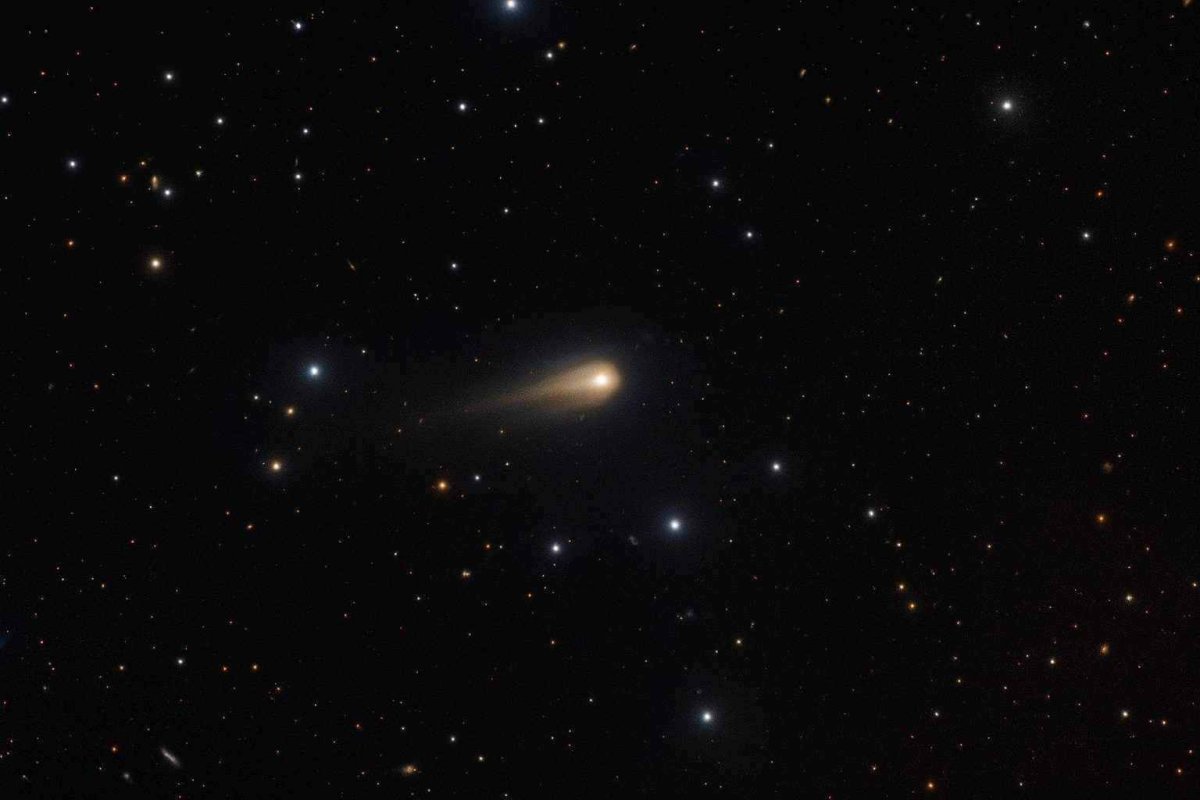
Astronomers have, for the first time, used the Atacama Large Millimeter/submillimeter Array (ALMA) to detect deuterated water—semi-heavy water—in an object from beyond our solar system. The interstellar comet 3I/ATLAS, the third confirmed interstellar visitor, carries a water signature that suggests it formed in a much colder, more sheltered environment than the early solar system.
Record Deuterium Enrichment
A new study published in Nature Astronomy reports that the deuterium-to-hydrogen (D/H) ratio in water from 3I/ATLAS exceeds 6.6 × 10⁻³. That is more than 40 times the D/H ratio of Earth's oceans and at least 30 times higher than typical levels measured in comets originating in our solar system. Deuterium, a heavier isotope of hydrogen, serves as a thermometer of sorts: higher enrichment points to water ice that condensed in extremely cold conditions, below about 30 Kelvin (minus 406 degrees Fahrenheit).
Rare Interstellar Sample
Unlike previous interstellar objects such as 1I/‘Oumuamua and 2I/Borisov, 3I/ATLAS has displayed comet-like activity, shedding gas and dust as it approached the Sun. This allowed astronomers to analyze its chemical composition remotely, without the need for a space probe. The comet was first spotted on July 1, 2025, by the NASA-backed ATLAS survey telescope in Chile. Its hyperbolic trajectory confirmed it as interstellar, and it made its closest approach to Earth at about 270 million kilometers (1.8 astronomical units). ALMA captured its water signature just six days after perihelion, a timing that proved challenging for optical telescopes due to solar glare.
Implications for Planet Formation
Lead author Luis E. Salazar Manzano, a doctoral student at the University of Michigan, described the finding as evidence that the early solar system was not shaped by the same conditions seen elsewhere in the galaxy. “Much different,” he said, referring to the ancient environments that produced 3I/ATLAS. The comet's water contains roughly one semi-heavy water molecule for every 10,000 regular water molecules, a proportion far higher than the typical 1 in 10,000 seen in solar system comets.
The research involved a coordinated effort by more than a dozen NASA missions—including TESS, MAVEN, the James Webb Space Telescope, and SPHEREx—as well as ESA spacecraft such as Mars Express, ExoMars Trace Gas Orbiter, and Juice. Despite the wealth of data, the comet's exact parent star remains unknown. Orbital models have not identified a definitive origin, and uncertainties persist about whether the water signal reflects early disk conditions, a later ejection, or an origin in a carbon-dioxide-rich zone.
Rarity of Interstellar Visitors
Interstellar comets are rare: 1I/‘Oumuamua appeared in 2017, followed by 2I/Borisov in 2019. 3I/ATLAS is only the third confirmed such object. As it now speeds past Jupiter at approximately 137,000 miles per hour, it is fading from view, leaving astronomers with archived images and spectral data to analyze. Teresa Paneque-Carreño, an assistant professor at the University of Michigan and ALMA project lead, noted that solving the remaining “puzzle pieces” could reveal crucial clues about planet formation during the galaxy's cold, ancient past.
Independent experts have called the measurement “very, very difficult” and caution that the result is not yet definitive. Darryl Seligman of Michigan State University suggested the findings present a sharp choice: either our solar system is an exception, or astronomers have more to learn about planet formation around other stars.