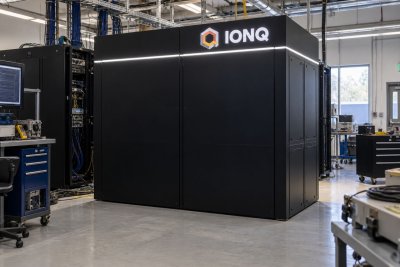
Shares of IonQ (IONQ) declined 1.4% to $67.26 on Thursday, as the market absorbed the public market debut of rival Quantinuum, which opened at $68 per share on the Nasdaq, above its initial public offering price of $60. Quantinuum's listing valued the Honeywell-backed quantum computing company at approximately $17.63 billion, providing investors with a new yardstick for assessing quantum-computing stocks.
Despite the dip, IonQ's market capitalization remains higher at just under $25 billion, reflecting its continued status as one of the most closely watched pure-play names in the quantum sector. The broader market, as measured by the SPDR S&P 500 ETF, was up 0.5% in afternoon trading, highlighting IonQ's relative underperformance on the day.
Quantum Computing Landscape Shifts
Quantinuum's initial public offering marks a significant milestone for the quantum computing industry, which has attracted substantial investment but has yet to demonstrate broad commercial demand. The IPO gives the market a clearer comparative metric for IonQ, which has long been a bellwether for the space. Other quantum-related stocks showed mixed reactions: Rigetti Computing rose 2.0%, and D-Wave Quantum gained 2.7%, suggesting that investors were selectively sorting through the sector rather than selling across the board.
Quantum computing, which leverages quantum bits (qubits) to perform complex calculations faster than classical computers, holds promise for applications in artificial intelligence, communications, cybersecurity, and national security. However, the challenge remains in translating laboratory advancements into consistent revenue streams.
"The investment case is centered on the long-term potential of quantum computing and its potential role in future computing infrastructure," said Kat Liu, an analyst at IPOX Schuster, in comments to Reuters. She noted that government support is "meaningful" as quantum technology is increasingly viewed as strategic, intertwined with security, AI, and advanced computing.
IonQ's Fundamentals and Outlook
IonQ recently reported first-quarter revenue of $64.7 million, a 755% increase year-over-year, and raised its full-year 2026 revenue guidance to a range of $260 million to $270 million. Chief Executive Niccolo de Masi described the quarter as the "biggest quarter" in the company's history, citing strong demand for its quantum computers and platform. As of March 31, IonQ held $3.1 billion in cash, cash equivalents, and investments.
However, the company also reported an adjusted EBITDA loss of $96.8 million for the quarter and reaffirmed its full-year adjusted EBITDA loss forecast of $310 million to $330 million. This combination of rapid top-line growth and significant spending leaves the stock sensitive to evidence that quantum systems are moving beyond pilot programs and research budgets.
A key near-term catalyst is IonQ's pending $1.8 billion acquisition of SkyWater Technology, which would bring chip manufacturing in-house. The deal, expected to close in the second or third quarter of 2026 pending approvals, would see SkyWater shareholders receive $15 in cash and $20 in IonQ stock per share.
Risks and Sector Concentration
Commercial adoption across the quantum computing industry remains limited, and development costs are high. Reuters reported that Japan's RIKEN research institute accounted for roughly 60% of Quantinuum's 2025 revenue, underscoring how concentrated demand can be in the sector. For IonQ, any delays in large customer orders, government contracts, or the SkyWater closing could pressure a stock priced for rapid execution.
Investors will have additional opportunities to assess IonQ's trajectory as management is scheduled to present at the Mizuho 2026 Global Technology Conference on June 9 and the Rosenblatt 2026 Annual Technology Summit on June 10. These events will likely provide further insight into orders, margins, the SkyWater deal, and how the company views Quantinuum's new public-market benchmark.