IREN Ltd. (NASDAQ: IREN) saw its stock climb 1.6% to $61.94 on Thursday, as traders positioned ahead of the company's fiscal third-quarter earnings report due after the U.S. market close. The uptick extends a weekly rally fueled by the bitcoin miner's aggressive push into artificial intelligence cloud infrastructure, following its all-stock acquisition of Mirantis for approximately $625 million and the energizing of its massive Sweetwater 1 data center in Texas.
The earnings report, scheduled for release after the closing bell with a conference call at 5:00 p.m. Eastern, comes at a critical juncture. Investors are not only focused on IREN's bitcoin mining profitability but also on whether its strategy to repurpose grid-linked power for AI computing—including servers and GPUs—is beginning to generate tangible revenue. The quarter under review includes only two days of Mirantis operations and less than a week since the Sweetwater 1 milestone, making this report a key test of management's claims.
Sweetwater 1 and Mirantis: Key Catalysts
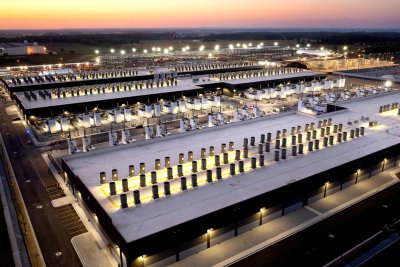
On May 1, IREN announced it had switched on Sweetwater 1, connecting its 1.4-gigawatt Texas data center to the ERCOT grid via a high-voltage substation. Co-founder and co-CEO Daniel Roberts emphasized the project's on-schedule completion, with power delivery expected to scale up as the larger 2-gigawatt Sweetwater campus undergoes phased construction and commissioning. The Mirantis acquisition, meanwhile, adds cloud infrastructure, Kubernetes-based orchestration software, and enterprise support, which IREN plans to operate as a standalone subsidiary. Roberts noted that Mirantis enhances how IREN's compute resources are deployed, managed, and operated for customers.
Mirantis CEO Alex Freedland highlighted that AI clients are seeking platforms that are open, flexible, and built for scale, aligning with IREN's offerings. The deal is designed to address a specific but crucial need in the AI cloud market, positioning IREN to compete more effectively against larger players.
Hardware Ambitions and Microsoft Partnership
IREN's hardware ambitions are substantial. In March, the company announced an agreement for over 50,000 Nvidia B300 GPUs, bringing its total planned GPU count to 150,000. Management stated this fleet could translate into more than $3.7 billion in annualized run-rate revenue from AI cloud by the end of 2026. However, IREN cautioned that this figure is based on pipeline and existing contracts, not all of which are locked in, and actual revenue could differ.
IREN's most significant deal remains its $9.7 billion GPU cloud services agreement with Microsoft (NASDAQ: MSFT), a five-year pact with a 20% prepayment. Additionally, IREN committed to purchasing approximately $5.8 billion worth of GPUs and equipment from Dell Technologies (NYSE: DELL). Microsoft's Jonathan Tinter described IREN as a strategic partner, citing its integrated AI cloud and locked-in power.
Financial Performance and Analysts' Expectations
IREN's fiscal second-quarter results showed revenue of $184.7 million, down from $240.3 million the previous quarter, and a net loss of $155.4 million. Adjusted EBITDA fell to $75.3 million. For the March quarter, analysts surveyed by TipRanks expect revenue of $219.69 million and a loss per share of 22 cents. Zacks cites a consensus revenue estimate of $213 million, representing a 43.8% increase year-over-year.
Cantor Fitzgerald analyst Brett Knoblauch called the Microsoft deal game-changing for IREN, but the company now faces the challenge of proving that AI cloud revenue is ramping up quickly enough to offset expenses and funding requirements. Competitors like CoreWeave have secured fresh AI cloud agreements with Anthropic and Meta, while Reuters Breakingviews notes that CoreWeave and Nebius are part of a neocloud group catering to hyperscalers unable to scale AI infrastructure on their own.
Risks and Investor Focus
IREN acknowledges that its AI and high-performance computing unit is still early-stage, with a thin operating history, heavy reliance on a few customers, and exposure if those clients reduce spending, miss payments, or seek shorter contracts. Missed AI cloud revenue targets, GPU deployment delays, or rising financing costs could shift the narrative from AI backbone to high-beta miner burdened with capital expenditures.
On Thursday, investors are expected to scrutinize revenue breakdowns, contracted AI capacity, cash burn, and financing details, rather than just headline losses. With the stock rally providing a window of opportunity, the company's numbers must now deliver on its bold promises.