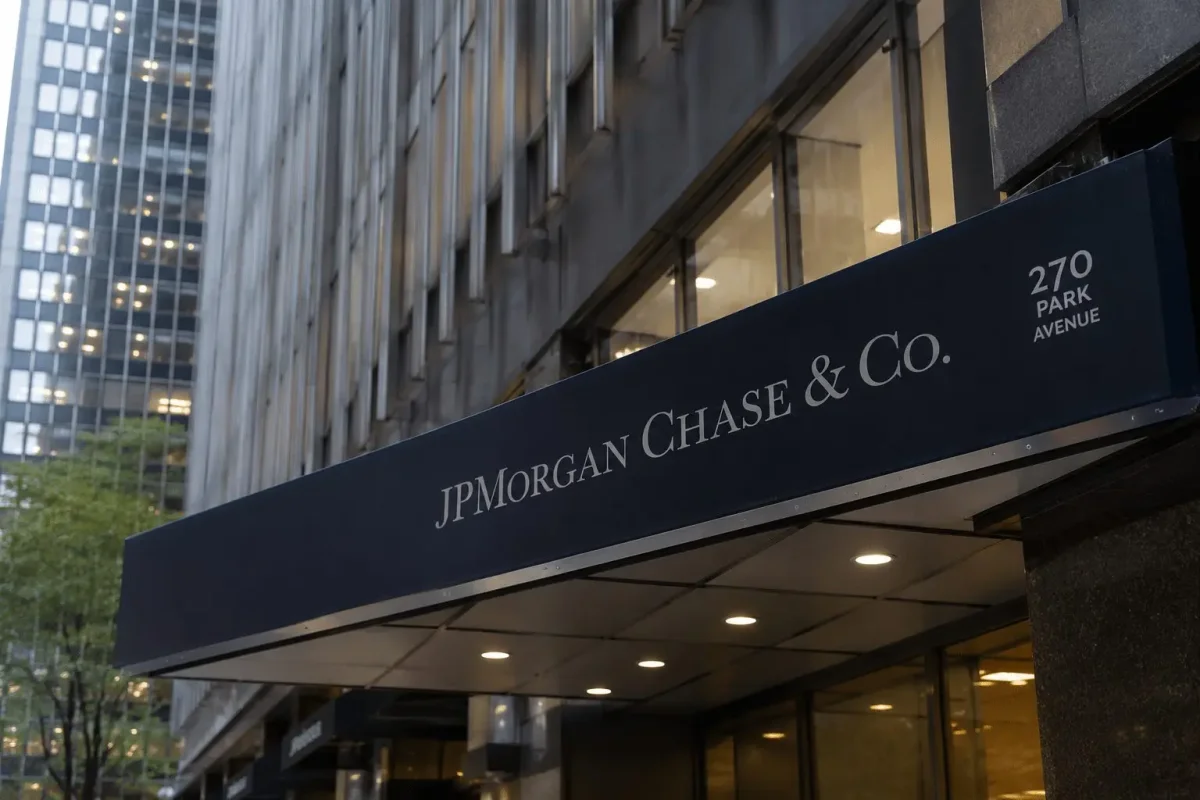
As JPMorgan Chase (NYSE: JPM) prepares to release its second-quarter earnings on Tuesday, options markets are signaling a potential $35 billion shift in the bank's market capitalization. Weekly options data indicates an expected 3.77% move through Friday, translating to roughly $34.9 billion on the bank's $925.1 billion market cap. JPMorgan shares edged down 0.7% to $334.27 on Monday afternoon, reflecting cautious positioning ahead of the report.
The implied move represents about 70% of JPMorgan's recently announced $50 billion share buyback program. While buybacks can boost earnings per share by reducing the share count, their effectiveness is limited if revenue growth remains sluggish. The board has also approved a dividend increase to $1.65 per share from $1.50. CEO Jamie Dimon highlighted the bank's "significant excess capital and robust liquidity" but cautioned about "an increasingly complex set of risks" in the macroeconomic environment.
Market participants are focused on management's commentary regarding trading, dealmaking, and capital requirements, according to Seeking Alpha. Investor's Business Daily had earlier estimated a 4.3% options move for earnings, though the timeframe differs. JPMorgan's results are due around 7 a.m. EDT on Tuesday, followed by a conference call at 8:30 a.m.
According to LSEG consensus from Investing.com, JPMorgan is expected to report Q2 earnings of $5.78 per share on revenue of $50.2 billion. Citigroup (NYSE: C), also reporting Tuesday morning, is forecast to post $2.74 per share on $23.8 billion in revenue. Year-to-date total returns through Friday show Citi at 21.68%, significantly outperforming JPMorgan's 5.82%.
The divergence in capital return strategies is pronounced. JPMorgan repurchased $8.1 billion in stock during the first quarter, representing about 0.9% of its market cap. In contrast, Citi bought back $6.3 billion, or 2.6% of its market cap—a roughly 2.9-to-1 ratio in buyback intensity. This disparity helps explain Citi's stronger stock performance, as each dollar spent on buybacks has a more pronounced effect on its share count.
Banks are benefiting from robust fee income. The top five U.S. investment banks are projected to generate $11.1 billion in second-quarter fees, a 27% year-over-year increase and the highest since 2021, according to the Financial Times. Global investment-banking revenue rose 24% in the first half to $61.4 billion. JPMorgan led total revenue, while Goldman Sachs (NYSE: GS) dominated M&A advisory. "Equities is set to be the primary engine of growth across global markets," said Jamie Vickers of Coalition Greenwich. However, Morningstar's Sean Dunlop cautioned that trading growth could decelerate after a volatile first quarter.
JPMorgan enters earnings on a challenging note. Q1 markets revenue was up 20% at $11.6 billion, while investment-banking fees surged 28%. This raises the stakes for any guidance changes—even routine updates on costs or capital plans could rattle markets. In May, JPMorgan raised its 2026 expense target to around $106 billion. Argus Research's Stephan Biggar noted that "any increase in expenses worried the market." Additionally, oil prices climbed roughly 5% on Monday amid heightened U.S.-Iran tensions, adding inflationary pressure ahead of consumer-price data due Tuesday. Higher rates can boost net interest income but also elevate deposit costs and credit risk.
Board approval of buybacks does not guarantee immediate execution. Investors are keen to hear how quickly JPMorgan plans to repurchase shares near $334, whether deal and trading gains will persist beyond Q2, and if the bank can sustain payouts without costs outpacing revenue growth. A simple earnings beat may not be sufficient to address these concerns.