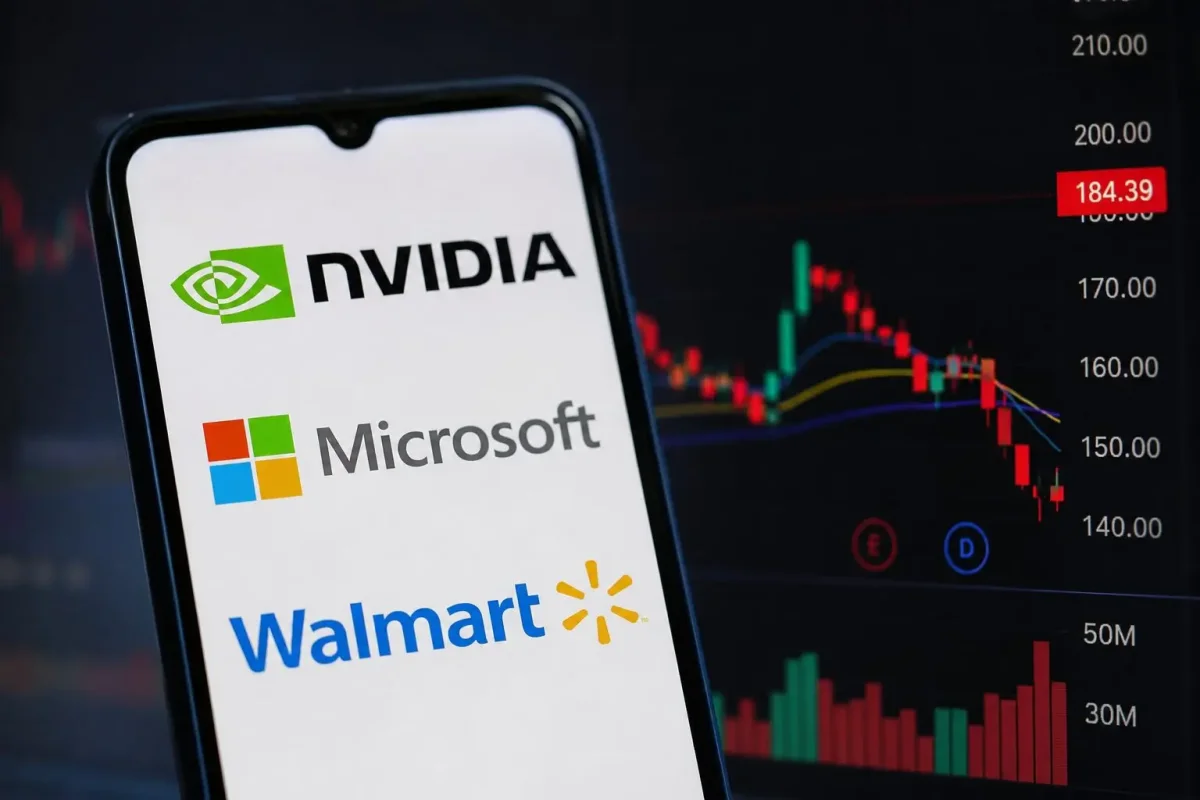
U.S. stock futures edged lower on Monday, with oil prices hovering near $110 a barrel and Treasury yields climbing, setting the stage for a week of critical tests for major stocks including Nvidia, Microsoft, and Walmart. The market's recent rally faces scrutiny as investors weigh the impact of rising energy costs and a key earnings calendar.
Market Overview
S&P 500 and Nasdaq futures dipped in premarket trading, while crude oil remained elevated, adding pressure on consumer spending and corporate margins. The 10-year Treasury yield also moved higher, reflecting concerns over inflation and the Federal Reserve's policy path. Regular trading opened at 9:30 a.m. New York time, with the SPDR S&P 500 ETF (SPY) trading at $739.17, the Invesco QQQ Trust (QQQ) at $708.93, and the Dow-linked DIA fund at $495.37.
Nvidia Earnings in Focus
Nvidia shares fell $10.44 in premarket trading to $225.32, as the chipmaker prepares to report quarterly earnings on Wednesday. Wall Street expects sales near $78.5 billion and adjusted earnings per share of $1.75 to $1.78, according to Reuters. Investors are looking for evidence that Nvidia's AI-driven growth can sustain its premium valuation, especially as competitors like Advanced Micro Devices and Broadcom also slipped in premarket action.
Allen Bond, portfolio manager at Jensen Investment Management, told Reuters that the market wants to see "evidence that justifies the increase in the stock price." Yung-Yu Ma at PNC Financial Services Group added that the key question is whether Nvidia can maintain its lead in AI chips as rivals encroach.
Microsoft Gains on Pershing Square Stake
Microsoft shares rose $12.50 to $421.92 in premarket trading after Bill Ackman's Pershing Square disclosed a new stake, calling the valuation "highly compelling." Matt Britzman, senior equity analyst at Hargreaves Lansdown, noted that the move aligns with his view that Microsoft still has "scope to re-rate." The company's cloud arm Azure and Microsoft 365 suite are seen as critical for corporate AI adoption, making Microsoft a long-term play rather than a fast trade.
Walmart and Consumer Resilience
Walmart traded down $1.02 to $131.45 ahead of its quarterly earnings on Thursday, while Target slipped to $121.54. Retail stocks remain under pressure as gasoline prices above $4.50 a gallon raise concerns about consumer spending. "At some point, these costs are going to catch up with consumers," Ma said to Reuters. The big question for retail earnings is "how resilient is the consumer?" Consumer spending accounts for more than two-thirds of the U.S. economy.
AI Demand and Broader Risks
Despite the headwinds, AI stocks continue to attract buyers. Shawn Tuteja, who runs ETF and custom baskets volatility trading at Goldman Sachs, said investors are returning to hyperscalers and AI, viewing their demand as relatively "inelastic." However, he cautioned that the trade could involve "two-way volatility."
Markets are leaning on a narrow set of buys, but that could expose the broader market to risks. If oil runs higher, inflation could accelerate, and higher Treasury yields might divert capital from stocks. Weak results from Walmart or Target would question whether consumers can still absorb rising prices. George Lagarias, chief economist at Forvis Mazars, said markets were "panicking" about the risk that the Strait of Hormuz could remain closed.
This week, the focus is on which companies can maintain pricing power. Nvidia must justify its AI premium, Microsoft needs to prove its software cash flows are safe, and Walmart must show that U.S. consumers aren't folding under pressure.