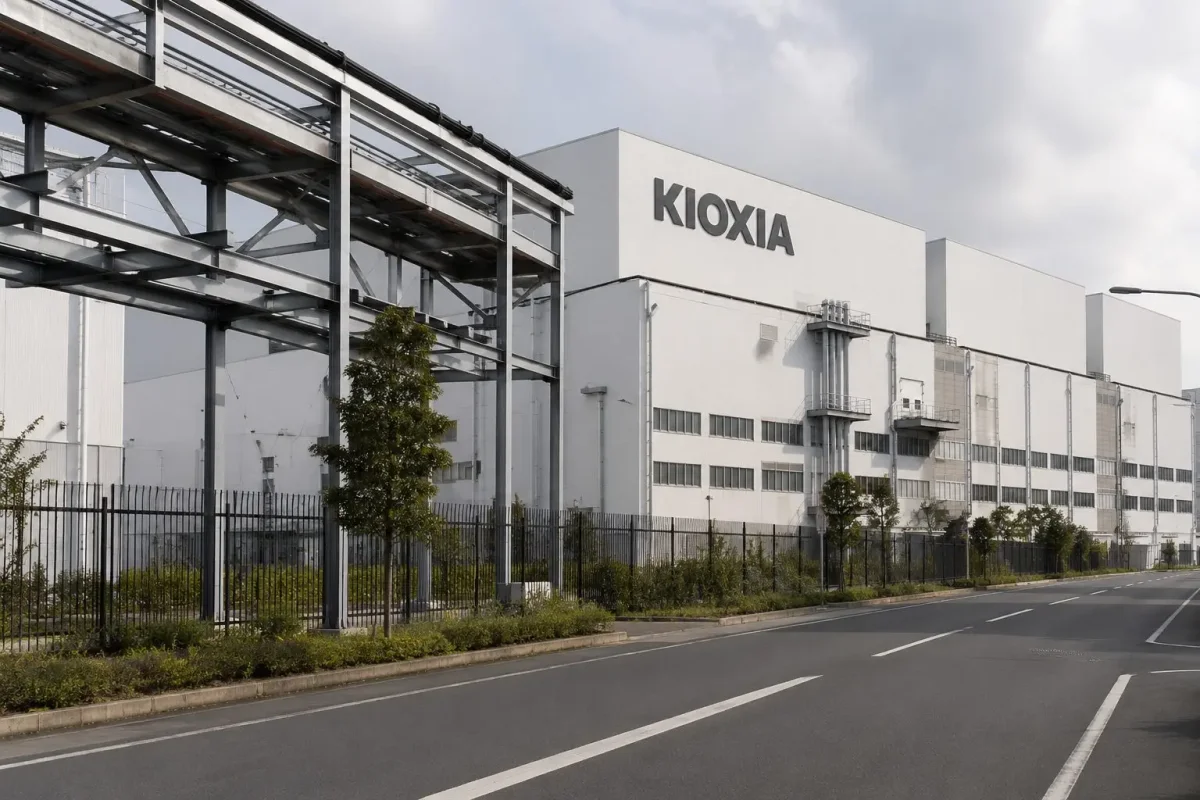
Kioxia Holdings (TYO:285A) unveiled a massive ¥800 billion share repurchase program after the Tokyo market close on Friday, aiming to return capital to shareholders while capitalizing on surging demand for AI-driven NAND flash memory. The announcement accompanied robust first-quarter results that showed a dramatic year-over-year revenue increase of 415.5%, reaching ¥1.77 trillion.
Share Price Reaction and Buyback Details
Kioxia shares closed at ¥46,500 on Friday, up 17.72% on the day, though the stock remains 16.98% lower over the past five sessions. The buyback authorization, which represents approximately 3.1% of outstanding shares at Friday's closing price, is part of a broader capital-return strategy. The company has maintained its interim dividend projection at zero, signaling a preference for buybacks over dividends.
The buyback cap of ¥800 billion is notably higher than the ¥791 billion in cash held at the end of June, and it accounts for 92% of the operating cash flow generated in the first quarter. However, the maximum number of shares that could be repurchased under the program is 30 million, which would require an average price of ¥26,667—42.7% below Friday's close—to fully execute. At the current price, the company could only buy back about 17.2 million shares, or 3.1% of outstanding stock.
Earnings Outlook and Market Consensus
For the July-September quarter, Kioxia projects operating profit of ¥1.89 trillion, a 48.8% increase quarter-over-quarter, but this falls short of the LSEG consensus estimate of ¥1.95 trillion by 3.1%. Revenue is forecast to rise 35.2% to ¥2.39 trillion. The company expects an operating margin of approximately 79.1%, up from 71.9% in the April-June period.
The strong performance is driven by increased average selling prices (ASPs) for NAND flash, fueled by data center demand for generative AI applications. The SSD and Storage segment saw revenue nearly double sequentially, accounting for two-thirds of total sales in the June quarter. Smart Devices also grew, though at a slower pace.
Balance Sheet Strengthens
Kioxia's balance sheet has improved rapidly. The equity ratio climbed to 50.8% from 37.9% at the end of March, with total equity growing by roughly ¥1 trillion during the quarter. The company also repaid ¥433.2 billion in long-term loans, reducing total bonds and borrowings by ¥413 billion, giving management additional financial flexibility.
However, the buyback authorization is substantial relative to planned capital expenditures. The ¥800 billion cap is 170% of the company's projected annual capital spending of ¥470 billion, and it also exceeds the combined annual capex and R&D budget of ¥700 billion. The filing notes that some or all of the shares may not be repurchased, depending on market conditions.
Management Commentary and Industry Competition
Chief Executive Hiroo Ota stated that Kioxia will "fully meet growing market demand" through the expansion of its Fab2 facility. Kazuyoshi Saito, an analyst at IwaiCosmo Securities, highlighted that Kioxia's NAND technology is "two to four years ahead of rivals."
Competition is intensifying, however. SK Hynix (KRX:000660) plans to invest 80 trillion won in a new NAND facility, which could ease current supply constraints over time. Kioxia also announced a three-for-one stock split effective October 1, with a record date of September 30, aimed at reducing the minimum investment and broadening its investor base.
Risks and Outlook
Key risks include NAND pricing cyclicality, potential capacity increases, a slowdown in AI investment, currency fluctuations, and the possibility that the buyback may not be fully executed. The buyback period begins Monday, August 3, and continues until October 2, 2026.