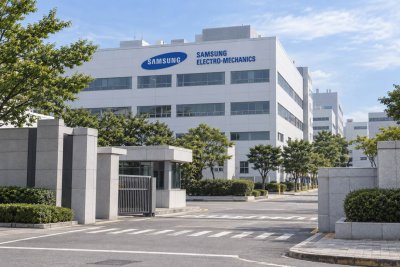
Samsung Electronics (KRX:005930) and SK Hynix (KRX:000660) have unveiled plans to invest 800 trillion won, approximately $518 billion, in new semiconductor fabrication facilities in the southwestern region of South Korea. This initiative is part of a broader national chip push that now exceeds $576 billion, underscoring the country's aggressive strategy to dominate the global memory market.
Tool Makers Lead Market Reaction
The announcement sent shockwaves through the stock market, with equipment makers emerging as the primary beneficiaries. ASML Holding (AMS:ASML), the Dutch lithography giant, saw its shares surge 6.79% in Amsterdam on June 30, reaching €1,721.40. This single-day gain added roughly €43 billion to ASML's market capitalization, which now stands at €675.86 billion, according to Google Finance data.
The rally reflects investor expectations of robust order flows for chip-making tools. SK Hynix's March order of 11.95 trillion won ($7.97 billion) for ASML's EUV lithography systems—the largest single order ASML has reported from a customer—provided an early gauge of demand. While the new fab plan is about 65 times larger than that tool order, not all spending is for lithography, but the momentum is clear.
Market Movers: Tool Makers vs. Memory Makers
Other tool makers also benefited. ASM International (AMS:ASM) rose 2.95%, BE Semiconductor Industries (AMS:BESI) gained 2.94%, and Tokyo Electron (TYO:8035) climbed 3.28%. In contrast, memory makers saw more modest gains. Samsung Electronics rose 3.41% to 334,000 won, while SK Hynix advanced just 0.84% to 2,650,000 won.
The divergence highlights a key investor concern: tool makers have clearer order books, while memory makers face pricing volatility and oversupply risks. As Morningstar analyst Jing Jie Yu noted, "Memory pricing is still tied to supply and demand, and if capex speeds up over the next decade, the risk of long-term oversupply grows."
Investment Details and Execution Risks
The plan involves building two new factories each for Samsung and SK Hynix in the southwest, though no timeline has been provided. The companies account for roughly two-thirds of global memory chip output, according to AP reports. The broader commitment includes a total pledged spend of 3,200 trillion won ($2.07 trillion), with the southwest hub representing a quarter of that. Additionally, a Chungcheong chip packaging cluster worth 81 trillion won is part of the AI supply chain strategy.
Execution risks remain significant. SK Hynix Chairman Chey Tae-won emphasized the need for "vast sites, along with sufficient power, water and skilled workers," noting that the company's Gyeonggi Province cluster took nine years to complete. Nomura's CW Chung suggested that investing in other regions could hedge uncertainty tied to the Yongin cluster.
Long-Term Demand and AI Adoption
South Korean officials project demand will climb as AI adoption expands into industrial robots and autonomous vehicles. The policy has been described as a $1 trillion effort spanning memory chips and humanoid robots. However, Lee Jong-ho, a professor at Seoul National University, cautioned that while demand is solid now, the outlook over three years is uncertain.
CLSA's Sanjeev Rana flagged the risk of a memory market downturn but noted that producers could scale back spending if capacity becomes excessive. The gap between ASML's 6.79% rise and SK Hynix's 0.84% move encapsulates the market's focus: tool makers are being rewarded for expected orders, while memory makers are pricing in a supply crunch that must hold for new fabs to pay off.