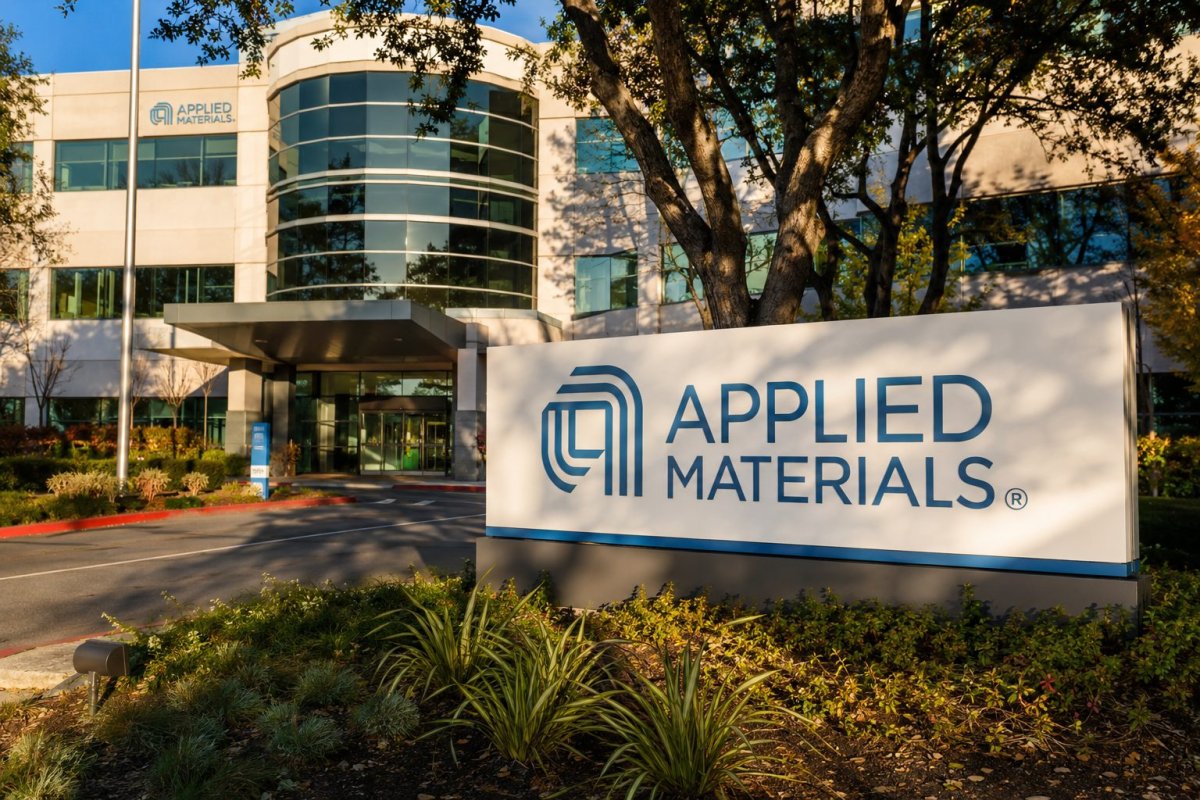
Applied Materials (NASDAQ:AMAT) experienced a notable sell-off on Friday, with shares declining 5.2% to close at $506.85. The drop came despite the company reporting record quarterly earnings and issuing fourth-quarter revenue guidance that exceeded Wall Street expectations. The market's reaction underscores growing investor scrutiny over the company's valuation, particularly in the context of its flat gross margin outlook.
The semiconductor equipment maker's market capitalization now stands at approximately $405 billion, placing it among the weakest performers in the large-cap technology sector for the day. The stock's weekly decline reached 6.0%, with the shares closing 7.5% below their highest close of the week, which occurred on Wednesday at $548.15.
Strong Guidance, But Margin Concerns Persist
Applied Materials forecast fourth-quarter revenue of $10.25 billion, a 7.4% premium over the consensus estimate of $9.54 billion. However, the company's non-GAAP gross margin guidance remained unchanged at 50.4%, a figure that investors weighed more heavily than the revenue beat. This stagnant margin, despite an anticipated 12.5% sequential revenue increase, suggests limited incremental profit conversion at the current stage, placing greater pressure on operating leverage to drive earnings growth.
Impressive Fiscal Q3 Results
The company's fiscal third-quarter performance was robust. Revenue climbed 25% year-over-year to $9.115 billion, while non-GAAP diluted earnings per share rose 41% to $3.50, both surpassing analyst forecasts of approximately $9.00 billion and $3.40, respectively. GAAP gross margin expanded by 1.5 percentage points to 50.3%, and operating margin improved to 33.7%. GAAP diluted EPS increased 43% to $3.17.
Chief Executive Gary Dickerson highlighted "increased demand visibility" and expressed confidence in robust growth continuing into 2027. The company raised its 2026 Semiconductor Systems forecast, citing strength in DRAM, advanced foundry-logic, and advanced packaging as key growth areas.
Cash Flow and Shareholder Returns
Cash generation saw a significant uptick, with operating cash flow reaching $3.04 billion and free cash flow totaling $2.33 billion. Applied returned $860 million to shareholders through buybacks and dividends, maintaining $12.8 billion in authorized share repurchases. The company will trade ex-dividend on August 20 for its quarterly dividend of $0.53 per share, payable on September 10, representing an annualized yield of approximately 0.4%.
Valuation Comparisons and Analyst Sentiment
Despite the recent decline, Applied Materials trades at a forward price-to-earnings multiple of 32.1 times, which is lower than its key peers. Lam Research (NASDAQ:LRCX) trades at 34.6 times, KLA (NASDAQ:KLAC) at 36.9 times, and ASML (NASDAQ:ASML) at 33.4 times. However, as Summit Insights noted, Applied's revenue growth has trailed these rivals, contributing to the valuation discount.
Morgan Stanley described the quarter as "good, but not great," reflecting the market's mixed reaction. Nevertheless, sell-side analysts remain largely positive. JPMorgan raised its price target to $660 with an Overweight rating, UBS maintained Buy with a $675 target, Needham reiterated Buy at $740, and Jefferies held its target at $770. The average analyst target stands at $624.35, implying a 23.2% upside from Friday's close.
Market Context and Risks
The broader market provided little support, with the S&P 500 slipping 0.2% on Friday after reaching an all-time closing high the previous day. Investors weighed disappointing retail sales data against rising oil prices. Applied's decline was largely company-specific, though the weaker market environment exacerbated the move.
Looking ahead, risks include a potential slowdown in AI infrastructure spending, customer delays in fab projects, and export restrictions limiting sales to China. Conversely, stronger-than-expected demand for DRAM and advanced packaging could prove the current flat margin outlook too conservative. With no earnings reports scheduled for the upcoming week, investor attention will likely focus on broader market trends and the company's ex-dividend date.