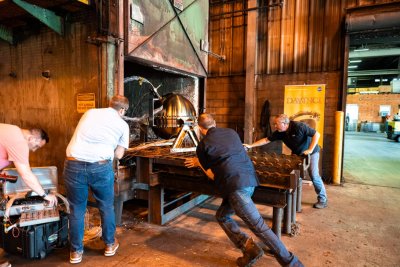
Lockheed Martin (NYSE: LMT) has officially broken ground on a new 87,000-square-foot production facility in Troy, Alabama, marking a significant expansion of its missile defense manufacturing capabilities. The facility, designated Building 47, will focus primarily on producing interceptors for the Terminal High Altitude Area Defense (THAAD) system, with plans to also support future work on the Next Generation Interceptor (NGI) program.
The move comes as the Pentagon's demand for missile defense systems has climbed sharply following the conflict in Ukraine and heightened tensions with Iran. According to a report by The Washington Post, U.S. forces deployed more than 200 THAAD interceptors to protect Israel earlier this year, depleting roughly half of the Pentagon's available stockpile. This has underscored the urgent need to replenish inventories and expand production capacity.
Lockheed's expansion in Alabama is part of a broader framework agreement signed in January, which outlines a long-term plan to dramatically increase THAAD interceptor production. Under this agreement, the company aims to raise annual output from the current 96 units to as many as 400 units over the next seven years. However, the plan remains contingent on congressional authorization and funding, as well as final supplier contracts.
The company is also working on parallel efforts to boost production of other key munitions, including Patriot PAC-3 interceptors and Precision Strike Missiles (PrSM). Lockheed CEO Jim Taiclet stated that the firm is "ready now" to ramp up, citing more than $1 billion in investments already committed. The company plans to spend between $8 billion and $9 billion on munitions production facilities through 2030, with $900 million to $1.1 billion targeted specifically for the Troy site. Additionally, Lockheed expects to add approximately 4,500 jobs nationwide as part of this production surge.
The THAAD system is designed to intercept and destroy incoming ballistic missiles during their terminal phase, whether inside or outside the atmosphere. It uses "hit-to-kill" technology, which relies on direct collision rather than an explosive warhead to neutralize targets, according to the Congressional Research Service.
Supply chain effects are already rippling through the defense industry. In March, the Pentagon announced a deal with both BAE Systems and Lockheed Martin to quadruple production of seekers used in THAAD interceptors. Competitors are also responding: Raytheon, a division of RTX (NYSE: RTX), has its own Pentagon agreements to expand production lines for Tomahawk cruise missiles, AMRAAM air-to-air missiles, and Standard Missile variants.
Despite the ambitious plans, some analysts caution that the new facility represents planned capacity rather than immediate stockpile relief. Kelly Grieco, a senior fellow at the Stimson Center, described the current interceptor numbers as "striking" and noted that the U.S. now has a thin THAAD magazine, with production unable to keep pace with demand. This shortage is particularly concerning for U.S. allies in Asia, such as Japan and South Korea, which rely on American missile-defense guarantees.
The Troy facility will also support Lockheed's Next Generation Interceptor (NGI) program, a key U.S. effort to defend against long-range ballistic missile threats. The company has indicated that further expansions in Alabama are planned for NGI, the AGM-158 cruise missile, and the Air-Launched Rapid Response Weapon (ARRW) programs.
Lockheed Martin shares closed at $533.24 on Friday. U.S. markets were closed Monday for Memorial Day, with the NYSE and Nasdaq scheduled to reopen on Tuesday. The new plant, while not yet a celebration, clearly marks a transformative moment for the missile defense sector, where demand is clear but the challenge of scaling production quickly remains a significant hurdle.