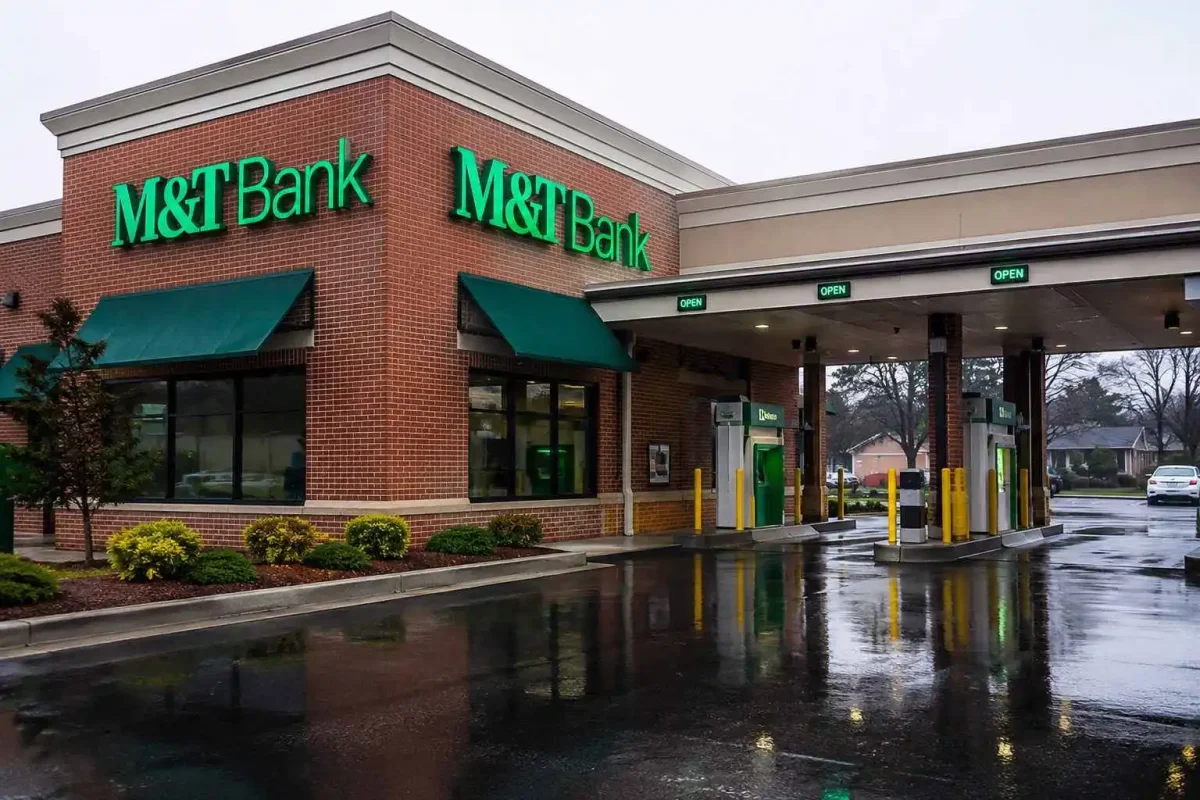
M&T Bank (NYSE:MTB) reported its highest-ever quarterly earnings, yet the regional lender increasingly relied on borrowed funds to keep pace with rising loan demand. The shift in funding strategy comes as deposits declined, highlighting a key balance-sheet challenge.
Shares of M&T Bank were trading around $245 on Thursday afternoon, down 2.2% from the prior close. The stock has faced pressure amid broader market uncertainty and concerns about the sustainability of its funding model.
Average loans grew by $3.0 billion quarter over quarter to $141.4 billion, while average deposits fell by $652 million to $163.5 billion. To bridge the gap, average borrowings surged by $4.0 billion to $20.8 billion. As a result, the loan-to-deposit ratio climbed to 86.5% from 84.3% in the first quarter, while borrowings as a percentage of deposits rose to 12.7% from 10.2%.
The increased borrowing was driven by greater use of Federal Home Loan Bank advances, senior notes, and securitizations. Despite the shift, deposit costs edged down by two basis points to 1.95%, but the overall cost of interest-bearing funding increased four basis points to 2.36%. The net interest margin held steady at 3.70%.
M&T's earnings performance remained robust. Non-GAAP net operating earnings per share came in at $5.35, beating the MarketBeat consensus estimate of $4.66. Revenue reached $2.53 billion, ahead of the expected $2.46 billion. The efficiency ratio improved to 52.8% from 58.3% a year earlier.
Chief Financial Officer Daryl Bible noted that the company generated record earnings per share in the second quarter. Credit quality also improved, with net charge-offs falling to 0.23% of average loans and nonaccrual loans declining to 0.84% of total loans.
Looking ahead, M&T expects its full-year net interest margin to be in the upper 3.60% area, with net interest income likely at the lower end of its $7.2 billion to $7.35 billion guidance. The company bought back $465 million in shares during the quarter, though its CET1 capital ratio slipped 14 basis points to 10.19%, near the lower boundary of its 10%–10.5% target range.
Analyst sentiment remains mixed. According to MarketBeat, the stock has 14 Hold ratings, seven Buys, and one Sell, with a consensus price target of $251.43—implying a potential upside of about 2.5%. Truist Securities analyst Brian Foran reiterated a Hold rating but raised his price target to $268 from $230.
Risks persist, including the potential for accelerated deposit outflows that could push funding costs higher. Deteriorating credit quality would also increase provisions and reduce capital flexibility. Executives anticipate higher deposit levels in the second half of the year, which could ease some pressure on margins and support continued loan expansion.