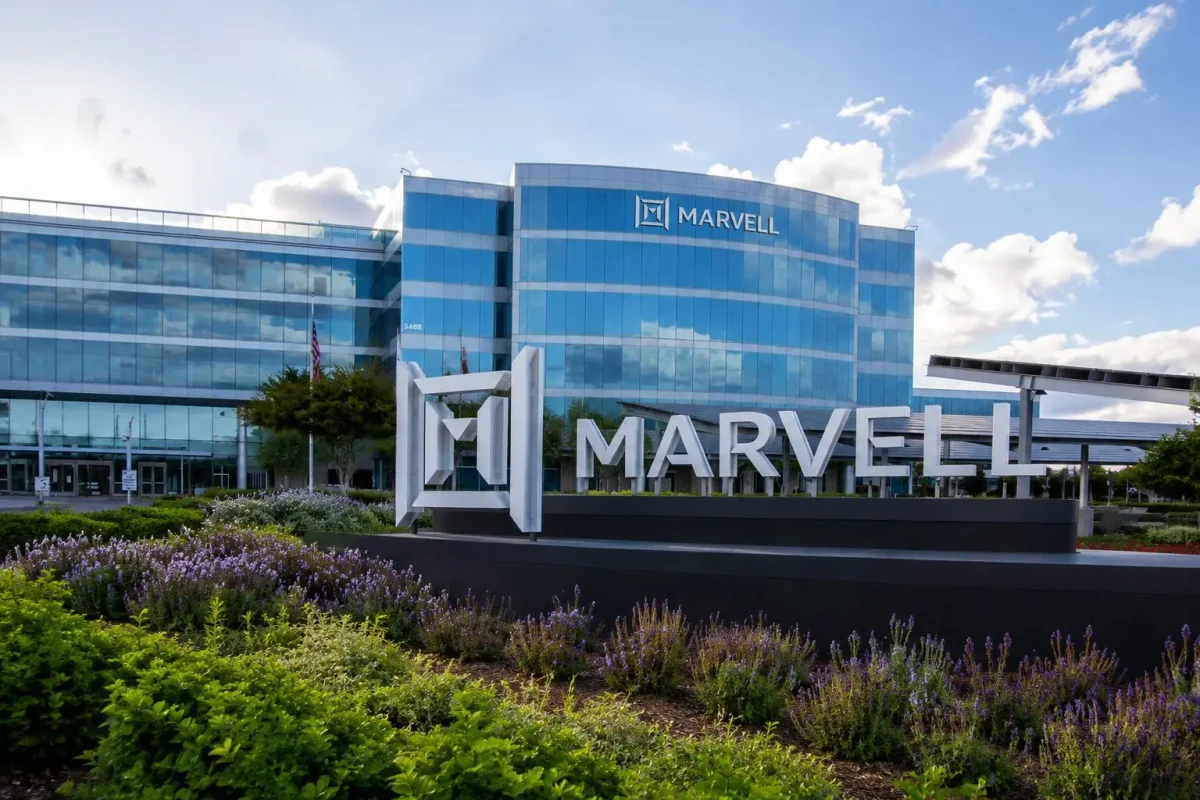
Marvell Technology (MRVL) shares climbed sharply in pre-market trading on Tuesday, extending gains after S&P Dow Jones Indices announced the addition of the AI-focused chipmaker to the S&P 500 index. The stock was trading at $288.85, up approximately 9.6% from Friday's close, pushing the company's market capitalization to nearly $258 billion.
The index inclusion triggers a mechanical buying wave from passive funds that track the S&P 500, as fund managers must adjust their portfolios to include Marvell before its official entry on June 22. Marvell will replace Pool Corp. in the benchmark, while Flex Ltd. also joins, taking the spot of The Campbell's Company.
Marvell's recent momentum extends well beyond this index reshuffling. Shares have rallied roughly 59% since May 27, when the company reported record first-quarter fiscal 2027 revenue of $2.418 billion. Management guided second-quarter revenue to $2.7 billion, with CEO Matt Murphy citing "exceptional AI-related bookings" and projecting accelerating growth through fiscal 2027. Net income on a GAAP basis reached $34.5 million for the quarter.
The AI chip sector has been a major driver of Marvell's ascent. The company designs custom chips—known as XPUs—for cloud data center clients seeking alternatives to Nvidia's expensive and often supply-constrained processors. This positions Marvell alongside Broadcom in a market that is increasingly diversifying away from Nvidia's dominance.
Nvidia itself has placed a significant bet on Marvell. In March, the two companies announced a $2 billion investment by Nvidia in Marvell, along with plans to collaborate on Nvidia's AI infrastructure, including custom XPUs and networking solutions. Nvidia founder and CEO Jensen Huang further fueled enthusiasm last week at Computex in Taipei, calling Marvell the next "trillion-dollar company," a remark that sent Marvell shares to a new high.
Marvell also showcased its technological ambitions on June 1, unveiling the Teralynx T100 switch silicon, a 102.4-terabit-per-second chip designed specifically for AI clusters. "Hyperscalers require networks that optimize latency, power and scalability simultaneously," said Rishi Chugh, vice president and general manager of Marvell's data-center switch unit.
However, the trade is not without risks. The chip sector experienced a sharp selloff on Friday, erasing about $1.3 trillion in market capitalization from U.S.-listed chipmakers, with Marvell sliding 17%. Wells Fargo chief equity strategist Ohsung Kwon described the sector as "way overbought." Marvell's latest regulatory filing also highlights reliance on a small group of large customers, exposure to data-center sales, potential export control impacts, and the risk that AI capital expenditure may not sustain current growth rates.
Looking ahead, June 22 remains a key catalyst as index demand meets the AI trade. The central question for investors remains: how much of Marvell's future growth is already priced into the stock at current levels?