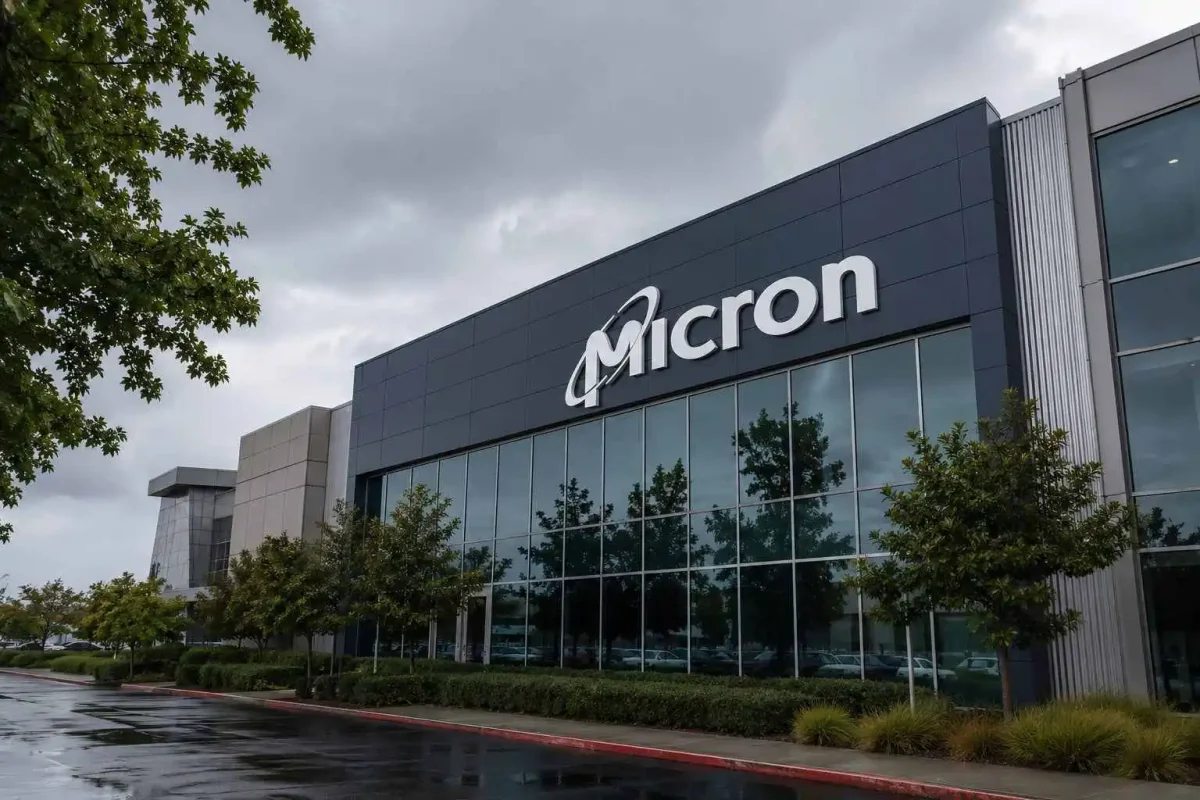
Micron Technology, Inc. (NASDAQ:MU) experienced a sharp decline in late-morning trading on Tuesday, July 7, 2026, with shares falling approximately 7.9% to $906.65. The sell-off erased roughly $89.4 billion in equity value, a figure that nearly matches the $100 billion in minimum revenue that Micron has secured from 14 of its 16 Strategic Customer Agreements (SCAs). The session low of $892.50 represented a 9.4% drop from Monday's close, wiping out about $105.6 billion in market capitalization.
Market Context and Sector Impact
The decline in Micron's stock was part of a broader downturn in the semiconductor sector. The iShares Semiconductor ETF (NASDAQ:SOXX) slid 7.3% to $539.01, while the VanEck Semiconductor ETF (NASDAQ:SMH) fell 5.7% to $569.77. The Philadelphia Semiconductor Index dropped to a four-week low, off 5.5% in early trading. Intel Corp (NASDAQ:INTC) also fell sharply, losing 8.2%.
Asian markets experienced similar pressure. Samsung Electronics Co Ltd reported a 19-fold jump in Q2 operating profit but still saw its stock slide 6.9%. SK Hynix Inc dropped 6%, and South Korea's KOSPI index fell 4.9%. Analysts noted that Samsung's results were largely "priced in" and warned of a "risk of slower AI infrastructure spending," according to Albert Yong at Petra Capital Management. Morningstar's Jing Jie Yu observed that DRAM price gains were "more moderate," while Raisah Rasid at JPMorgan Asset Management anticipated profit "moderation" ahead.
Ford Agreement and Contract Floors
On Monday, Ford Motor Co (NYSE:F) announced a long-term Strategic Customer Agreement with Micron to secure memory and storage for its next-generation vehicles. The deal is underpinned by new DRAM capacity at Micron's Manassas, Virginia site. Ford CEO Jim Farley emphasized that future large-scale U.S. vehicle production will require a "resilient supply chain," while Micron CEO Sanjay Mehrotra called the agreement a step toward "reliable, long-term supply."
Despite the positive news, investors remain skeptical about the durability of Micron's contract floors. The company has stated that 14 of its 16 completed SCAs guarantee roughly $100 billion in total revenue at minimum prices, with an additional $22 billion in anticipated cash deposits and financial commitments. These contracts cover about 20% of DRAM production and one-third of NAND, with approximately 40% of revenue expected to be under fixed or capped prices once all SCAs are active. However, Tuesday's trading suggests that market participants are not convinced these price floors will hold if AI demand cools.
Auto Industry Memory Demand
The automotive sector is increasingly competing with data centers for memory chips. DRAM prices have risen roughly 70% since December, according to S&P Global Mobility, driven by AI-related demand from data centers. Memory content in vehicles is also growing, with new driver-assistance features and infotainment systems requiring more components. This trend is expected to support pricing, but the market remains wary of potential oversupply.
Financial Performance and Outlook
Micron's most recent quarterly results provided strong momentum. Revenue surged to $41.46 billion from $23.86 billion in the prior quarter, while non-GAAP earnings per share came in at $25.11. The company guided for Q4 revenue of $50.0 billion, plus or minus $1.0 billion, and non-GAAP EPS of $31.00, plus or minus $1.00. Based on Tuesday's share price, that EPS guidance implies a simple annualized run-rate multiple of about 7.3x—not a forward-looking valuation.
CEO Sanjay Mehrotra has expressed confidence that "tight conditions" in the memory market will "persist beyond calendar 2027." Daniel Newman, CEO of Futurum Group, echoed this sentiment, stating that "memory will continue to command premium pricing" as supply remains constrained. However, Jake Behan at Direxion highlighted the bear case, noting that "pricing power is the first thing at risk" if supply loosens.
Technical and Trading Details
Micron's stock opened at $920.32 on Tuesday and fell to a low of $892.50 before recovering slightly. The day's drop reduced the company's market capitalization to approximately $1.038 trillion, based on a share count of roughly 1.145 billion. The stock remains below its opening price, reflecting persistent selling pressure.