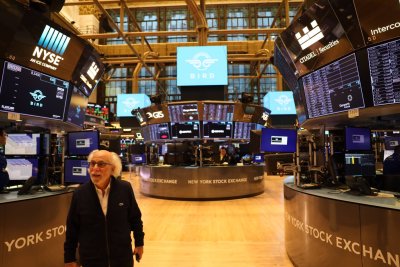
U.S. equity markets closed with a mixed tone on Tuesday, as a broad selloff in semiconductor shares weighed heavily on the Nasdaq Composite, while the Dow Jones Industrial Average managed to hold near its recent record high. The divergence underscored a market increasingly driven by a narrow set of high-conviction themes, with artificial intelligence and chip exposure taking center stage.
The Nasdaq Composite shed 361.25 points, or 1.38%, to settle at 25,759.91, according to MarketWatch data. The S&P 500 declined 0.56%, closing at 7,495.34, while the Dow eked out a modest 0.10% decline to finish at 53,002.58. Declining stocks outnumbered advancers by a ratio of approximately 4,139 to 2,908 on U.S. exchanges.
The weakness was most pronounced in the technology sector, with the Invesco QQQ Trust (NASDAQ:QQQ), which tracks the Nasdaq-100, sliding 2.29% to $706.30. That drop was roughly nine times the decline in the SPDR Dow Jones Industrial Average ETF Trust (NYSEARCA:DIA) and more than three times the loss in the SPDR S&P 500 ETF Trust (NYSEARCA:SPY). The iShares Russell 2000 ETF (NYSEARCA:IWM) also fell 0.88%.
Chip Stocks Take the Brunt
The Philadelphia Semiconductor Index tumbled 5.5% to a four-week low, as a wave of selling hit major chipmakers. The catalyst appeared to be a combination of profit-taking after a strong run and company-specific news. Samsung Electronics (KRX:005930) reported a better-than-expected second-quarter operating profit of 89.4 trillion won, with revenue surging 129%. Despite the strong numbers, Samsung shares closed down 6.9% in Seoul, as analysts suggested the results had been largely "priced in." Albert Yong of Petra Capital Management noted that the market had already anticipated the strong figures, while Raisah Rasid of JPMorgan Asset Management cautioned that returns may "moderate" going forward.
In the U.S., Intel Corporation (NASDAQ:INTC) fell as much as 8.2% before closing down 10.85% at $108.94. Micron Technology (NASDAQ:MU) slid 8.23% to $903.71, making it one of the biggest percentage losers in the S&P 500. Broadcom Inc. (NASDAQ:AVGO) gave up early gains and closed 2.93% lower at $362.94, reversing a 3.7% jump from Monday that was tied to an extended chip-supply deal with Apple Inc. (NASDAQ:AAPL) through 2031. Jake Dollarhide of Longbow Asset Management described the move as "very tenuous," while Thomas Hayes of Great Hill Capital pointed to ongoing uncertainty around the return on Microsoft Corp.'s (NASDAQ:MSFT) spending.
DeepSeek and Nvidia
Adding to the pressure on chip stocks was a report from Reuters that Chinese AI startup DeepSeek is developing its own inference chip, potentially reducing its reliance on Nvidia Corp. (NASDAQ:NVDA) and Huawei. Nvidia shares fell 1.89% to $191.85, wiping approximately $89 billion off its market capitalization given its $4.68 trillion valuation. Analyst Richard Windsor of Radio Free Mobile noted that Nvidia already has "zero in China" and argued the DeepSeek news does not fundamentally alter Nvidia's competitive position. Nonetheless, the report added to a broader derating of AI-related chip names.
Other Movers
Outside the semiconductor space, several stocks moved on company-specific news. Rivian Automotive (NASDAQ:RIVN) plunged 12.98% to $17.525 after announcing a 75 million-share offering, even though the electric-vehicle maker forecast second-quarter revenue above analyst estimates. Fiserv Inc. (NASDAQ:FISV) rose 3.88% to $53.79 following a Reuters report that it is in talks to sell its debit-card transaction network to JPMorgan Chase (NYSE:JPM) and Bank of America (NYSE:BAC).
Commodities saw a notable move, with front-month West Texas Intermediate crude oil rising 2.48% to $70.25 per barrel.
Looking Ahead
Investors are now turning their attention to the release of the Federal Reserve's meeting minutes on Wednesday, which will be the first set under Chair Kevin Warsh. Additionally, SK Hynix (KRX:000660) is scheduled for its U.S. trading debut on Friday, while earnings reports from Delta Air Lines (NYSE:DAL) and PepsiCo Inc. (NASDAQ:PEP) are expected later in the week.
The day's trading highlighted a market where concentration risk in a handful of mega-cap tech names can amplify volatility. As the Associated Press noted, Nvidia's size means its price swings now have an outsized impact on the S&P 500, a dynamic that is likely to persist as earnings season unfolds.