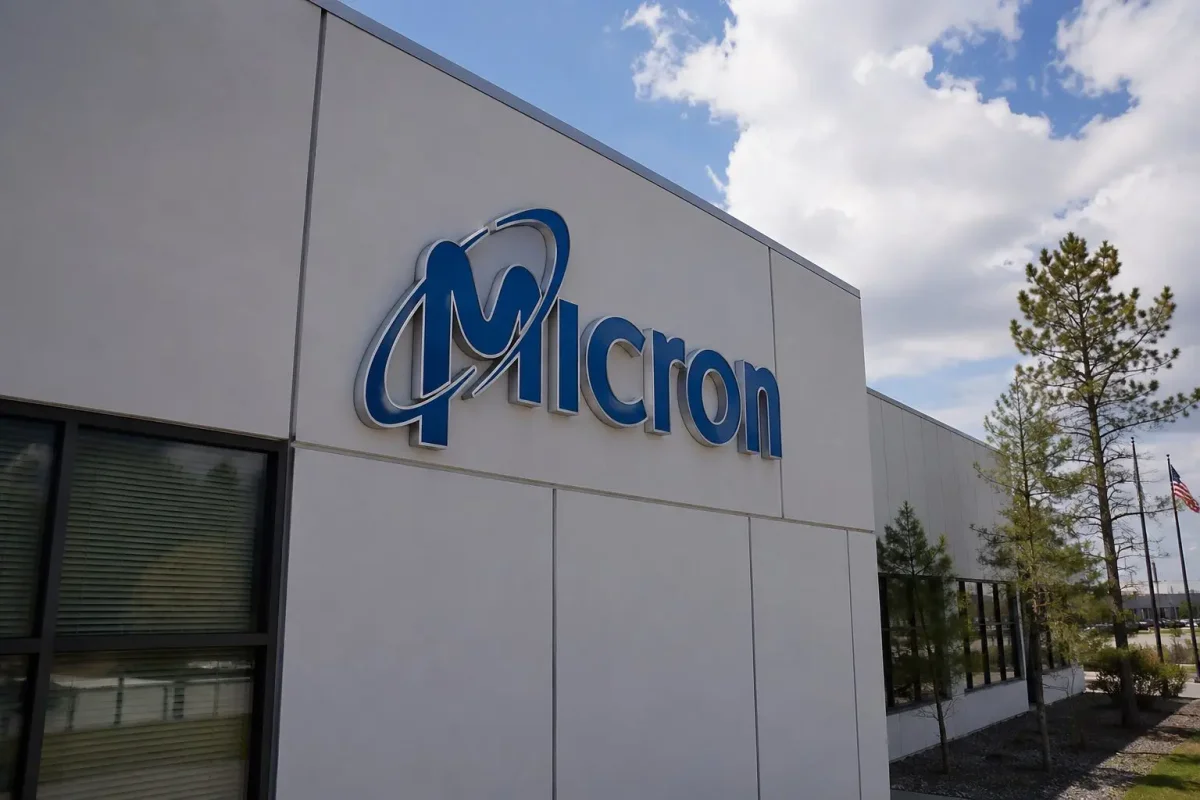
Micron Technology (MU) suffered a sharp decline on Thursday, with shares falling 7.7% and wiping out approximately $94.24 billion in market capitalization. The selloff, which continued into Friday's premarket trading, was triggered by Broadcom's weaker-than-expected revenue and a flat AI revenue forecast, casting a shadow over the semiconductor sector. The stock last traded around $996, down roughly $81 from the previous close.
The broader market saw mixed results on Thursday. While the S&P 500 and Dow Jones Industrial Average managed to close higher, with the Dow hitting another record high, the Nasdaq Composite ended the session nearly flat, down 0.09%. Other chipmakers, including Advanced Micro Devices (AMD) and Qualcomm (QCOM), also suffered losses ranging from 2.6% to 7.7%.
Broadcom's disappointing quarterly results were the primary catalyst for the selloff. The company's revenue missed analyst expectations, and it maintained its 2027 AI revenue forecast without raising it, despite ongoing optimism about long-term demand. According to Matt Britzman, an analyst at Hargreaves Lansdown, the market had built up "very high expectations" and was looking for flawless numbers. Stacy Rasgon of Bernstein Research suggested that Broadcom's stock could "take a pause" for the next few quarters.
For Micron, the selloff raises critical questions about whether the AI-driven demand for memory chips can justify the company's trillion-dollar valuation. Micron reached a $1 trillion market capitalization on May 26, driven by a roughly tenfold surge in its stock price over the past year. The rally was fueled by demand for high-bandwidth memory (HBM), a type of stacked memory that sits close to AI processors to enable faster data transfer.
Micron has been actively promoting its role in the AI ecosystem. At the COMPUTEX trade show this week, Chief Business Officer Sumit Sadana emphasized that system performance now depends more on "memory bandwidth and memory capacity." The company highlighted its HBM products, server memory modules, and data-center solid-state drives designed for AI training and inference. Nvidia CEO Jensen Huang has also endorsed Micron, stating that the two companies have their road maps "lined up." Ben Bajarin, an analyst at Creative Strategies, told Reuters that the demand is driven by steady customer demand and "real commitment."
Micron's financial performance has indeed improved dramatically. In its fiscal second quarter, the company reported revenue of $23.86 billion and GAAP net income of $13.79 billion. CEO Sanjay Mehrotra has declared that memory is now a "strategic asset" for customers. The company is scheduled to release its fiscal third-quarter results on June 24.
However, some analysts warn that the memory cycle could turn earlier than the market expects. According to a report from Barron's, Raymond James analyst Karl Ackerman believes that DRAM and NAND memory prices could peak around mid-2026 and begin declining in early 2027. Factors contributing to this outlook include increasing supply from Chinese manufacturers and a potential reduction in memory consumption by buyers as prices have risen sharply.
The broader question is whether Micron's stock price has run ahead of earnings clarity. Paul Nolte, senior wealth adviser and market strategist at Murphy & Sylvest, told Reuters that investors haven't "given up on chips yet" but that valuations still need to prove themselves. With the stock now trading at a premium, any signs of a slowdown in AI memory demand could trigger further selling.
Traders are now watching Friday's open to determine whether Thursday's sharp drop was a temporary pullback in a strong uptrend or the beginning of a more significant correction in AI memory stocks. The next major catalyst for Micron will be its fiscal third-quarter earnings report, due after the market close on June 24.