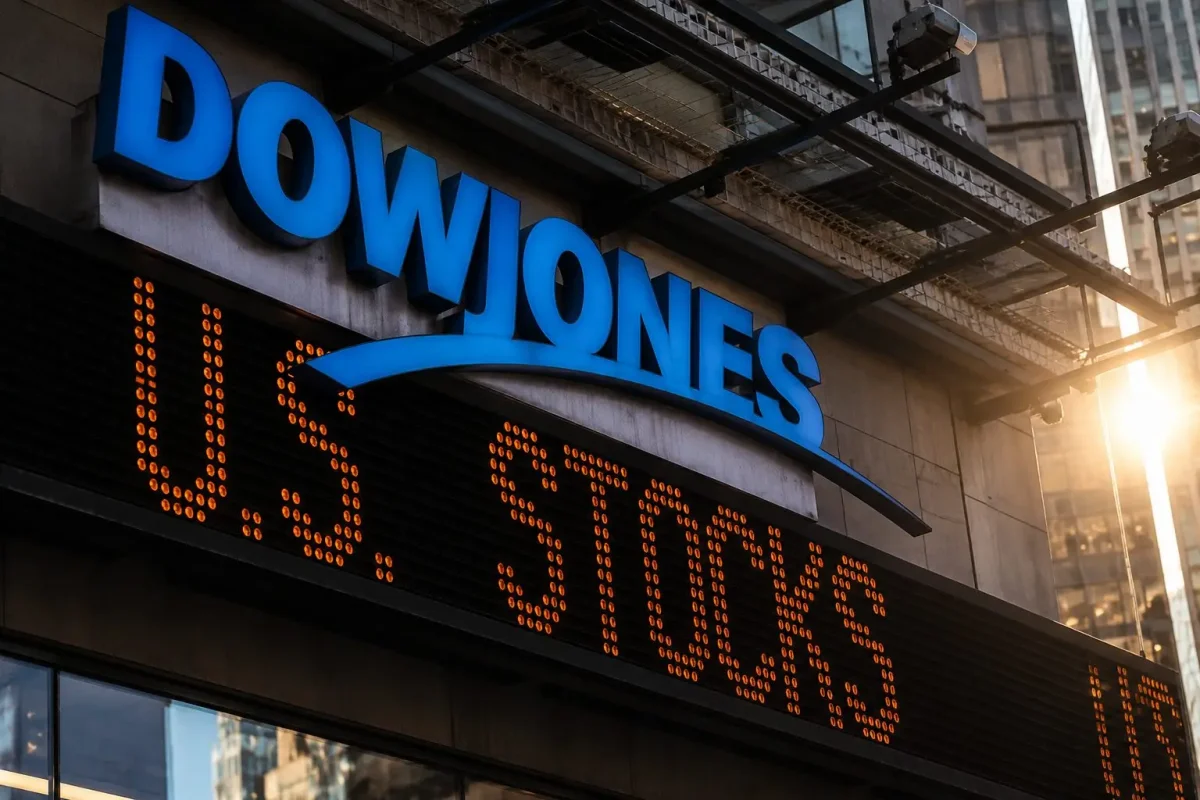
NEW YORK, July 20, 2026 – U.S. stock markets opened mixed on Monday, with the Dow Jones Industrial Average slipping further while technology-heavy indices gained ground. By midday, the Dow was down 0.17%, while the Nasdaq Composite rose 0.62%, reflecting a sharp divergence driven by a recovery in semiconductor stocks.
The Dow has fallen 0.95% since Thursday's close, a steeper two-session decline compared to the S&P 500's 0.68% drop and the Nasdaq's 0.79% loss. This marks a reversal from the prior week, when the Dow fell only 0.93% versus the S&P 500's 1.55% decline and the Nasdaq's 2.9% plunge. The Dow's earlier resilience had provided some insulation during the chip selloff, but that trend has now reversed.
The index's price-weighted structure explains part of the divergence. Unlike market-cap-weighted indices, the Dow assigns higher weight to stocks with higher share prices. Apple (NASDAQ:AAPL) and Boeing (NYSE:BA) were among the biggest drags, dropping 2.0% and 1.7% respectively in early trading, together accounting for roughly 62 points of the Dow's 157-point loss—about 40% of the total decline.
Outside the Dow, chip stocks rallied strongly. Micron Technology (NASDAQ:MU) advanced 5.1%, SanDisk (NASDAQ:SNDK) gained 5.4%, and Advanced Micro Devices (NASDAQ:AMD) rose 3.4%. The Philadelphia semiconductor index climbed 2.5% after entering bear market territory on Friday, though it remains over 20% below its late June record high. Nvidia (NASDAQ:NVDA), a Dow component, was up about 1.8%, while Alphabet (NASDAQ:GOOGL) surged 3.4% following a report on new artificial-intelligence chips.
Market breadth remained narrow. On the Nasdaq, new lows outnumbered new highs by 55 to 31, indicating selective buying. “There’s just a little less room for error in the market,” said Jack Herr, senior investment analyst at GuideStone Funds. Consensus S&P 500 earnings growth was reported at 26%, up from the previous 23.7%, according to Reuters.
Investors are now focused on upcoming earnings reports from Alphabet, IBM (NYSE:IBM), Intel (NASDAQ:INTC), and Texas Instruments (NASDAQ:TXN) this week. These results will test whether demand for chips is robust enough to support current profit forecasts. Meanwhile, Brent crude hovered around $88 per barrel, and the yield on the 10-year Treasury note stayed near 4.57%. Analysts warn that an energy shock or disappointing guidance could pressure equity valuations.
The Dow's continued weakness contrasts with Friday's steadiness, when technology shares bounced back. The Nasdaq regained roughly 44% of its Friday loss, while the Dow failed to hold its ground. The divergence highlights the impact of price-weighting and the ongoing rotation between sectors.