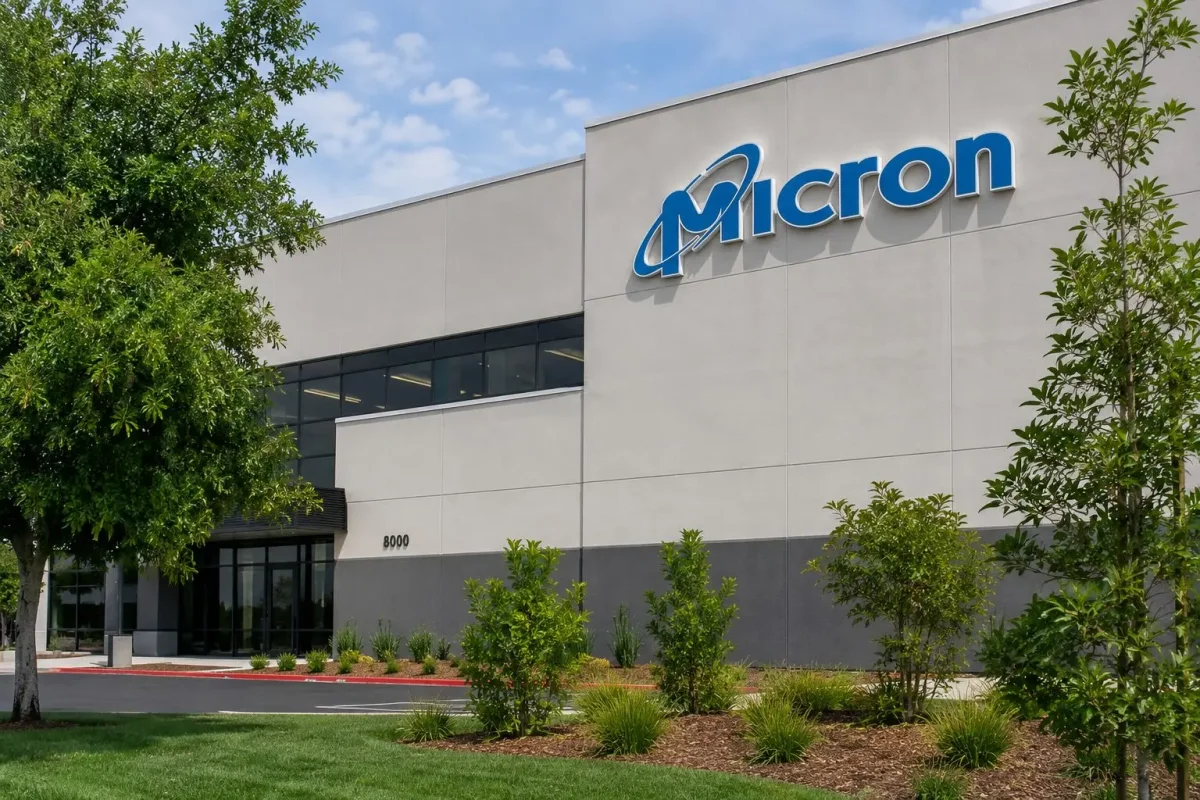
Micron Technology (MU) shares closed Thursday at $995.87, up 11.66%, recovering from a sharp five-session pullback and moving back within striking distance of the $1,000 milestone. The rebound underscores the market's intense focus on the AI-driven memory boom, which has propelled Micron's market capitalization to approximately $1.14 trillion. However, with the stock trading near its 52-week high, investors are now debating whether the rally has further room to run or if expectations have become too aggressive.
The recent jump followed a swift reset in semiconductor stocks. After a 17% decline over the prior five sessions, Micron's 12% gain on Thursday was seen by some analysts as a healthy correction rather than a fundamental shift. The broader memory-chip sector experienced a similar pullback, which market observers characterized as a natural consolidation within a strong uptrend.
Analyst activity has remained bullish, with several firms raising price targets. Wolfe Research reiterated its Outperform rating and increased its price target to $1,250, citing stronger pricing expectations for DRAM and NAND memory. Goldman Sachs maintained a Neutral rating but lifted its target to $900, while Wells Fargo raised its forecast to $1,220. According to Benzinga, consensus estimates for Micron's fiscal third quarter call for earnings of $19.46 per share on revenue of $34.07 billion, a dramatic increase from the year-ago period when the company reported $1.91 per share and $9.30 billion in revenue.
The company's last quarterly report set a high bar. In fiscal Q2, Micron posted revenue of $23.86 billion, GAAP net income of $13.79 billion, and non-GAAP earnings of $12.20 per share. Management guided for fiscal Q3 revenue of $33.5 billion, plus or minus $750 million. CEO Sanjay Mehrotra emphasized during the call that "in the AI era, memory has become a strategic asset for our customers," directly linking the company's margin expansion to AI-driven demand and constrained supply.
The next major catalyst is Micron's fiscal third-quarter earnings call scheduled for June 24 at 4:30 p.m. EDT, followed by a post-earnings analyst call at 6:00 p.m. EDT. Investors will be closely watching for confirmation of strong high-bandwidth memory (HBM) demand, pricing discipline, gross margin strength, and long-term customer agreements. These factors will determine whether earnings can remain elevated beyond the current shortage cycle.
The bull case for Micron rests on the argument that the company is no longer a purely cyclical memory supplier. AI servers require vast amounts of fast memory, and cleanroom capacity is limited. Analysts cited by MarketWatch and Benzinga see supply constraints supporting pricing into 2027. Additionally, Micron recently selected Bechtel for the first phase of its Clay, New York, memory manufacturing complex, a project the company says is planned to become the nation's largest semiconductor manufacturing facility and support 50,000 jobs in New York.
However, the bear case highlights that the stock may have already priced in a near-perfect memory upcycle. MU remains close to its 52-week high of $1,089.29, with a trailing price-to-earnings ratio of about 47. The average analyst price target of $927.29 sits below Thursday's close, suggesting limited upside. Momentum signals have also cooled, and the memory business has historically been vulnerable to overbuilding, price declines, and competition from SK Hynix and Samsung.
For investors who believe AI memory shortages and long-term supply agreements can sustain unusually high earnings into 2027, Micron may still offer upside. For more valuation-sensitive buyers, the stock appears fairly valued to risky after its rebound, given that expectations are already aggressive and the June 24 report must support both the earnings estimates and the AI-supply narrative. The clearest risk is not that demand disappears overnight, but that pricing, margins, or capacity plans fail to justify a trillion-dollar-plus valuation.