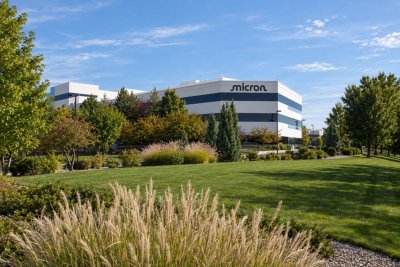
Micron Technology (MU) shares ended Friday at $751.00, down 1.46% for the session, yet the stock still managed a 3.6% advance for the week. The holiday-shortened trading period saw the memory chipmaker's stock give back some of its recent gains as investors weighed a major U.S. manufacturing milestone against growing concerns that the AI-driven memory rally may have become overextended.
U.S. equity markets will be closed Monday for Memorial Day, meaning Micron's next trading session won't begin until Tuesday. The pause gives traders time to digest a flurry of developments that could shape the near-term outlook for the memory sector.
Manufacturing Milestone in Virginia
Micron announced Friday that it has commenced production of 1-alpha DRAM at its Manassas, Virginia facility, a key step in the company's broader $2 billion expansion plan for the site. The move is expected to quadruple the plant's output of DDR4 memory, targeting customers in automotive, defense, aerospace, industrial, networking, and medical-device markets. CEO Sanjay Mehrotra described the initiative as bringing “advanced 1α DRAM manufacturing to American soil.”
The expansion is part of Micron's estimated $200 billion investment plan in the United States over the coming years. U.S. Trade Representative Jamieson Greer, who visited the Manassas site, indicated that no immediate semiconductor tariffs are planned but emphasized the need for future protections to support reshoring efforts.
Samsung Labor Talks in Focus
Investors are also closely watching developments at Samsung Electronics, one of Micron's primary competitors in the high-bandwidth memory (HBM) market. Workers at Samsung's South Korean operations began voting Friday on a pay agreement that averted an 18-day strike. The vote remains open until 10 a.m. local time on May 27. A favorable outcome could remove a potential supply disruption premium that has been supporting memory prices.
Strong Financials and Rising Capex
Micron's financial performance remains robust. The company reported fiscal second-quarter revenue of $23.86 billion and non-GAAP earnings of $12.20 per share. For the current quarter, management guided for revenue of approximately $33.5 billion, plus or minus $750 million, with non-GAAP earnings of $19.15 per share, plus or minus 40 cents. Mehrotra has characterized memory as a “strategic asset.”
Capital spending is also on the rise as the chipmaker ramps up capacity to meet surging demand. Ben Bajarin, CEO of Creative Strategies, noted that the increased capex “makes sense” given the strength of demand and “no signs of easing any time soon.”
Nvidia's AI Momentum
The broader AI narrative got a boost last week from Nvidia (NVDA), which guided for second-quarter revenue of $91 billion, exceeding Wall Street estimates. Data-center revenue reached $75.2 billion. Analyst Jacob Bourne of eMarketer highlighted that the key question now is whether Nvidia can sustain its AI infrastructure buildout into 2027 and 2028.
The S&P 500 notched its eighth consecutive weekly gain, while the Nasdaq Composite edged up 0.19% to 26,343.97 on Friday. Most chip stocks traded higher, though Nvidia shares slipped 1.9%.
Market Risks and Outlook
Some analysts caution that memory scarcity may already be fully priced in. If Samsung secures a labor agreement, the supply-shock premium could quickly dissipate, potentially pressuring stretched tech valuations. Additionally, Micron's heavy investment in new capacity could become a drag if memory prices soften before the new output becomes profitable.
As U.S. stocks face renewed headwinds from inflation concerns and rising bond yields, Micron investors are bracing for Tuesday's market open. The week ahead will hinge not on any single data point but on the interplay of Samsung's labor decision, Nvidia's AI spending trajectory, and the impact of interest rates on the broader semiconductor sector.