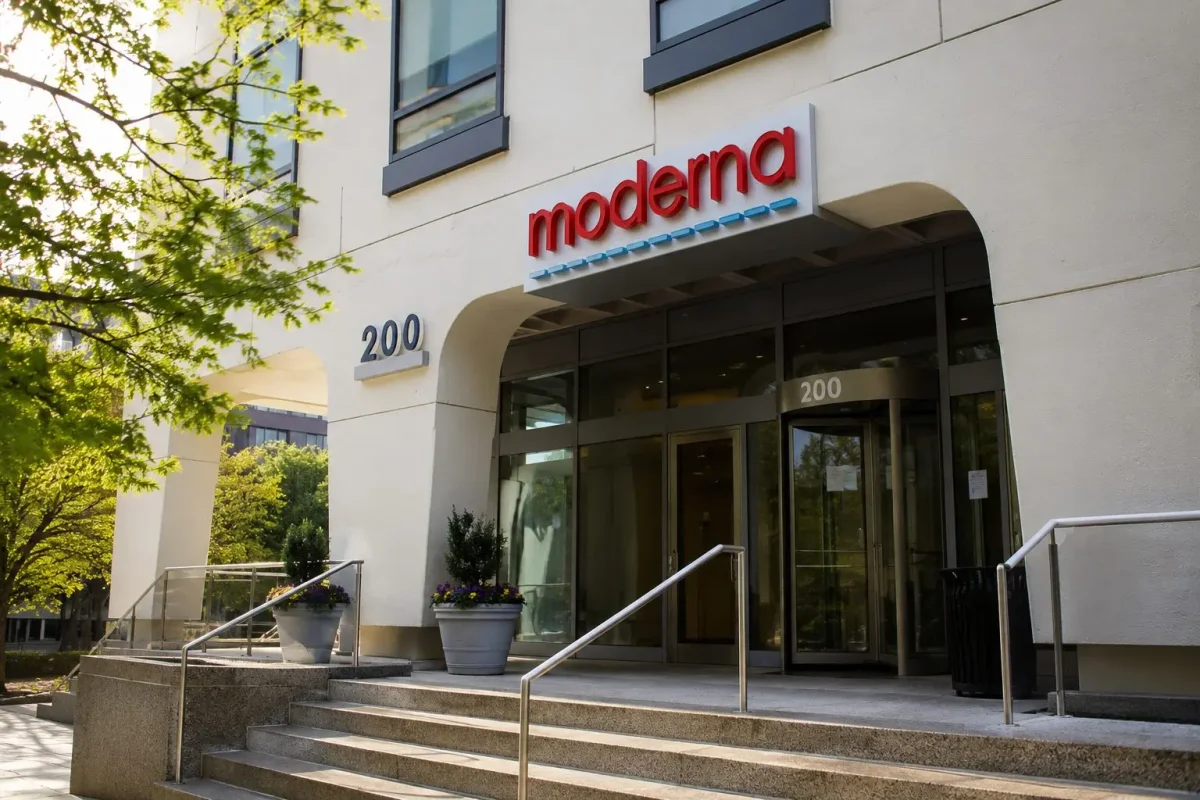
Moderna Inc. (NASDAQ:MRNA) saw its shares climb sharply in after-hours trading on Thursday, with the stock last changing hands at $79.76, up $7.36, or 10.2%. The move added approximately $2.9 billion to the company's market capitalization, which now stands at around $31.5 billion based on roughly 395 million shares outstanding.
The rally extends a broader upward trend for Moderna, which has gained about 24.7% since June 18. On that date, advisers to the U.S. Food and Drug Administration voted unanimously in favor of Moderna's mRNA-based flu vaccine candidate, known as MFLUSIVA, for adults aged 50 and older. The stock closed at $63.96 that day, and has since added roughly $6.2 billion in market value.
To put the move in perspective, Thursday's one-day gain of nearly $2.9 billion is roughly 1.5 times Moderna's total revenue for 2025, which came in at $1.944 billion. It also roughly matches the company's net loss of $2.822 billion for that year. The market value increase since June 18 is about 8.3 times Jefferies' estimate of $750 million in U.S. sales from Moderna's flu vaccine and its COVID-flu combination product by 2030.
Moderna's balance sheet remains a key concern for investors. The company reported first-quarter revenue of $389 million and a GAAP net loss of $1.34 billion. As of March 31, cash, cash equivalents, and investments totaled $7.5 billion — about 39% of Thursday's paper gain. Moderna has guided for 2026 year-end cash and investments of $4.5 billion to $5.0 billion, excluding any additional credit-facility draws. Research and development costs are expected to be around $3.0 billion in 2026, with selling, general, and administrative expenses of about $1.0 billion.
Despite the recent surge, some analysts caution that significant revenue from MFLUSIVA may not materialize until later. Citi analyst Geoff Meacham noted that the vaccine likely won't start delivering meaningful sales until the second half of 2027, as Moderna missed the 2026 U.S. flu shot contracting cycle. The FDA is expected to make its final decision on MFLUSIVA by August 5, though advisory panel votes are non-binding.
Moderna CEO Stéphane Bancel continues to position the company as a platform play, emphasizing its ability to develop multiple medicines. In a blog post following the company's Science Day on June 25, Bancel stated, "We are building a platform capable of repeatedly creating new medicines." In Moderna's May earnings release, he highlighted expectations for "several additional approvals around the world," with seasonal flu being a potential fifth approved product.
The stock's outperformance relative to the broader market and biotech sector underscores the company-specific nature of the rally. While Moderna surged over 10%, the iShares Nasdaq Biotechnology ETF (IBB) gained about 2.9%, and the SPDR S&P Biotech ETF (XBI) rose 2.5%. In contrast, the Invesco QQQ Trust (QQQ) fell 1.7%, and the SPDR S&P 500 ETF (SPY) edged down 0.1%. Other vaccine stocks also moved higher but to a lesser extent: BioNTech (BNTX) added 3.8%, Novavax (NVAX) rose 3.0%, Pfizer (PFE) gained 1.8%, and GSK (GSK) climbed 4.6%.
Piper Sandler recently raised its price target on Moderna to $77 from $69, maintaining an Overweight rating. The stock traded above that new bull target in after-hours action, closing 3.6% above the analyst's revised estimate.
The Nasdaq will be closed on Friday, July 3, 2026, in observance of Independence Day. U.S. markets will have their last trading session before the holiday on Thursday.