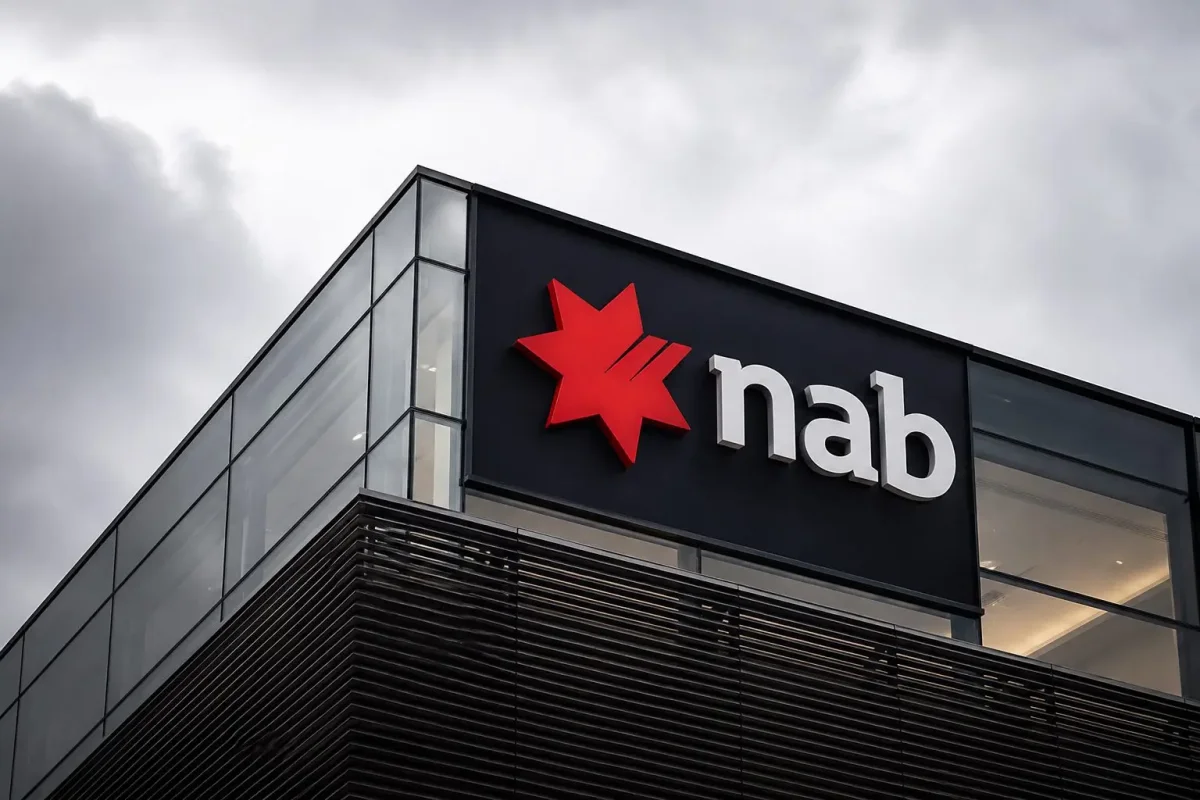
SYDNEY — National Australia Bank Limited (ASX:NAB) edged up 0.23% to A$39.85 on Friday, making it the only Big Four bank to close in positive territory as the broader market retreated. The S&P/ASX 200 index fell 0.50% to 8,796.70. NAB’s resilience reflects the strength of its business banking division, which is the bank’s largest profit driver.
Business and Private Banking generated A$1.85 billion in cash earnings in the first half of fiscal 2026, representing 51.6% of group cash earnings before large notable items, according to company filings. This segment benefits from easing price pressures, which support lending activity and margins.
New data from NAB showed consumer demand remained robust in June. Customer spending rose 1.2% month-on-month and 6.8% year-on-year. Excluding fuel, spending increased 1.4% from May and 7.1% from a year earlier. However, momentum slowed during the quarter, with spending growth moderating to 1.5%, down from 1.7% in the March quarter. NAB Chief Economist Sally Auld noted, “Consumer spending held up in June,” adding that future data will indicate if this trend persists.
NAB’s June business survey provided a complementary view. Business conditions held steady at +3 for the third consecutive month. Confidence improved nine points to -5. Retail prices fell for the first time in seven years, signaling reduced inflationary pressure. While activity remains below average—capacity utilization sits at 82.0%—the absence of earlier price competition is significant for NAB’s key profit segment.
The peer comparison highlights the contrast. NAB was the only gainer on Friday, while Commonwealth Bank of Australia (ASX:CBA) fell 0.78% but outperformed over the week, rising 1.7%. Westpac Banking Corp (ASX:WBC) declined 0.19%, and ANZ Group Holdings (ASX:ANZ) dropped 0.41% on Friday. NAB trades at a price-to-earnings ratio of 19.88x, roughly 10% higher than Westpac’s 18.02x, yet offers a similar dividend yield of 4.27%.
Credit expenses continue to offset gains. NAB’s first-half impairment charges rose to A$706 million, a 45.6% increase from the September 2025 half. The bank set aside A$300 million for potential Middle East risks. The risk environment intensified after Friday’s close, with Brent crude surging 4.59% to $88.10 per barrel and the S&P 500 slipping 1.01%. NAB’s relative strength will be closely watched when the ASX opens Monday.
No update from NAB is expected next week. The lender will release its third-quarter trading update on August 17. Australia’s June jobs data is scheduled for release on Thursday, July 23, at 11:30 AEST. A soft jobs report would undermine arguments for a smooth economic slowdown and could pressure bank earnings.
Risks include a further spike in oil prices, which may reignite inflation and prompt renewed rate hike expectations. The Reserve Bank of Australia has raised interest rates three times this year, bringing the cash rate to 4.35%. For now, NAB’s primary earnings driver is experiencing steady activity with moderated price competition, providing some justification for its premium valuation relative to cheaper rivals. The upcoming employment report will be the next key indicator for the banking sector.
