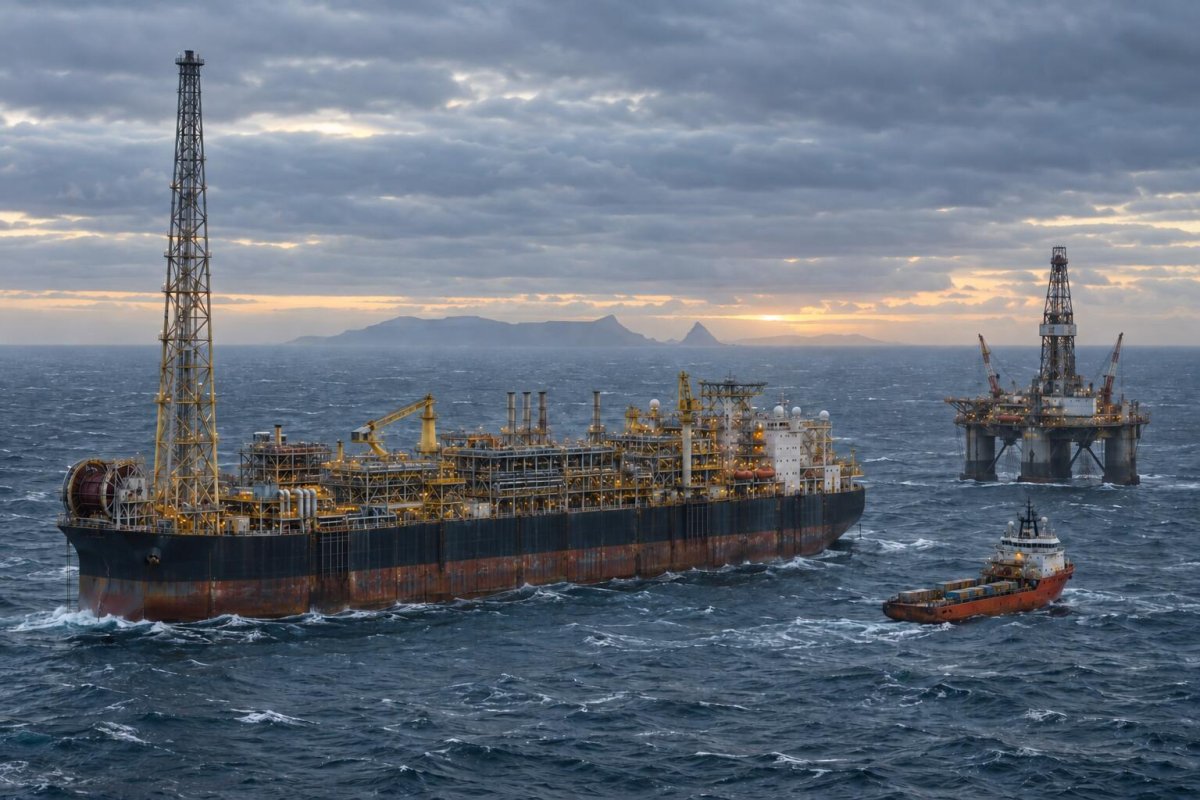
Shares of Navitas Petroleum fell 2% in Tel Aviv trading on Tuesday after Argentina announced it would file a criminal complaint against the company and several partners over their oil exploration activities in the Falkland Islands. The move adds a new layer of legal and political risk to the Sea Lion development, though analysts note the complaint does not directly revoke licenses or halt construction.
At 10:41 a.m. Israel time, Navitas units traded at ILa 12,520, down 2.03% from Monday's close of ILa 12,780. The stock touched an intraday low of ILa 12,150, a decline of 4.93%, before recovering somewhat. The market's reaction reflects concern over increased counterparty risk and potential delays, but not a full repricing of the project's value.
Argentina's Legal Action
Argentina's presidency announced that Foreign Minister Pablo Quirno and Treasury Prosecutor Sebastián Amerio would present a criminal complaint against Navitas Petroleum Development & Production Ltd., Navitas Petroleum Atlantic United, Navitas Petroleum LP, JHI Associates, and Eco (Atlantic) Oil & Gas. The complaint also names directors, managers, and other individuals allegedly involved in the Falklands oil activities.
The allegations center on UK-issued exploration and production licenses in the North Falkland Basin, which Argentina claims violate its Law 26,659. This law, updated to cover hydrocarbon extraction, carries potential prison terms of 10 to 15 years for individuals and corporate fines based on the market value of 150,000 to 1.5 million barrels of WTI crude. With WTI at $94.41, the upper fine could reach approximately $142 million. The law also allows for activity suspensions and exclusion from Argentine state tenders.
Notably, the presidential notice did not include a court docket or an injunction against project work, and Navitas had not issued an immediate response by the time of publication. Reuters reported that the company did not immediately answer a request for comment.
Sea Lion Project at Stake
Navitas operates Sea Lion with a 65% working interest. The company's June 2026 financial statements list gross proved and probable reserves of about 314 million barrels of oil and 108 billion cubic feet of gas. First oil is scheduled for March 2028.
The same filing indicates that Navitas must provide approximately $773 million in equity for Sea Lion, including a loan component for partner Rockhopper Exploration, before the first debt drawdown expected at the end of Q1 2027. Three Sea Lion-related balance sheet lines, including the FPSO right-of-use asset and loans to Rockhopper, totaled roughly $561 million as of June 30. These figures make any delay or disruption more consequential than the headline fine alone.
Despite the legal cloud, there are buffers. Navitas and Rockhopper took final investment decisions in December 2025 after Falkland authorities approved the development plan, and licenses were extended for 35 years. The financing disclosure set a $1.8 billion Phase 1 construction budget, including contingencies, with $650 million in project loans available after required equity is invested. Major supplier, FPSO, drilling, and subsea contracts are described as binding.
Market Implications
Argentina does not administer the Falkland Islands, which are controlled by Britain, and the complaint does not claim that any lender, shipyard, or contractor has withdrawn. This limits the direct effect on the construction schedule today, and the 2% share decline should not be interpreted as a 2% probability of total project loss.
The real risk lies in practical channels: personal exposure for executives, restrictions on suppliers with Argentine business, attempts to attach assets where courts recognize Argentine orders, or tighter terms from banks and insurers. Argentina had already begun administrative sanction proceedings against 45 people and companies on September 4, so part of this sovereignty risk was already visible.
The strongest counterargument is that Sea Lion's sponsors have financed the project with full knowledge of this dispute. Falkland licensing, the UK-based project company, and an 11-well first phase are established, and construction was described as on schedule just two weeks ago. Partner Rockhopper reiterated the Q1 2028 first-oil target when it raised capital in August for later Sea Lion development.
What to Watch
Investors should monitor whether the complaint is formally accepted by a federal court, whether prosecutors seek measures against named individuals or assets, and whether Navitas changes its March 2028 schedule, $773 million equity plan, or Q1 2027 debt-draw timetable.
If contractors and lenders continue performing and the company reports no schedule or budget changes, Tuesday's decline may prove to be a geopolitical risk-premium adjustment. However, any delay to the first debt drawdown, revised guarantees, or supplier withdrawal would turn it into an operating and financing event. For now, that distinction is the line between a volatile headline and a damaged project value.