Navitas Semiconductor (NVTS) saw its stock decline 6.6% to close at $22.85 on Tuesday, erasing earlier gains as the market digested a significant capital raise announcement and a board member's departure. The power-chip maker's shares traded in a wide range between $20.71 and $25.58, with over 42.5 million shares changing hands, as investor sentiment turned cautious.
The sell-off came after Navitas filed a prospectus supplement on June 8 for the sale of up to $500 million in Class A common stock through underwriters including UBS Investment Bank, Morgan Stanley, and Needham & Company. Such stock sale programs can provide growth capital but also risk diluting existing shareholders, a concern that weighed on the stock.
Adding to the uncertainty, Navitas disclosed in a Form 8-K that director Ranbir Singh resigned from the board effective immediately. The company stated that Singh did not provide a reason for his departure, and it referred to his earlier Schedule 13D filings. Singh had joined the board in November 2024 and served as chair of the Executive Steering Committee.
The broader semiconductor sector also faced headwinds, with the Philadelphia Semiconductor Index falling as much as 8.6% before paring losses. The Nasdaq Composite ended the session down 0.98%. JonesTrading's Michael O'Rourke described the market action as a "momentum unwind," reflecting a pullback in tech stocks that have benefited from AI-related enthusiasm.
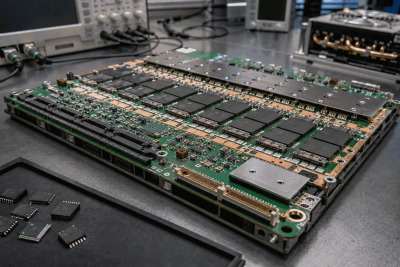
Navitas has positioned itself as a key player in the AI infrastructure buildout, focusing on power delivery solutions using gallium nitride (GaN) and silicon carbide (SiC) semiconductors. These materials enable chips to operate at higher voltages and temperatures than traditional silicon, making them suitable for AI data centers, grid equipment, and industrial electrification. The company recently highlighted its role in Nvidia's MGX ecosystem, which targets 800-volt DC AI systems.
CEO Chris Allexandre has emphasized the critical nature of power delivery as AI workloads grow, stating that Navitas is pursuing greater power density and a smaller hardware footprint. However, the market remains skeptical about the near-term revenue potential from these emerging applications. The company cautioned that the 800-volt AI system market is still unproven and that its "design wins" do not guarantee firm orders or backlog.
On Monday, Navitas announced the launch of an isolated through-hole package for SiC MOSFETs, designed for direct-cooled thermal setups in 1,200- to 3,300-volt products. Paul Wheeler, vice president and GM of SiC, said the new design offers "efficient thermal management with robust high-voltage isolation" and delivers "power module–class performance" in a smaller footprint. Despite this product news, the stock could not sustain its early gains.
Financially, Navitas remains in the early stages of its business rollout. The company reported first-quarter revenue of $8.6 million, down from $14.0 million a year earlier but up from $7.3 million in the prior quarter. It posted a net loss of $33.8 million and ended March with $221.0 million in cash. For the second quarter, Navitas guided revenue of approximately $10.0 million, plus or minus $0.5 million.
Competition in the power semiconductor space is intense. In its annual report, Navitas listed Infineon, Power Integrations, and Texas Instruments as GaN competitors, while Infineon, Wolfspeed, Onsemi, Rohm, Qorvo, and STMicroelectronics are SiC rivals. Many of these competitors have significantly greater financial resources, posing a challenge for Navitas as it scales its operations.
Investors appear to be reassessing the stock's valuation relative to its actual revenue trajectory. With a $500 million sale capacity that could bolster the balance sheet but at the risk of dilution, and with the broader chip sector under pressure, Navitas shares are trading largely on AI infrastructure expectations rather than current financial performance. The combination of financing uncertainty, management changes, and market weakness has led to a cautious outlook among traders.