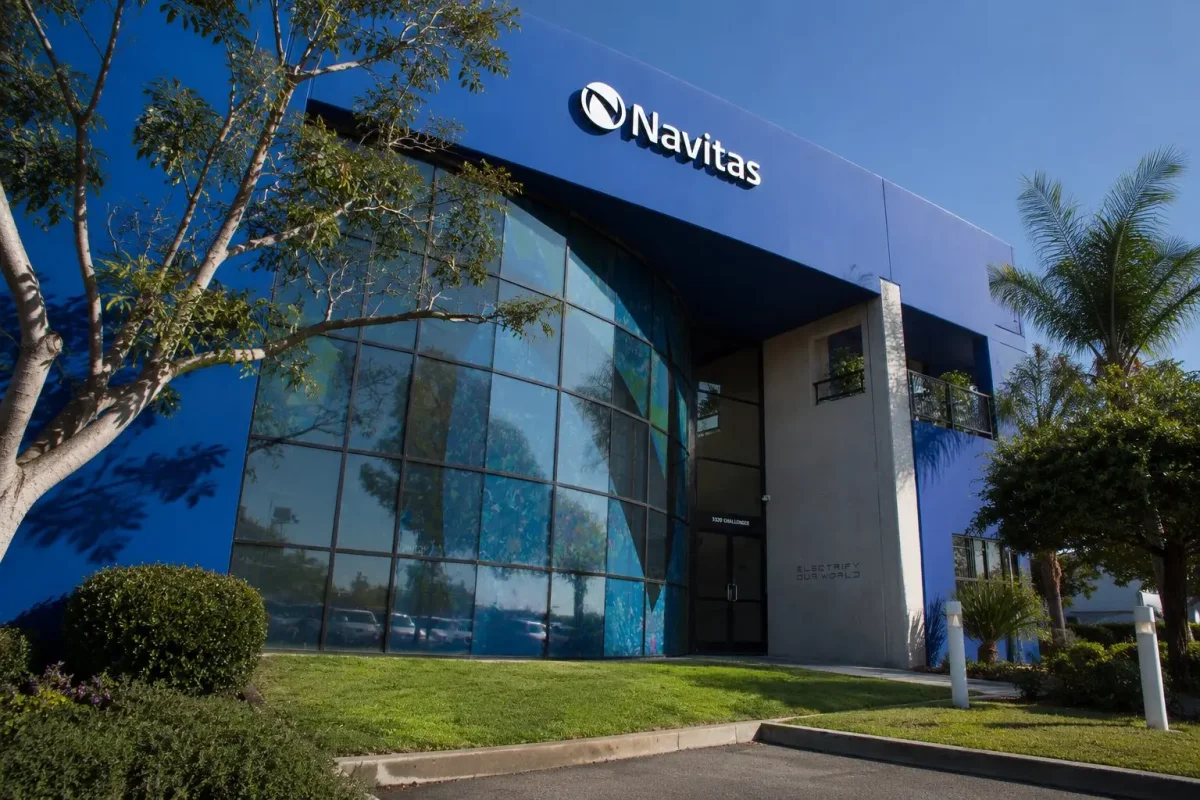
Navitas Semiconductor shares climbed sharply again on Friday, extending a rally that has turned the small power-chip maker into one of the more volatile bets on AI data-center infrastructure. The stock closed at $28.36, up 16.33%, following an 18.32% surge on Wednesday ahead of the company's PCIM 2026 power-electronics showcase.
The AI Power Trade Expands
The timing of the rally matters because the AI trade is moving beyond graphics processors. Nvidia reported 92% year-on-year growth in data-center revenue to $75.2 billion this week, and Chief Executive Jensen Huang said the buildout of "AI factories" was moving at "extraordinary speed." That has pushed investors toward power semiconductors, chips that manage and convert electricity inside servers and data centers.
Gallium nitride (GaN) and silicon carbide (SiC) are materials used in chips that can switch power faster and lose less energy as heat than older silicon designs. Navitas has leaned hard into that story, positioning itself as a key player in the next generation of AI infrastructure.
Financial Performance and Guidance
Navitas reported first-quarter revenue of $8.6 million, up 18% from the prior quarter but down from $14.0 million a year earlier. The company guided for second-quarter revenue of about $10 million, plus or minus $500,000. Its non-GAAP gross margin, an adjusted measure excluding some accounting items, was 39.0%.
Chief Executive Chris Allexandre called the quarter a "return to top-line sequential growth" as Navitas moves to "pivot away from mobile and consumer" markets. Chief Financial Officer Tonya Stevens pointed to "disciplined cost management" and a "gradual expansion of gross margin" as the company tries to narrow losses.
Product Showcase and Technology
Navitas plans to demonstrate at PCIM 2026 a 20 kilowatt 800-volt-to-6-volt power delivery board targeting 97.5% peak efficiency and a 10 kilowatt 800-volt-to-50-volt platform targeting 98.5% peak efficiency. The 800 VDC architecture is a higher-voltage approach being explored for future AI data-center power systems.
Breakeven Challenges
But the breakeven math remains difficult. Analysts at Zacks, in an analysis carried by TradingView, said operating breakeven may require quarterly revenue in the high-$30 million range, well above Navitas' current sales base, even if AI infrastructure revenue keeps rising. That leaves Navitas fighting on two fronts: it needs to prove the technology ramps, and it needs to justify the stock's price.
Zacks noted that Navitas had surged 222% year to date and traded at roughly 98 times forward sales, versus about 6.4 times for onsemi, a much larger peer in power and sensing chips. onsemi is the cleaner comparison because it already has scale in the same AI power chain. The company said first-quarter revenue was $1.513 billion, AI data-center revenue more than doubled from a year earlier, and Chief Executive Hassane El-Khoury said that business grew "more than 30% sequentially."
Competitive Landscape
Infineon also sits in the competitive set, but the sharper investor debate now is Navitas versus onsemi: one is a smaller, higher-beta AI power story, the other has a broader revenue base and customer footprint. Zacks said onsemi's AI data-center revenue is expected to double year over year in 2026, while Navitas remains small and unprofitable.
Risks and Outlook
The risk is that product demos and design wins do not become revenue fast enough. Navitas warned in its filing that customer pipeline figures and design wins are not orders, backlog or revenue forecasts, and that actual business depends on customer qualification, production timing and ramp pace. For now, traders are paying for optionality. The next test is whether Navitas can turn 800-volt AI power boards, grid-infrastructure products and Nvidia-linked credibility into enough sales to move from a hot theme to a business that can cover its own operating costs.