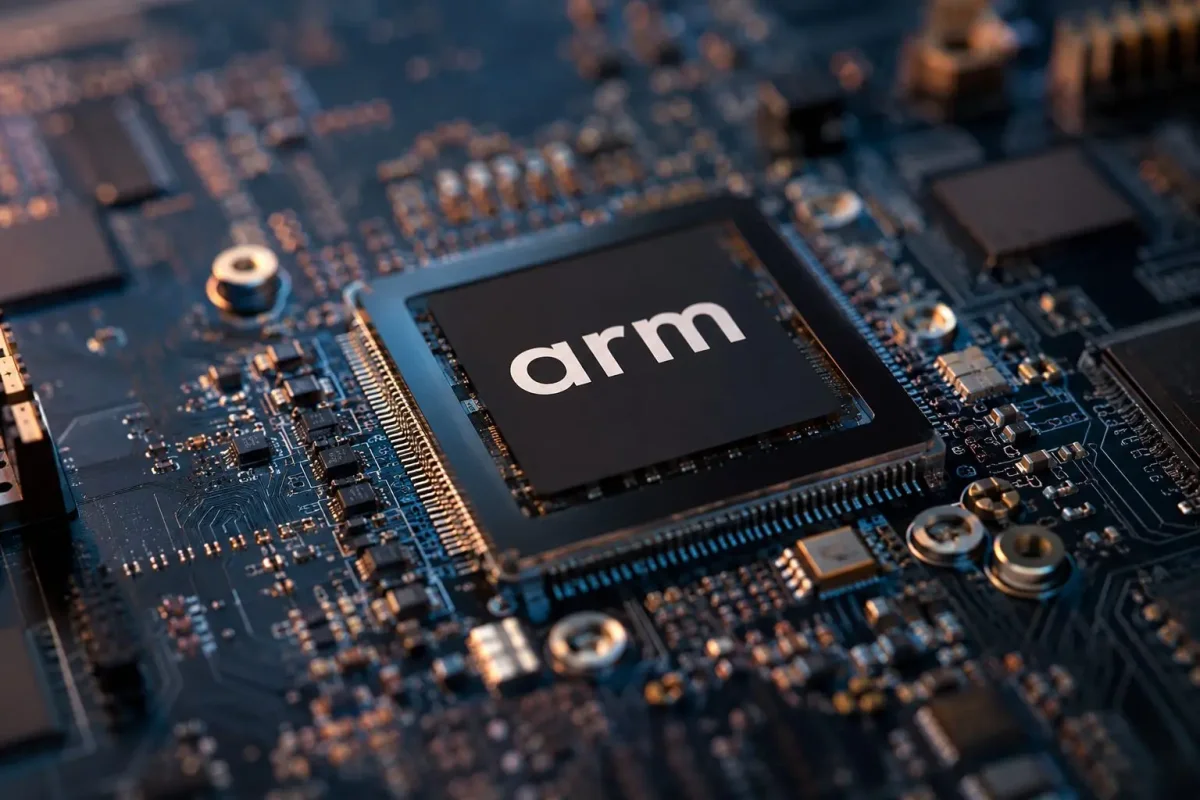
New York, May 22, 2026, 10:11 EDT – Arm Holdings shares climbed above the $300 mark on Friday morning, extending a historic rally that has placed the British chip designer at the forefront of the evolving artificial intelligence semiconductor landscape. The stock was trading at $300.89 as of 9:58 a.m. Eastern, up 0.9%, according to data from MarketBeat.
This milestone signals a broader shift in investor focus. While graphics processing units (GPUs) dominated the early wave of generative AI model training, market participants are now turning their attention to central processing units (CPUs). These general-purpose chips are essential for coordinating server workloads as AI agents take on increasingly complex, multi-step tasks.
The momentum gained fresh impetus this week from Nvidia, which reported record quarterly revenue of $81.6 billion—an 85% year-over-year increase—and record data-center revenue of $75.2 billion. CEO Jensen Huang declared that “Agentic AI has arrived,” further validating the CPU trade. Unlike direct competitors such as AMD or Intel, Arm does not manufacture chips; instead, it licenses processor designs and collects royalties when customers ship chips based on its technology. Wall Street views Nvidia's push into Arm-based CPUs as a potential royalty windfall.
Bernstein analyst David Dai initiated coverage on Arm with an Outperform rating and a $300 price target. Dai argued that Arm is well-positioned as AI workloads transition from chatbot-style systems to autonomous agents. “Arm stands out in server CPUs given its unparalleled power efficiency,” Dai wrote, as reported by Benzinga. The stock had already hit a new high on Thursday, touching $298.69 before closing at $298.23, a 16.16% gain, following Bernstein's call and a forecast that Arm's profits could grow fivefold over four years.
Arm's own financial performance provided a solid foundation for the rally. The company reported fiscal fourth-quarter revenue of $1.49 billion and full-year revenue of $4.92 billion. Licensing revenue in the quarter reached $819 million, while royalty revenue came in at $671 million, bolstered by cloud AI applications where data-center royalties more than doubled year over year.
The larger narrative centers on Arm's deepening penetration into data centers. The company disclosed that customer demand for its Arm AGI CPU—a data-center processor tailored for AI-agent workloads—exceeded $2 billion across fiscal 2027 and fiscal 2028, more than double what it had previously disclosed. Meta is the lead partner and co-developer, with systems based on the chip available from ASRock, Lenovo, Quanta, and Supermicro.
This development has reshaped investor perception. As noted by Barchart, Dai framed Arm as being at the center of a CPU “renaissance,” with major cloud providers like Alphabet's Google, Microsoft, and Meta adopting Arm-based custom silicon to enhance power efficiency and computing density.
The rally has also shifted the semiconductor leaderboard. Arm surged 38% over three sessions, moving ahead of Micron to rank second in year-to-date performance among iShares Semiconductor ETF holdings, behind Intel, according to Benzinga.
However, risks remain. The stock's rapid ascent may have outpaced fundamentals. MarketBeat data shows Arm's average 12-month analyst price target at $208.79, well below the current price, even though the highest listed target is $300. Barchart also noted that the stock's relative strength index is nearing overbought territory, a technical signal that often precedes a pullback.
For now, the market is betting on a cleaner narrative: Nvidia's AI spending wave is expanding beyond GPUs, and Arm stands to collect more royalties as CPUs regain prominence in data centers. This thesis will require concrete revenue growth—not just projections—to sustain the stock above the $300 threshold.