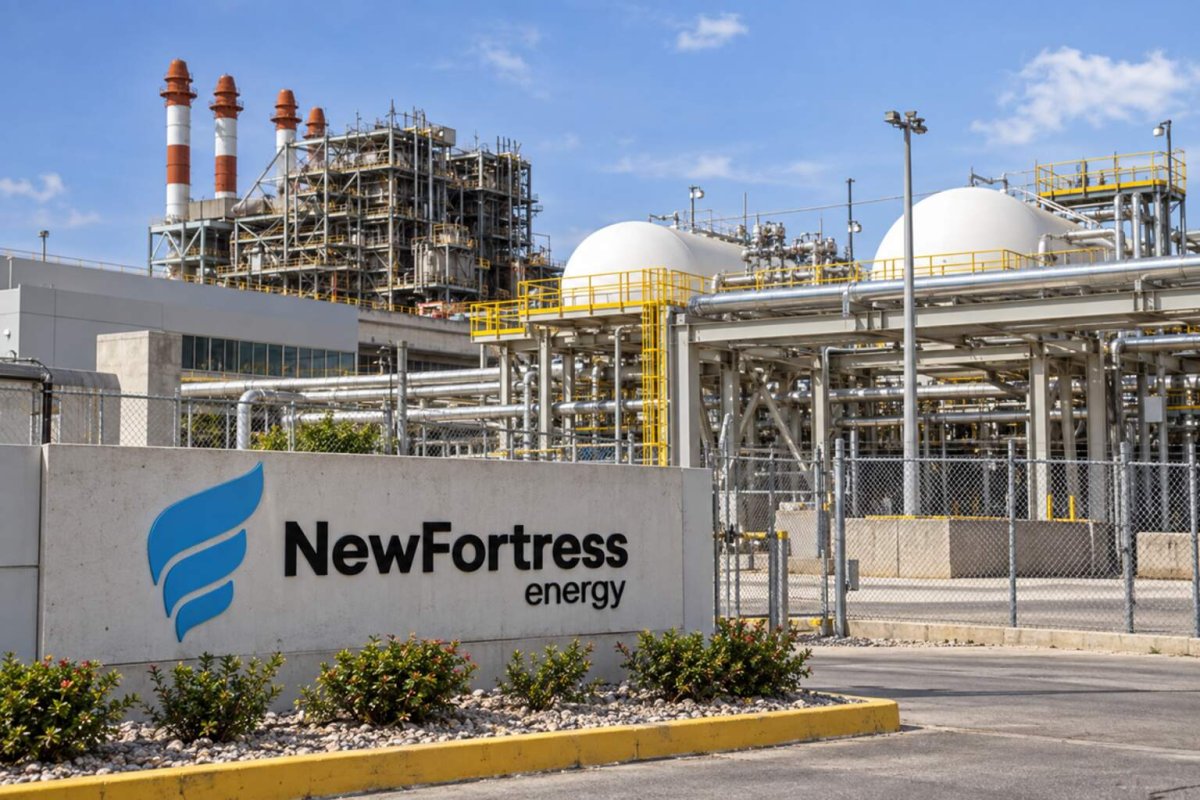
New Fortress Energy (NFE) has finalized a comprehensive restructuring that reduces its corporate debt from approximately $5.7 billion to around $700 million. However, the rescue plan transfers most of the economic upside to creditors, leaving legacy shareholders with a significantly diluted stake in the reorganized company.
According to the September 11 SEC filing, restructuring creditors received 10,608,922 common shares, representing 65% of New Fortress immediately after the spin-off of its Brazilian operations. Legacy holders retained the remaining 35%. Additionally, creditors now own 100% of the separated Brazil entity.
Preferred Conversion Threatens Dilution
The more consequential instrument is the 2,454,936 Series A mandatorily convertible preferred shares issued to creditors, each with a $1,000 initial liquidation preference. Unless New Fortress redeems them first, these preferred shares—along with any incentive-plan preferred—are designed to convert on the third anniversary into 87% of CoreCo's fully diluted common equity as measured at closing, subject to the terms and adjustments in the filing.
Investor math shows that if the preferred shares convert, legacy holders would be left with only 35% multiplied by the 13% remaining for the pre-conversion common pool, equating to approximately 4.55%. This implies legacy owners could end up with no more than about 4.6% of the company before further dilution from incentive plans. This is an inference from the disclosed terms, not a company forecast, and assumes the preferred remains outstanding until mandatory conversion.
Redemption Costs and Balance Sheet
Redemption is an alternative, but it comes at a cost. The preferred liquidation preference compounds through payment-in-kind accretion at 3% in year one, 5% in year two, and 7% in year three. Applying these rates to the initial preference results in approximately $2.84 billion after three years if nothing is redeemed. New Fortress would need substantial operating cash, asset-sale proceeds, or permitted financing to retire this claim and prevent the 87% conversion.
The restructuring extinguished or exchanged $5.7 billion of third-party debt, leaving the reorganized company with roughly $700 million of corporate debt. This includes $571.3 million of takeback loans, $36.5 million of senior new-money loans, and $100 million of junior new-money loans, plus a $3 million payment-in-kind premium. The company also secured $136.5 million of new financing. Additionally, the financing package includes a $400 million non-recourse FLNG 2 term loan and $200 million of FLNG 2 preferred interests, which ring-fence lender claims but still require project performance to deliver cash to the parent.
Surviving Assets and Market Outlook
The surviving CoreCo owns New Fortress's LNG terminals and logistics businesses in Mexico and Puerto Rico, along with a 735-megawatt power and gas-turbine portfolio. These assets now carry a much lighter corporate debt load, providing a foundation for the bullish case: lower cash interest and fresh liquidity could preserve value that an unresolved restructuring would have destroyed.
Initial trading, expected to resume Monday, September 14, under the NFE symbol after a 1-for-50 reverse split, will reveal how the market prices the reorganized operating assets. However, a volatile opening price will not settle the valuation. Investors need to consider the post-split share count, the preferred claim, and the Brazil separation in the same denominator. Comparing Monday's quote with the old penny-stock price without those adjustments would be misleading.
A near-term supply test is also approaching. New Fortress agreed to file a resale registration statement for creditor-held securities within 10 business days and to seek effectiveness within 30 days, or 90 days if the SEC reviews it. Registration does not guarantee sales, but it can turn a concentrated creditor block into a tradable overhang.
Bull Case vs. Dilution
The strongest counterargument to the dilution thesis is that 4.6% of a repaired, cash-generating enterprise can be worth more than a larger percentage of an overleveraged one. The evidence that would support that case is not the reverse split but sustained operating cash flow after maintenance and growth spending, followed by measurable preferred redemptions before the conversion date. Until that path is visible, the $2.455 billion preferred sits ahead of legacy common holders as both a cash obligation and a dilution clock.
