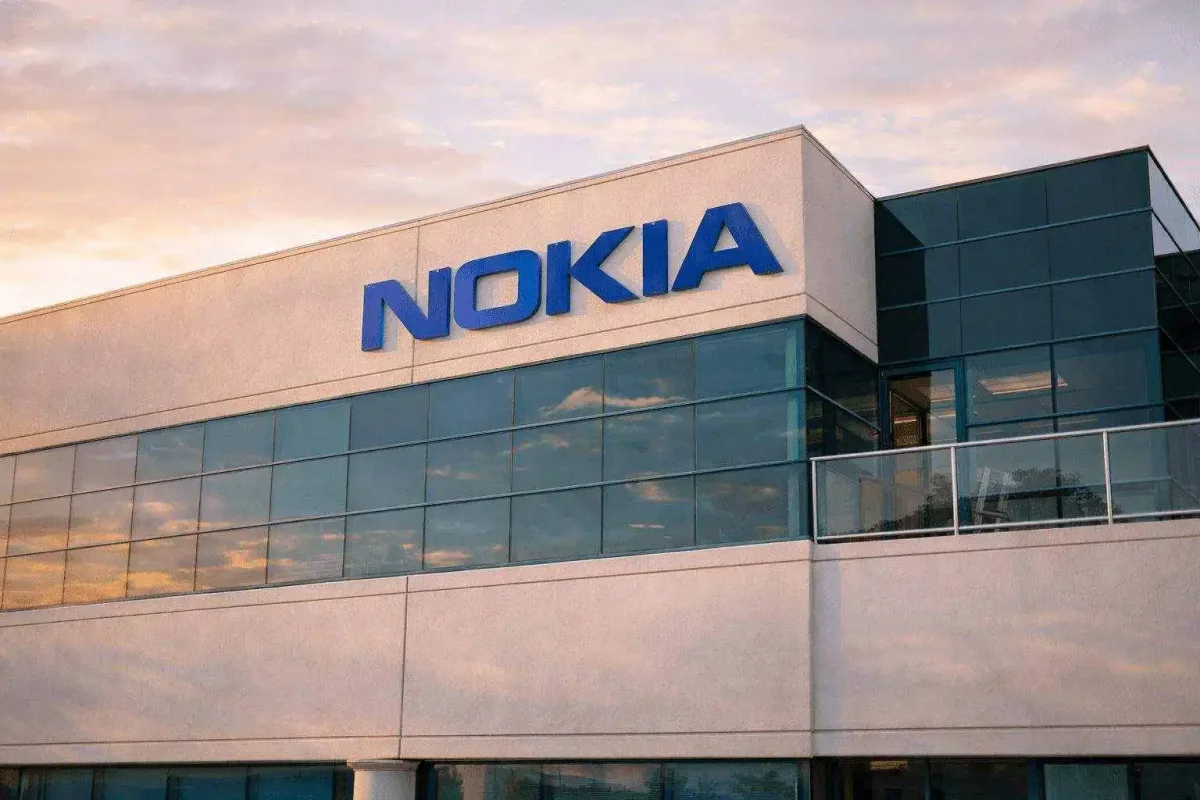
Shares of Nokia Corporation experienced a modest decline in trading on Tuesday, though they continued to hover near the upper boundary of their 52-week range. This movement occurred as market participants evaluated a series of strategic announcements from the Finnish telecommunications equipment manufacturer focused on artificial intelligence and network infrastructure.
In Helsinki, Nokia's stock price settled at 7.394 euros, down from a previous closing level of 7.488 euros. Meanwhile, its American Depositary Receipts (ADRs) traded in the United States saw a decrease of 1.7%, reaching $8.50 by early afternoon GMT. This price action is significant as Nokia seeks to expand optical and data-center networking into a more substantial growth driver, particularly while capital expenditure from mobile network operators remains inconsistent.
The company's recent financial disclosures provide context for this strategic emphasis. In its January earnings report, Nokia indicated that sales within its Optical Networks division increased by 17% year-over-year during the fourth quarter. Furthermore, the book-to-bill ratio—a key metric comparing new orders received to products billed—remained above 1.0 for both Optical and IP Networks, bolstered by rising demand linked to AI and cloud computing applications.
Ahead of the OFC conference in Los Angeles, Nokia introduced a new portfolio of optical transport solutions on Monday. The company asserted that this lineup could reduce the total cost of ownership for network operators by as much as 70%. David Heard, President of Network Infrastructure at Nokia, commented that the industry is approaching a "critical inflection point," where the surge in AI-related data traffic is compelling carriers and data-center operators to reassess their infrastructure capacity, power consumption, and physical space requirements.
Central to this launch is the Aurelis for Data Centers system, a fiber-based, out-of-band management platform. Nokia claims this technology can decrease the number of active switches by 90%, lower power usage by 50% or more, and reduce operational effort by 80%. Out-of-band management refers to a separate control network used to monitor and restore critical systems during failures of the primary data network.
Industry analyst Chris DePuy of 650 Group noted in Nokia's official release that the design signifies a "broader industry shift" toward more streamlined, fiber-based architectures. Nokia is not alone in targeting this expenditure. Competitor Ciena is also showcasing data-center optics tailored for AI at the OFC event, and Cisco launched new switching silicon and optics for AI clusters in February.
The stream of news expanded late Monday with separate announcements involving major technology partners. Nvidia and T-Mobile revealed they are collaborating with Nokia on physical AI applications deployed across distributed edge networks. Nvidia's CEO, Jensen Huang, stated the initiative aims to transform the 5G network into a "distributed AI computer" for edge infrastructure.
This direction aligns with Nokia's stated strategic focus over recent months. Reports from June 2024 indicated the company's $2.3 billion acquisition of Infinera was intended to capture AI-driven data-center spending. Furthermore, Nokia reorganized its corporate structure starting in January of this year to position the Network Infrastructure business unit at the core of its AI strategy.
However, Tuesday's share price retreat suggests investors may be looking for more than product launches and pilot projects for sustained momentum. Nokia has maintained its financial guidance for 2026, projecting a comparable operating profit between 2.0 billion and 2.5 billion euros. Concurrently, Nvidia noted that many features within the new collaborative project with T-Mobile are in various stages of development and will be released when available.
The next significant milestone for Nokia will be the release of its first-quarter financial results, scheduled for April 23. This report will serve as a concrete test of whether the company's intensified focus on AI and cloud technologies is translating into a sufficient volume of new orders to justify a stock price that remains proximate to its 52-week high of 7.54 euros.