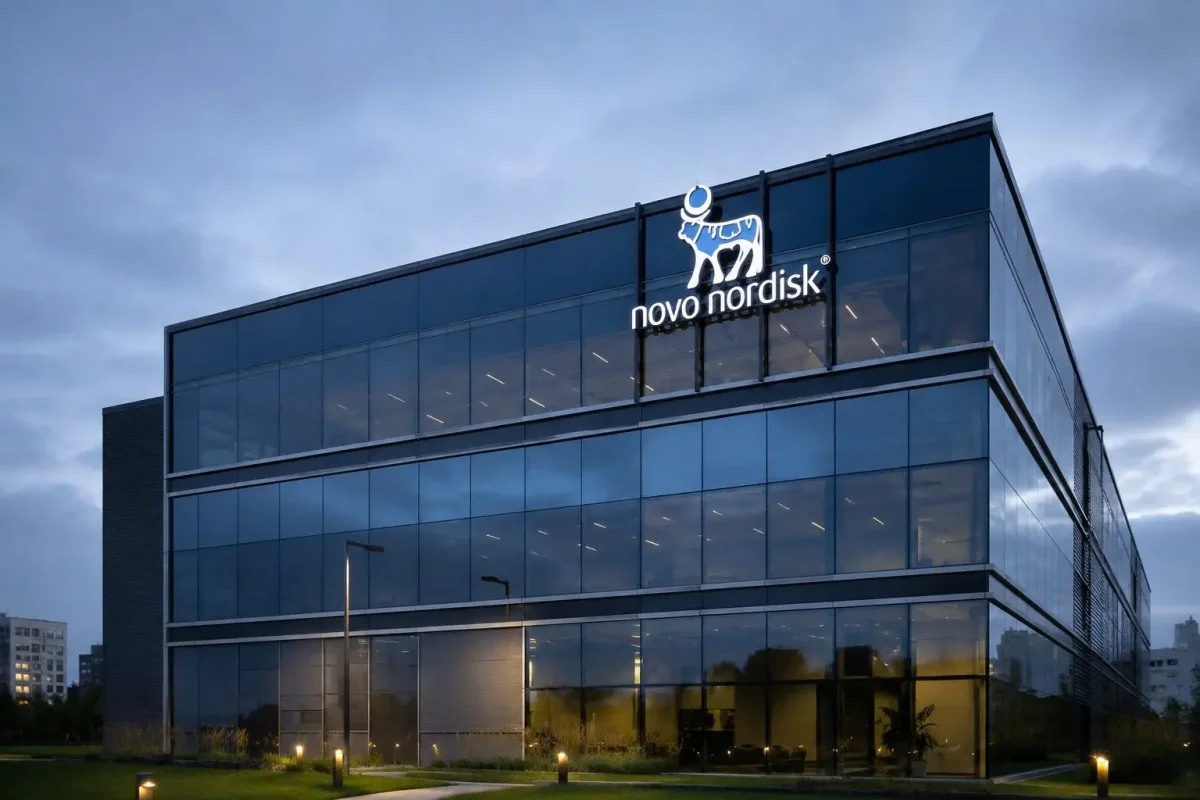
COPENHAGEN – Novo Nordisk (CPH:NOVO-B; NYSE:NVO) saw its shares decline approximately 4% on Wednesday, as a second-quarter profit that exceeded expectations on the back of cost reductions failed to alleviate investor concerns regarding the company's flagship obesity treatment, Wegovy.
The Danish pharmaceutical giant's B shares traded in the range of DKK 295.10 to DKK 295.25, marking a 4.03% decline on the Copenhagen exchange. The drop follows a 6% fall in the company's American Depositary Receipts (ADRs) the previous day, reflecting a cautious sentiment among investors about the quality of the earnings beat.
Cost-Cutting Drives Profit Beat
Novo Nordisk reported an adjusted operating profit for the second quarter of DKK 33.39 billion, surpassing the company-compiled consensus of DKK 28.74 billion by approximately 16%. This outperformance was primarily driven by a reduction in operating expenses rather than an improvement in product margins. The adjusted gross margin contracted by 4.5 percentage points to 78.2%, down from 82.7% in the prior year, impacted by roughly DKK 3 billion in manufacturing right-sizing charges.
An initial calculation based on rounded company figures suggests that savings in sales and adjusted research and development costs totaled DKK 2.68 billion, exceeding the approximately DKK 2.47 billion increase in adjusted operating profit. However, management cautioned that increased promotional and research expenditures in the second half of the year would make replicating these savings more challenging.
Wegovy and Pipeline Concerns Persist
Investor unease centered on the performance of Wegovy, particularly the oral formulation. While the injectable version saw a 22% decline in U.S. sales, international sales grew by 46% at constant exchange rates, contributing to an overall 4% increase in U.S. obesity revenue. Total Wegovy tablet sales reached DKK 3.22 billion, slightly below the anticipated DKK 3.3 billion, and the company noted that prescriptions for the product have surpassed five million since its debut.
Pipeline developments also weighed on the stock. Novo's CagriSema achieved a 15.2% weight loss in a clinical trial, compared to Eli Lilly's (LLY) Tirzepatide, which posted a 15.8% result. While CagriSema met non-inferiority for weight loss, it failed to do so for HbA1c lowering, a key diabetes metric. Additionally, the company discontinued development of monlunabant and incurred DKK 6.3 billion in pipeline impairments after the ziltivekimab ZEUS study missed its primary endpoint, potentially leading to further write-downs in the third quarter.
Outlook Raised but Risks Remain
Despite the concerns, Novo Nordisk lifted its full-year 2026 guidance. The company now expects adjusted revenue growth at constant exchange rates of -6% to 0%, an improvement from the previous range of -12% to -4%. Adjusted operating profit growth was similarly revised to -6% to 0% from -12% to -4%, and free cash flow guidance was increased to DKK 45–55 billion from DKK 36–46 billion. The revision is based on increased projected GLP-1 sales, though management maintains expectations of declining U.S. revenue due to price reductions and reduced Medicaid coverage.
CEO Mike Doustdar highlighted that Wegovy currently commands roughly 90% of the oral obesity market, with rollouts in the United States, Britain, and the UAE, and Germany expected to follow. However, analysts like Morten Gregersen of Formuepleje emphasized the need for a robust pipeline ahead of the semaglutide patent expiration, while Doustdar acknowledged the company must accelerate research efforts and pursue more "shots at goal."
Key risks include ongoing pressure on U.S. prices, reduced Medicaid coverage, patent expiration, and continued pipeline costs. Novo has announced plans to cut Wegovy's U.S. list price by approximately 50% to $675 starting January 1, 2027. Investors will be closely watching the earnings call scheduled for 13:00 CEST to assess whether margins can hold as spending increases in the second half.