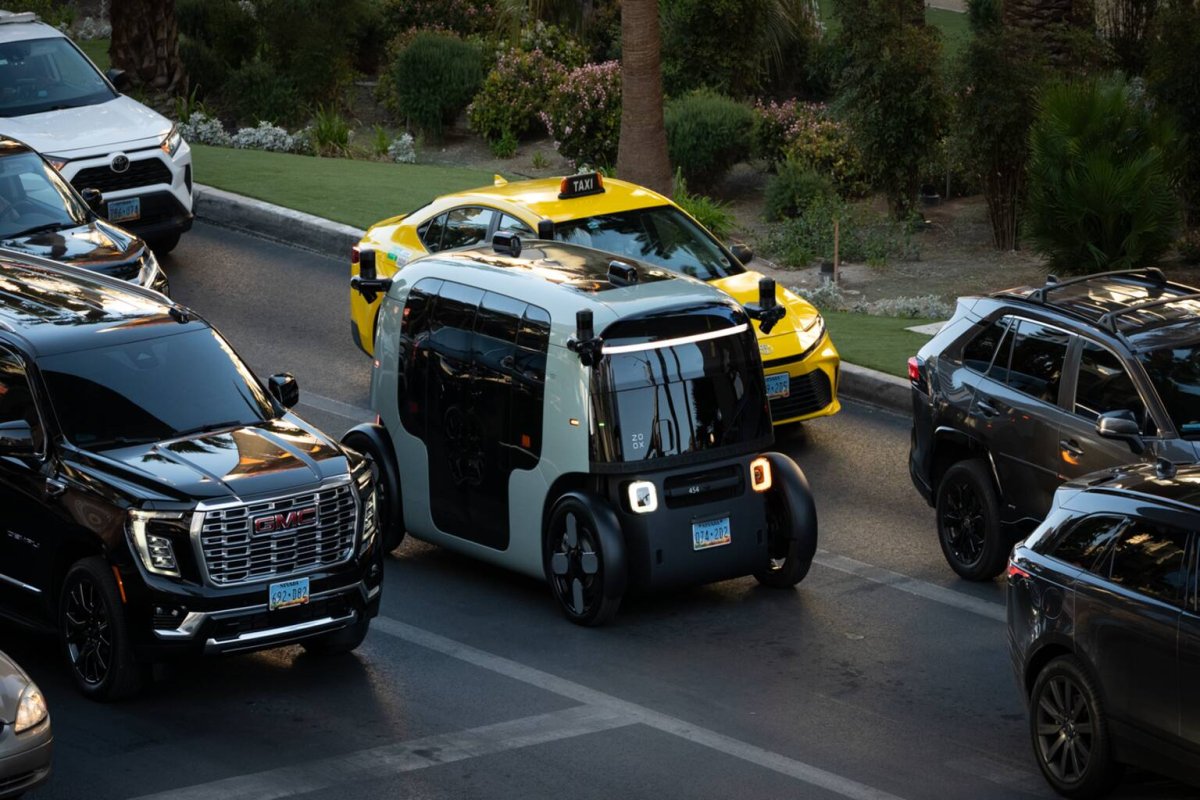
Amazon's autonomous vehicle subsidiary, Zoox, has transitioned from a research project to a commercial robotaxi service. On August 10, 2026, the company began charging passengers for driverless rides in Las Vegas, marking a significant milestone in the evolution of autonomous ride-hailing. The move follows a decade of development and extensive testing, positioning Zoox as a key player in the competitive autonomous vehicle market.
A Purpose-Built Vehicle
Unlike traditional automakers that add self-driving features to conventional cars, Zoox has designed its vehicle from the ground up for autonomous operation. The four-seat electric carriage lacks a steering wheel, pedals, and driver's seat. Its symmetrical design features two facing benches, allowing the vehicle to travel in either direction. Four-wheel steering enables it to pull away from curbs without a multi-point turn. The vehicle is engineered for speeds up to 75 mph, though operational limits vary by service area.
According to a June 2026 production update, the current model is equipped with 40 sensors, including cameras, radars, lidars, and infrared sensors. Sensor pods at each corner provide overlapping views of the street, ensuring redundancy. Cameras deliver color and visual detail, radar measures range and relative speed, lidar constructs a three-dimensional map, and infrared sensing aids low-light conditions. This multi-modal approach enhances detection but does not eliminate all misclassifications or unforeseen scenarios.
The AI Driving System
Zoox's autonomous driving software relies on high-definition three-dimensional maps created by its mapping teams. These maps include road networks with signals, signs, lanes, speed limits, and keep-clear zones. On the road, the robotaxi matches live sensor data against this reference, with localization calculating position and velocity up to 200 times per second.
The driving stack comprises three core functions: perception, prediction, and planning. Perception identifies vehicles, cyclists, pedestrians, signals, and free space. Prediction estimates how these actors might behave, while planning evaluates potential trajectories, balancing collision risk, traffic rules, progress, and passenger comfort. Zoox's Planner software updates the intended path several times per second, with a separate collision-avoidance layer reacting faster to immediate hazards.
Training and validation extend beyond public roads. By June 2026, Zoox had amassed over 10 million miles of real-world driving data. Engineers also modify recorded scenes and generate simulated scenarios, such as dense fog or a bus running a red light, before testing selected cases on a closed track. The company emphasizes that simulation must be paired with structured physical testing; a virtual pass does not guarantee real-world performance.
Human Oversight
Despite the absence of a driver, humans remain integral to operations. Mission Operations monitors fleet and vehicle health. When a robotaxi encounters unfamiliar closures or construction, a TeleGuidance operator can assess the scene and suggest a path. Zoox clarifies that this role provides context and guidance, not remote driving capability.
Commercial Launch and Expansion
Las Vegas is currently the only market where Zoox's purpose-built vehicles carry paying passengers. The company moved from free demonstrations to fares calculated from a base charge plus time and distance, with prices shown before booking. In September, service reached Harry Reid International Airport, connecting terminals with select Las Vegas Strip destinations.
Zoox is also operating or testing in San Francisco, Austin, and Miami, though local permissions and rider access differ. In March 2026, Zoox and Uber announced plans to integrate Zoox vehicles into Uber's platform, starting with eligible Las Vegas trips and expanding to Los Angeles in 2027. Zoox will continue to offer its own app.
Regulatory Framework
The commercial launch was enabled by a temporary exemption from the National Highway Traffic Safety Administration (NHTSA), granted on July 30, 2026. The exemption covers up to 2,500 vehicles per year for two years, with enhanced oversight. NHTSA acknowledged that the vehicle lacks equipment federal rules assumed a human driver would use, but allowed deployment under conditions. The agency also began a three-year effort to develop the first federal performance standards specifically for automated vehicles. The exemption is permission to operate, not a finding that autonomous driving is risk-free.
Scaling Challenges
A near-term limit is about to change. The Nevada Transportation Authority permit that capped Zoox at 100 robotaxis expires on September 25, 2026. Removing this ceiling permits growth, but it does not reveal how many vehicles Zoox can build, deploy, or keep productively occupied.
Zoox's vertical integration is both its wager and its burden. The company must manufacture a low-volume electric vehicle, validate an AI driver, run depots, charge and clean the fleet, support riders, and maintain enough utilization to make each machine economical. As Amazon (NASDAQ: AMZN) continues to invest in this ambitious venture, the success of Zoox will depend on its ability to scale operations while maintaining safety and efficiency in the competitive robotaxi market.