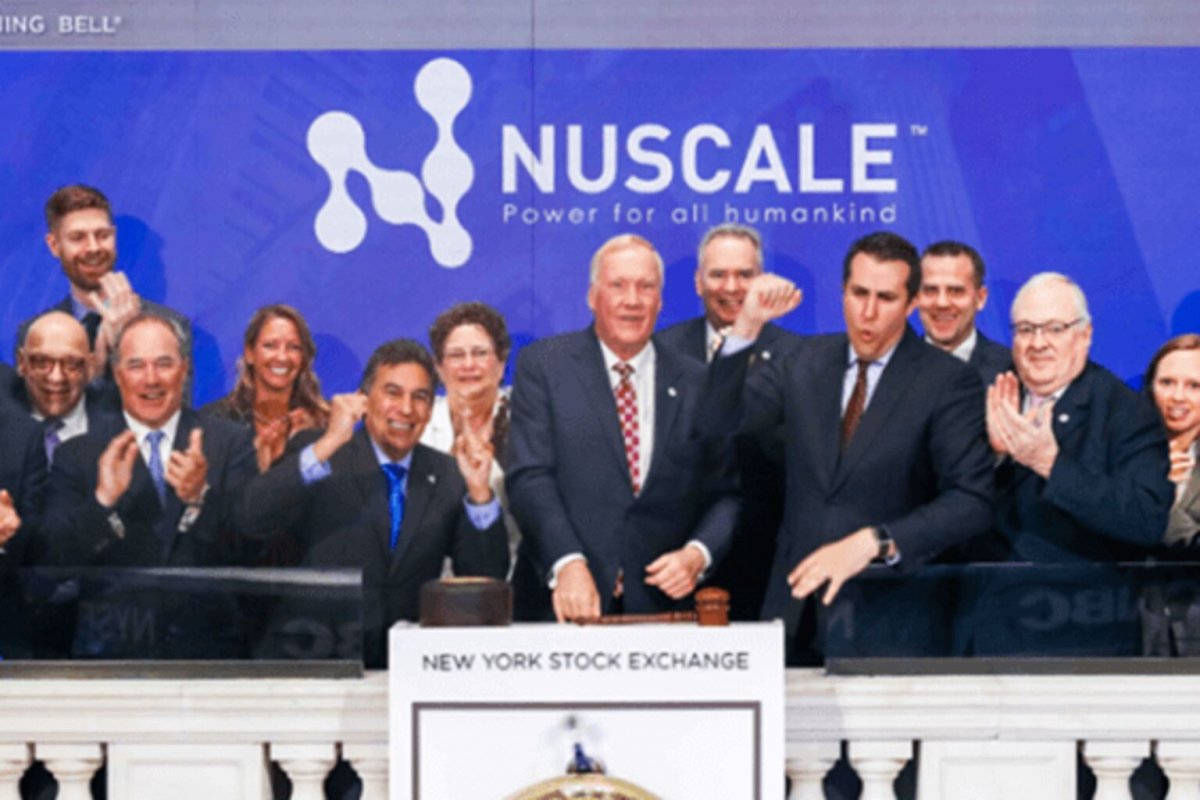
NuScale Power (SMR) shares experienced a sharp sell-off on Friday, closing at $8.61, down 15.67% after UBS issued a bearish downgrade. The investment bank cut its rating on the small modular reactor (SMR) developer to Sell from Neutral and reduced its price target to $6 from $10, according to The Fly. The new target implies an additional 30.3% downside from Friday's closing price, signaling that UBS believes the market is still pricing in too much optimism.
The downgrade was not a routine ratings change. Trading volume surged to 92.0 million shares, approximately 2.9 times the recent average, indicating significant investor reaction. The sell-off highlights a critical question facing SMR investors: how much should they pay for commercial execution before NuScale secures a binding power purchase agreement (PPA) and a concrete construction timeline?
Key Numbers Behind the Repricing
UBS’s bearish stance is grounded in a substantial gap between the company's current valuation and its near-term earnings potential. According to UBS analyst Jon Windham, the pre-downgrade share price implied a 2028 EBITDA of approximately $124 million, while the bank's own estimate stands at just $29 million. This $95 million discrepancy suggests that investors were discounting a much faster conversion of regulatory approvals and partnerships into revenue than UBS expects.
NuScale reported $1.893 billion in liquidity as of June 30, 2026, which provides a substantial runway. However, UBS projects a cumulative cash burn of roughly $700 million from 2026 to 2028, which would consume about 37% of that liquidity pool. The company's second-quarter financials showed just $75,000 in revenue, down from $8.1 million a year earlier, and an operating loss of $64.0 million. These figures underscore that while liquidity buys time, it does not yet validate the company's commercial prospects.
Valuation Gap and Market Implications
Friday's decline narrowed the valuation gap but did not eliminate it. Using NuScale's fully diluted share count of 439.1 million and the $8.61 closing price, the company's diluted equity capitalization stands at approximately $3.78 billion. Subtracting the June liquidity pool leaves roughly $1.89 billion of equity value beyond those liquid resources. This simplified comparison, which ignores liabilities and future capital needs, shows how much of the current price still rests on the assumption that the reactor platform will become a commercial fleet.
UBS’s bearish case is further supported by the competitive landscape. Rivals are moving toward construction, while NuScale faces an estimated timeline of more than five years and still lacks firm customer commitments. The bank now assumes only one NuScale project will begin construction in 2028, a conservative outlook compared to the market's earlier expectations.
Liquidity and Dilution Concerns
NuScale's balance sheet is a double-edged sword. The $1.9 billion cash and investments provide a strong buffer against near-term financing concerns, even under UBS's cash-burn projections. However, the company has also registered an at-the-market (ATM) program for up to $750 million of Class A shares, which gives management flexibility but also poses dilution risk if shares are sold before contracts materialize.
The company's Q2 report showed operating cash usage of $372.9 million in the first half of the year, further emphasizing that liquidity is a bridge to commercialization, not proof of it. Investors are demanding evidence of commercial progress, and the current financials do not yet provide it.
Potential Catalysts and Counterarguments
Despite the bearish outlook, NuScale has notable assets that could break the negative narrative. Its 77-megawatt module has received U.S. Nuclear Regulatory Commission standard design approval, it uses conventional low-enriched uranium fuel, and it lists more than 60 supply-chain partners. These elements could shorten the path to commercialization once a customer commits.
Specific catalysts include ongoing discussions between NuScale's strategic partner ENTRA1 and the Tennessee Valley Authority regarding a power purchase agreement, as well as the Romania's RoPower project progressing through next-phase conditions. A binding PPA, funded site work, a construction authorization, or a durable stream of engineering revenue would force investors to reassess UBS's assumption of only one project in 2028.
Until then, NuScale remains a contract-timing trade as much as a nuclear technology investment. Friday's 15.7% drop made the stock less demanding, but it did not remove the burden of proof embedded in a multi-billion-dollar valuation. Investors will be watching closely for any signs of commercial traction in the coming quarters.