Nvidia Corporation's shares showed minimal movement in Tuesday's premarket trading, inching up just 0.13% to $175.87. This follows a Monday close at $175.64, which represented a 1.7% gain for the session. The subdued price action underscores a broader market hesitation, with the semiconductor giant's stock still trading approximately 17% below its 52-week peak of $212.19 reached last year.
Supply Chain Headwinds Persist
Fresh reports from Asia highlight ongoing manufacturing constraints that continue to challenge the AI chip ecosystem. Broadcom's Natarajan Ramachandran indicated that Taiwan Semiconductor Manufacturing Company (TSMC) is operating at capacity limits, describing the situation as having "kind of choked" supply chains throughout 2026. TSMC has previously identified Nvidia among the clients placing significant pressure on its advanced production lines. These constraints come as demand for high-performance computing components shows no signs of abating.
China Market Complications
Geopolitical factors present another layer of complexity for Nvidia's growth trajectory. A U.S. congressional advisory body warned Monday that China's development of open-source artificial intelligence models is creating a "self-reinforcing competitive advantage" despite American semiconductor export restrictions. While Washington has blocked China from accessing the most advanced AI chips since 2022, exports of Nvidia's second-most advanced chip were approved this past December.
Nvidia is actively working to rebuild its business presence in the Chinese market. Chief Executive Jensen Huang revealed last week that the company has restarted manufacturing its H200 chip variant specifically for China after receiving customer orders. Notably, revenue from these China-specific products is not included in Huang's forecast of over $1 trillion in sales opportunities through 2027 for the company's Blackwell and Rubin architecture systems.
Robust Financial Performance and Shareholder Returns
Nvidia's fundamental financial metrics remain exceptionally strong. The company reported fiscal 2026 revenue of $215.9 billion with net income reaching $120.1 billion. During the same period, Nvidia returned $41.1 billion to shareholders through buybacks and dividends, with an additional $58.5 billion remaining under its current share repurchase authorization. These figures underscore the company's dominant position in the AI hardware market and its commitment to capital returns.
Expanding AI Infrastructure Vision
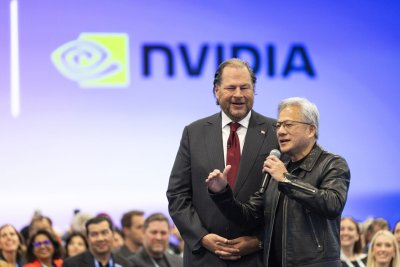
Beyond processor sales, Nvidia is advancing a broader ecosystem strategy. The company announced Monday collaborations with major energy providers including AES, Constellation, Invenergy, NextEra, Nscale, and Vistra to develop large-scale AI data centers—termed "AI factories"—designed for faster grid connectivity. "AI factories are the engines of the intelligence era," Huang stated, emphasizing the infrastructure component of the company's growth narrative.
Energy sector executives are aligning with this vision. Constellation CEO Joe Dominguez noted that data centers could help manage electrical grid demand through responsive load management, suggesting, "We don't have a supply problem—we have a peak problem." This partnership approach aims to address one of the critical constraints facing AI expansion: power availability.
Upstream Supply Chain Investment
Evidence of sustained demand appears throughout Nvidia's supply chain. South Korean memory chipmaker SK Hynix, a crucial supplier of high-bandwidth memory (HBM) modules that stack closely with AI processors to accelerate data transfer, has committed to purchasing $7.97 billion worth of equipment from Dutch semiconductor equipment manufacturer ASML. This investment supports SK Hynix's plans to expand advanced chip production capacity through 2027, indicating confidence in long-term AI hardware demand.
Market Context and Competitive Landscape
Monday's trading session provided mixed signals for semiconductor investors. While Nvidia saw moderate gains of 1.70% on volume of 182.84 million shares, competitor Broadcom surged 4.08%. The broader technology indices also outperformed, with the S&P 500 and Nasdaq Composite advancing 1.15% and 1.38%, respectively. This divergence suggests investors may be rotating within the semiconductor sector rather than abandoning the AI theme entirely.
Risk Factors and Valuation Considerations
Despite overwhelming demand signals, Nvidia's stock valuation appears to reflect significant risk premiums. Market participants remain concerned about potential tightening of export controls and the possibility that component shortages could extend beyond foundry capacity to include lasers and printed circuit boards—a scenario Broadcom has specifically warned about. This could create a disconnect between recorded orders and actual delivery timelines, a challenge Nvidia has navigated previously.
The current stock price suggests investors are not fully pricing in a best-case scenario for the AI pioneer. With shares still trading substantially below last year's highs despite Tuesday's modest uptick, the market appears to be balancing Nvidia's extraordinary financial performance against tangible operational and geopolitical risks that could impede growth realization in the coming quarters.