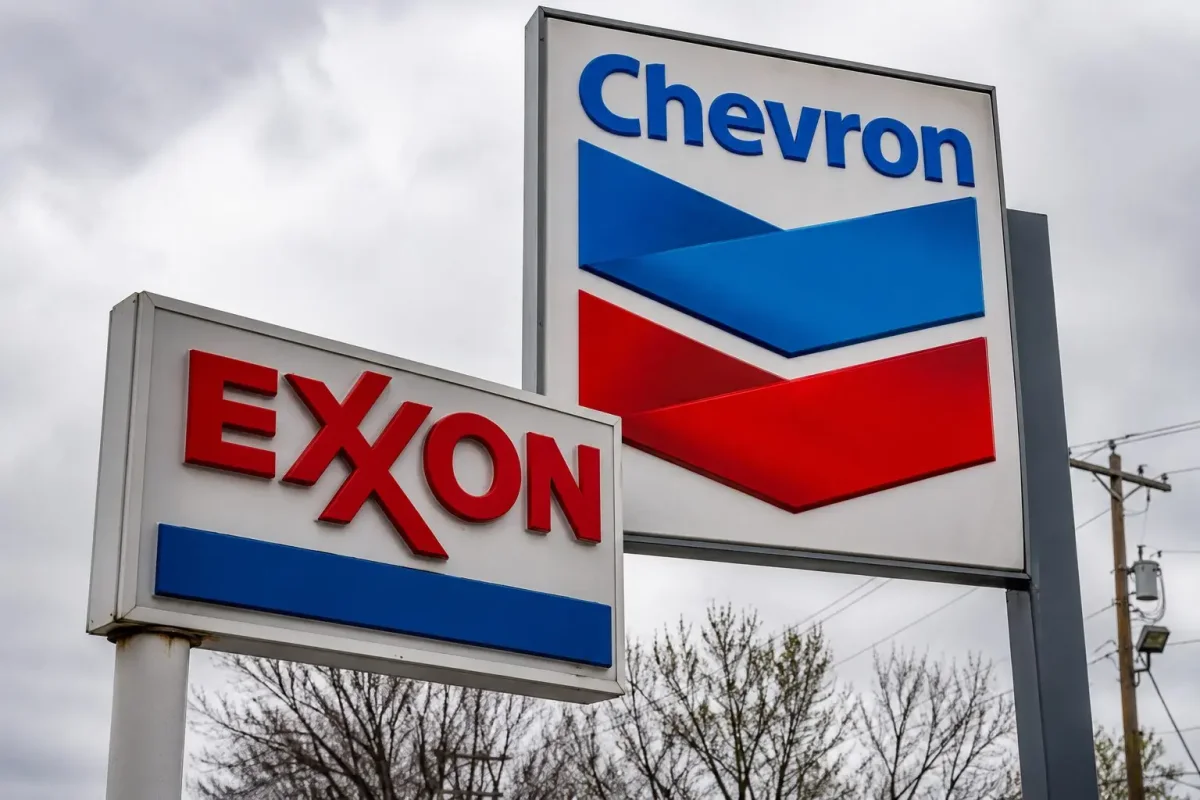
Houston, July 13, 2026 – Shares of major oil companies and refiners rallied sharply on Monday, driven by expectations of a blockbuster second-quarter earnings season fueled by robust fuel margins and ongoing geopolitical tensions. Marathon Petroleum (NYSE:MPC) and Valero Energy (NYSE:VLO) each jumped about 3.8% in late-morning trading, while Exxon Mobil (NYSE:XOM) added 3.4% and Chevron (NYSE:CVX) rose 2.2%. The gains outpaced a 4% rise in Brent crude, which topped $79 a barrel after President Donald Trump announced the U.S. would reinstate its naval blockade of Iran.
The market action underscores a critical shift: the primary earnings driver for the sector is no longer just the crude rally but significantly stronger refining margins. Analysts polled by LSEG expect Exxon and Chevron to collectively post $25.8 billion in adjusted net income for Q2, stripping out one-time items. That figure would be more than triple their combined profit in the first quarter. According to Tudor, Pickering, Holt & Co. (TPH), average U.S. gasoline crack spreads for the quarter were around $25 per barrel, up $16 from Q1, while diesel spreads jumped $15 to $45 per barrel.
Exxon's Earnings Picture: Headline vs. Adjusted
Exxon's headline net profit figure could warrant closer scrutiny. The Financial Times estimates the company's net profit at roughly $19 billion, but on an adjusted basis, that figure is around $15.9 billion. An Exxon filing revealed $2.2 billion to $3 billion in positive “timing effects” from energy products, partially offset by writedowns and other charges. These effects arise when derivatives are marked to market immediately, while profits from the actual cargoes are booked later, typically reversing over time.
Record Crack Spreads and Tight Inventories
Operating margin numbers tell a clearer story. The U.S. 3-2-1 crack spread, which tracks the margin from turning three barrels of crude into two barrels of gasoline and one barrel of diesel, hit an all-time high of $64.58 a barrel on July 8. European diesel margins also surged above $60. U.S. gasoline inventories are at their lowest for early July since 2021. “There’s just not enough refining capacity left globally to deal with all this,” said Neil Crosby, an analyst at Sparta Commodities.
Physical Bottlenecks and Geopolitical Risks
Physical bottlenecks are back in play. Kpler tracked just six vessels through the Strait of Hormuz on Sunday, the fewest in five weeks, and not a single LNG tanker transited over the weekend. Overall oil and gas tanker flows dropped to their lowest since May 25, with some vessels going dark by switching off their trackers. This disruption is adding a risk premium to fuel prices.
However, crude's medium-term outlook is already weakening. OPEC trimmed its 2026 demand-growth forecast by 190,000 barrels per day to 780,000. OPEC+ output in June climbed by around 3 million barrels per day. The International Energy Agency reported global supply grew by 4.1 million barrels per day and stocks rose by 21 million barrels. A steady reopening of the Strait of Hormuz could drag crude prices lower more quickly than fuel margins, at least while product stocks remain low.
Political and Price Pressures
Political risks are also mounting. U.S. regular gasoline stands at $3.872 a gallon, up 7.5 cents from last week and 71.9 cents higher than a year ago, according to AAA. That is 55% above Trump's stated goal of $2.50, with U.S. refiners moving record export volumes. Trump on Monday floated a 20% reimbursement fee for all cargo transiting Hormuz but did not specify how it would be implemented. “Investors will see returns, governments will see red,” said Kevin Book at ClearView Energy Partners.
The refinery trade can reverse quickly. If a solid ceasefire emerges, tanker traffic normalizes, and late-summer demand drops, crack spreads could tighten. Conversely, if the closure drags on, crude supply to plants could become thin, shipping and insurance costs could rise, and Gulf Coast assets could take a hit. In either scenario, fuel prices above $4 a gallon could push the U.S. closer to export limits or windfall taxes.
Earnings season will reveal whether the second quarter was a one-off for cash returns or a sustainable trend. Exxon is expected to post adjusted profit of about $16 billion, though the headline could reach $19 billion. For Marathon and Valero, the key question is how long record fuel margins can persist.