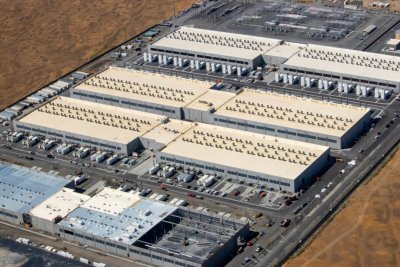
Oracle Corporation witnessed a significant rally in its share price on Wednesday, March 11, 2026, climbing 9.7% to close at $163.83. The surge was propelled by the company's announcement of an ambitious new revenue target and another quarter of powerful financial performance, largely fueled by its artificial intelligence and cloud computing segments.
Revised Outlook and Quarterly Performance
The technology giant announced it is raising its fiscal 2027 revenue goal to $90 billion, a substantial upward revision that captured investor optimism. For the quarter ended February 28, Oracle reported revenue of $17.19 billion, representing a 22% year-over-year increase. Non-GAAP earnings per share came in at $1.79. Company officials highlighted that this period marked the first time in over 15 years that both organic revenue and adjusted EPS grew by at least 20% in U.S. dollars.
Cloud services were the standout performer, with total cloud revenue soaring 44% to $8.9 billion. Within that segment, Oracle Cloud Infrastructure (OCI) revenue exploded by 84%. Furthermore, revenue from multicloud database services skyrocketed by an extraordinary 531%.
AI Contracts and Financial Backlog
A key driver behind the optimism is Oracle's growing pipeline of AI-related business. The company disclosed that many of its recent major AI contracts involve customers either paying upfront or supplying their own graphics processing units (GPUs). This structure allows Oracle to scale its capacity and recognize growth while mitigating a significant portion of the initial capital expenditure.
This momentum is reflected in the company's remaining performance obligations (RPO), which represent contracted revenue not yet recorded. The RPO backlog ballooned by 325% year-over-year to reach $553 billion, providing a substantial and visible runway for future revenue.
Funding and Capital Expenditure Plans
Despite the aggressive growth, Oracle maintained its capital spending forecast for fiscal 2026 at $50 billion. The company had previously indicated in February that it might need to raise up to $50 billion through debt and equity to fund its AI expansion. As of this week's report, Oracle stated it has already secured $30 billion toward that goal. Executive Clay Magouyrk noted that margins on AI chip rentals are between 30% and 40%, with database services being even more profitable.
However, risks remain on the horizon. Oracle acknowledged potential headwinds from semiconductor supply constraints, data-center capacity limits, and broader geopolitical issues like tariffs and trade tensions. Analysts from Morgan Stanley pointed out that investors are still seeking more concrete evidence that Oracle's AI chip leasing strategy will meaningfully boost earnings and free cash flow.
Market Context and Competitive Landscape
The quarterly results were described by eMarketer's Jacob Bourne as "a stress test result for the AI trade." Oracle continues to compete aggressively in the cloud infrastructure race against larger rivals like Amazon Web Services (AWS) and Microsoft Azure. Its strategy includes building data centers for major AI players, including OpenAI and Meta Platforms.
On the software front, executives addressed concerns that AI-powered coding tools could erode demand for traditional software-as-a-service (SaaS). Co-founder Larry Ellison dismissed these worries, asserting that a "SaaS-apocalypse applies to others but not to Oracle." The company added it is leveraging AI code generation to develop software more efficiently with smaller teams.
Forward Guidance and Investor Focus
Looking ahead, Oracle provided guidance for the current quarter. It expects adjusted earnings per share in the range of $1.96 to $2.00. Revenue is projected to increase by 19% to 21% in U.S. dollars, with cloud revenue anticipated to grow between 46% and 50%.
The impressive stock move, which saw shares touch an intraday high of $171.60 before settling, underscores the market's positive reception to Oracle's AI narrative and execution. The next critical hurdle for the company will be demonstrating that this explosive growth can translate into sustained and improved profitability, moving beyond top-line expansion to bottom-line results that satisfy analyst and investor expectations.