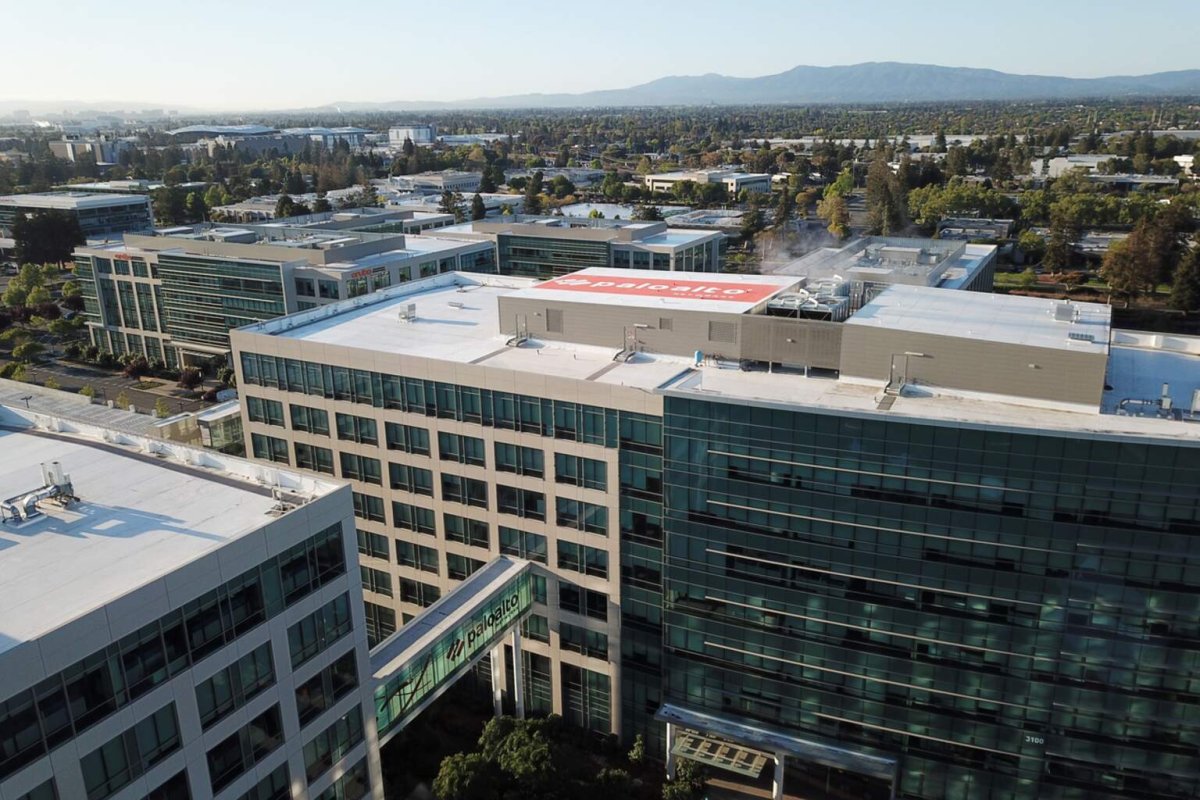
Palo Alto Networks (PANW) shares surged 12.37% to $371.54 by midday Monday, pushing the cybersecurity giant's market capitalization to roughly $304 billion. The gain, though significant, came without any company-specific news, as the broader cybersecurity sector rallied sharply. CrowdStrike (CRWD) climbed 14.75%, Zscaler (ZS) jumped 15.02%, and Okta (OKTA) rose 10.72% at the same time, according to Nasdaq data.
The coordinated advance suggests investors are repricing the sector after a volatile two-week stretch for software stocks. For Palo Alto, the rally raises the bar for its fiscal 2027 targets. At the current price, the company trades at roughly 21.5 times the midpoint of its fiscal 2027 revenue guidance of $14.10 billion to $14.20 billion. That multiple, based on the basic share count of 818 million shares, leaves little room for error.
Strong Growth, but Deceleration Ahead
The company's latest quarterly results, reported on September 1, showed robust momentum. Fourth-quarter revenue rose 34% year-over-year to $3.41 billion. Next-Generation Security (NGS) annual recurring revenue (ARR) grew 63% to $9.10 billion, while remaining performance obligations increased 34% to $21.2 billion. Management guided for fiscal 2027 revenue growth of 23% to 24%, NGS ARR growth of 22% to 23%, and an adjusted free-cash-flow margin of 38%.
However, the NGS ARR growth rate is expected to decelerate sharply from the acquisition-boosted 63% reported in the fourth quarter. Investors will need to see organic platform adoption and successful integration of CyberArk to sustain growth as the comparison normalizes. The company's long-term goal is $20 billion in NGS ARR by fiscal 2030, with the fiscal 2027 midpoint of $11.125 billion representing just over half that target.
Cash Flow Strong, but GAAP Gap Widens
Palo Alto's cash generation remains a bright spot. In fiscal 2026, the company produced $4.55 billion in operating cash flow and reported $4.11 billion in non-GAAP free cash flow, before a headquarters adjustment. Yet, the fourth quarter saw a GAAP net loss of $282 million versus non-GAAP net income of $853 million. Share-based compensation charges totaled $487 million for the quarter, and acquisition-related costs widened the gap further. While the cash economics are attractive, shareholders should not ignore the growing divergence between GAAP and adjusted metrics.
Buyback capacity is limited relative to the company's size. Palo Alto's fiscal 2026 Form 10-K shows just $1.0 billion remaining under its repurchase authorization as of July 31, a mere 0.3% of Monday's estimated market value. The company also issued 27 million net shares, valued at $5.6 billion, to settle 2025 warrants during the year.
Valuation Demands Execution
The bullish case for Palo Alto rests on its ability to deliver on guided revenue growth of 23% to 24% while maintaining a 38% adjusted free-cash-flow margin. If the company hits those numbers and successfully expands its platform, the premium valuation may be justified. However, the counterargument is the price itself. After Monday's jump, any modest miss on fiscal 2027 NGS ARR, weaker integration economics, or a larger-than-expected GAAP-to-adjusted profit gap could trigger a rapid multiple compression.
The next catalyst will not be another sector-wide trading day. Investors should watch first-quarter NGS ARR results, expected to land between $9.54 billion and $9.56 billion, as a key indicator of whether the company can sustain its growth trajectory. Until then, the market's enthusiasm may be ahead of the fundamentals.