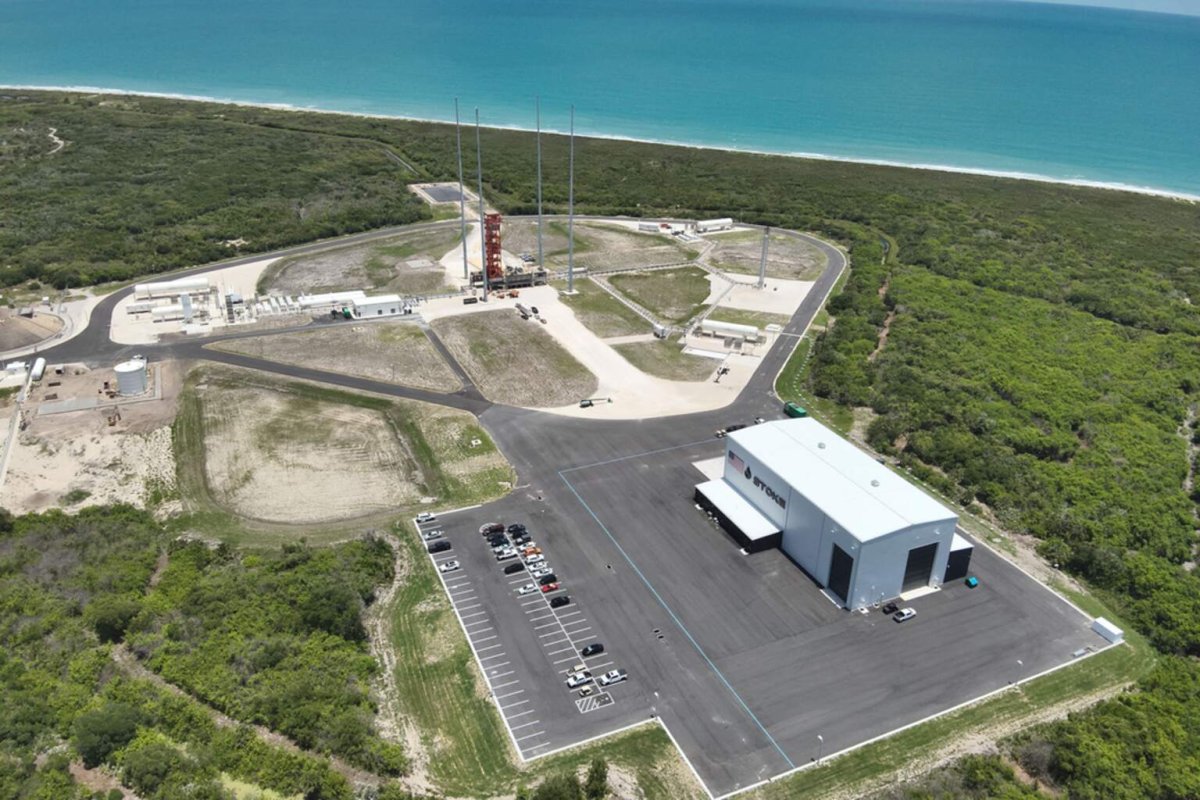
The U.S. Department of Defense has signaled its support for Stoke Space's ambitious expansion plans with a conditional loan commitment of $150 million. The announcement, made on Monday, October 26, 2026, is earmarked for the construction of a second launchpad at Cape Canaveral Space Force Station. This infrastructure is intended to accommodate the company's upcoming Nova Block 2 rocket, a significantly larger vehicle compared to its predecessor, the Nova Pathfinder.
Stoke Space, a relatively young player in the commercial space sector, has been making strides with its fully reusable rocket designs. The Nova Block 2 is designed to carry up to 15,000 kilograms to low Earth orbit (LEO) in a fully reusable configuration, a six-fold increase over the Pathfinder's advertised 2,500-kilogram capacity. However, the company notes that flight conditions for these ratings may differ, and both figures represent planned capabilities rather than demonstrated performance.
The new launchpad will be dedicated to supporting the Block 2 vehicle, while the existing infrastructure will continue to serve the Pathfinder. Stoke Space has set ambitious timelines: the Pathfinder's first flight is targeted for early 2027, with Block 2 following in 2029. Neither rocket has yet achieved orbital flight, which separates the financing announcement from actual operational launch capacity.
The technical differences between the two rockets are substantial. The Block 2 booster will be powered by 14 Zenith engines, double the seven used on the Pathfinder. Both engines run on liquefied natural gas and liquid oxygen. The upper stage of the Block 2 also undergoes significant changes, featuring cylindrical propellant tanks, a five-meter payload fairing, and 12 independent engine units, each with two thrust chambers. This contrasts with the Pathfinder's shared turbopump design. Both vehicles will use liquid hydrogen to cool their metallic heat shields during reentry, a critical technology for reusability.
The federal loan follows Stoke's recent Series E funding round, which saw an initial closing of $1 billion on September 8, 2026. The company has raised a total of $2.3 billion in private capital to date. The proposed federal loan represents 15% of that private round, though it remains subject to closing conditions, including financial, legal, and technical reviews. The Department of Defense's release did not disclose interest rates, loan maturity, or the total cost of the second pad, making it difficult to assess the loan's share of project spending.
Jordan Sebold, Senior Managing Director for Investments at the Office of Strategic Capital, commented on the loan, stating, "This conditional commitment would enable Stoke Space to scale its Cape Canaveral infrastructure and facilities efficiently." The company's September development plan already includes a payload-processing facility designed for both rockets, critical ground equipment for Block 2 on order, and an offshore recovery platform intended to support both vehicles. These shared investments complement the proposed new launchpad.
Despite the positive momentum, significant risks remain. Stoke Space must demonstrate orbital flight, recovery, and repeated operation to establish dependable launch capacity. The company's September plan calls for multiple Pathfinder missions during 2027 and 2028 to generate operational data for Block 2. The next milestone is financial close, though no date was provided in Monday's announcement.
For investors, this conditional loan highlights the growing interest of the U.S. government in fostering commercial space capabilities. The space sector has seen increased private and public investment as launch costs decline and demand for satellite deployment grows. Stoke Space's focus on full reusability could position it as a key player in the market, but execution will be critical. The company's stock, if publicly traded, would be closely watched, but as of now, it remains a private entity.
