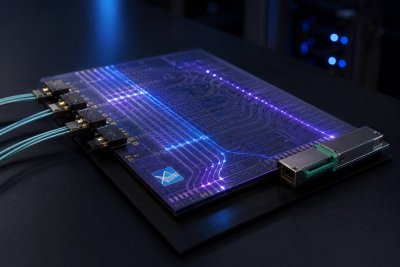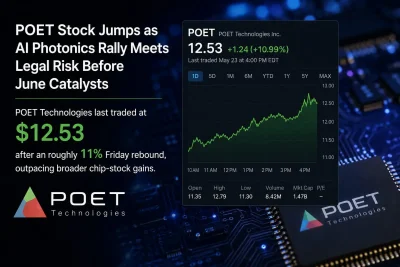
POET Technologies Inc. experienced a decline in its stock price on Tuesday, closing down 8.02% at $13.07 on the Nasdaq, even after the company successfully completed a $400 million financing arrangement. The Toronto-based photonics company, which specializes in photonic integrated circuits (PICs) that use light rather than electricity for data transmission, is in a critical expansion phase to meet the growing demands of artificial intelligence and hyperscale data centers.
The financing deal, which closed on Monday, involved the issuance of 19,047,620 common shares and an equivalent number of warrants to institutional investor MMCAP International Inc. SPC. Each share-and-warrant unit was priced at $21, and the warrants entitle the holder to purchase additional shares at $26.25 over a three-year period. According to a filing with the U.S. Securities and Exchange Commission, POET expects net proceeds of approximately $399.7 million after expenses, with no placement agent involved in the transaction.
CEO Suresh Venkatesan stated that the company is planning to expand its wafer production and optical-engine assembly capacity by roughly tenfold as it gears up for manufacturing ramp-up into 2027. Optical engines are key components that convert electrical signals into light and back, enabling efficient data movement within servers. The company's focus is on scaling production to support its growing customer base.
The stock's decline reflects ongoing investor concerns about dilution from the share issuance and execution risks. The broader Nasdaq composite index dropped 0.8% on Tuesday, marking its third consecutive losing session, but POET's slide was more pronounced, indicating company-specific headwinds. The market is closely watching for signs of revenue growth and operational milestones.
POET's financial performance remains modest. In the first quarter, the company reported non-recurring engineering and product revenue of $503,389, up from $166,760 in the same period last year, but still relatively small. The net loss for the quarter was $12.3 million. Non-recurring engineering revenue comes from one-time development projects rather than recurring product sales.
A significant commercial opportunity lies with Lumilens. Last week, POET announced that Lumilens placed an initial $50 million order for electrical-optical interposer-based engines, with the potential for the deal to grow to more than $500 million over five years. The first engineering samples are targeted for late 2026, with production expected to ramp as hyperscale data center operators deploy equipment in 2027. However, actual delivery depends on development, product qualification, and manufacturing scale-up.
Lumilens CEO Ankur Singla described GPU interconnects as the "defining bottleneck for scaling AI," while POET's co-founder Venkatesan noted the deal could bring "semiconductor-style manufacturing discipline" to optical engines. These statements underscore the long-term promise, but the market remains focused on near-term execution.
POET faces competition from established players such as Coherent and Lumentum, which already have high-speed optical transceivers on the market targeting AI and cloud data centers. Coherent is shipping 800G transceivers in production, while Lumentum offers 800Gbps and 1.6Tbps modules. POET's ability to capture market share will depend on its technology differentiation and production ramp.
Key risks for POET include potential loss of the Lumilens order, inability to replace the lost Marvell Semiconductor business, and production delays. The company's new cash infusion may only delay challenges if sales fail to materialize. Investors are now looking for evidence of shipments, qualification milestones, and recurring revenue rather than financing news.