Shares of POET Technologies (POET) slid roughly 10% in early trading Friday, as investors weighed the implications of a significant capital raise against the backdrop of a major new customer order. The stock was last seen trading at $18.47, down 10.2% from Thursday's close, according to data from Markets Insider.
Financing Details
The company announced a registered direct offering of 19,047,620 common shares, each paired with a warrant to purchase additional shares. The units are priced at $21 each, a premium to Thursday's Nasdaq close of $20.57. The warrants, exercisable at $26.15, have a three-year term. The sole institutional investor in the deal is purchasing all units directly from POET, bypassing traditional broker intermediaries.
Proceeds from the offering, totaling approximately $400 million, are earmarked for manufacturing infrastructure, targeted acquisitions, research and development, the company's light-source business, and general working capital. The financing provides POET with substantial capital to scale its operations, but it comes at the cost of significant dilution for existing shareholders.
Lumilens Order and Strategic Context
The capital raise follows Thursday's announcement that Lumilens had placed an initial $50 million order for POET's electrical-optical interposer (EOI) engines. POET indicated that this relationship could expand to over $500 million over five years. In conjunction with the order, POET issued Lumilens a warrant for up to 22.9 million shares at $8.25 each, contingent on future purchase milestones.
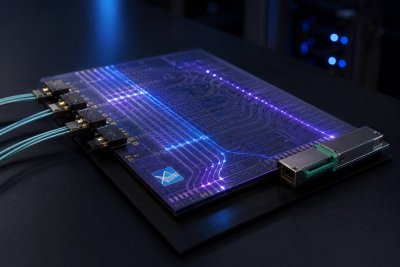
POET's EOI technology is designed to combine electrical and photonic components in a single manufacturing flow, targeting faster data movement within AI infrastructure. Lumilens CEO Ankur Singla noted that GPU interconnects remain a key bottleneck for AI scaling, while POET CEO Suresh Venkatesan emphasized the collaboration's potential to bring semiconductor-style manufacturing discipline to optical engines.
Execution Risks and CFO Transition
Despite the positive order news, the company faces execution risks. POET noted that actual fulfillment and revenue from the Lumilens order depend on successful development, qualification, and manufacturing scale-up. Engineering samples are expected late this year, with full production tied to hyperscaler rollouts in 2027.
Adding to investor unease, the company disclosed that longtime CFO Thomas Mika plans to retire this year. The board has initiated a search for his replacement, creating another element of uncertainty during a critical growth phase.
Financial Performance and Recent Challenges
POET's first-quarter results provided little relief. The company reported revenue of $503,389 and a net loss of $12.3 million, or 8 cents per share. Operating cash flow decreased by $8.8 million. The company's path to profitability remains uncertain as it transitions from development-stage to production-stage operations.
The stock has been volatile in recent months. In late April, POET disclosed that all purchase orders from Celestial AI had been canceled after Marvell, Celestial's new parent, cited confidentiality violations. POET maintained it still holds a separate $5 million purchase order from another technology client.
Market Implications
The financing, while strengthening POET's balance sheet, introduces a sizable overhang of potential future dilution from both the new warrants and those issued to Lumilens. Any production delays, revenue shortfalls, or management missteps could exacerbate the stock's downward pressure.
POET operates in the competitive AI optical networking space, facing established players like Coherent and Lumentum, which offer advanced optical transceivers and laser solutions for hyperscale data centers. The company's success hinges on its ability to execute on its manufacturing ramp and secure additional customer commitments.
For now, investors are parsing the dual signals: a substantial capital infusion that enables growth, but at the direct expense of current shareholders' stakes. The stock's decline reflects the market's focus on the immediate dilution impact rather than the longer-term strategic benefits of the financing.