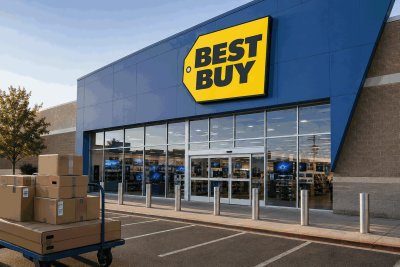
Pokémon's 30th-anniversary trading card release created a rare physical retail spectacle: customers lined up outside Best Buy stores before opening hours. On September 16, queues snaked around Best Buy, Target, and Walmart locations in New Jersey, with similar scenes reported in Phoenix, San Antonio, and Mobile. This collector frenzy provided a tangible test of in-store traffic for Best Buy, just weeks after the company highlighted trading cards as one of its fastest-growing merchandise categories.
Best Buy deliberately made the first wave of anniversary products physical-only. Its Pokémon landing page listed the September 16 items as in-store only, with limited quantities and available while supplies lasted. The $49.99 Elite Trainer Box, $14.99 Poster Collection, and other launch items were not high-ticket electronics, but scarcity gave shoppers a compelling reason to visit bricks-and-mortar stores. Best Buy's stock closed at $92.45 on Wednesday, up 4.95% from the previous close, though that move cannot be solely attributed to Pokémon.
The release day provided evidence that preorders could not: people actually showed up. News 12 New Jersey found shoppers who had camped overnight or visited multiple stores, and an independent card shop described the set as its most anticipated release. Axios Phoenix reported intense demand across Arizona, with collectors seeking inventory at smaller shops after the initial rush. This is a new fact beyond pre-launch resale premiums and product listings—it is proof of real-world demand.
Best Buy had prepared for this audience. The company said 225 stores hosted an August 29 Trade & Play event with three-card packs and other giveaways, followed by nationwide display takeovers beginning August 31. Its official event notice named the Poster Collection, Elite Trainer Box, and Tech Sticker Collection among the products stores would carry as they released.
However, the inventory strategy limits what can be inferred. Best Buy has not disclosed unit allocations, sell-through rates, average basket size, or how many customers purchased items beyond cards. A long line can indicate unmet demand, but it can also reflect intentionally small shipments. The $49.99 box would need enormous volume to meaningfully impact Best Buy's $42.3 billion to $42.8 billion fiscal-year revenue forecast.
Despite the scale question, trading cards already contribute to Best Buy's sales mix. In its second-quarter results, the company said computing, home theater, and emerging categories such as AI glasses and trading cards were the largest weighted drivers of comparable-sales growth, while traditional gaming declined. Enterprise comparable sales rose 4.1%, domestic comparable sales gained 4.5%, and quarterly revenue reached $9.78 billion.
This context explains the investor relevance. Collectibles can attract younger shoppers and drive repeat visits to a chain still exposed to long replacement cycles for televisions, appliances, and computers. Best Buy also gains opportunities to sell accessories or convert a scarce-product visit into membership and marketplace activity. The strongest confirmation would be a third-quarter disclosure that trading cards again contributed materially to comparable sales, not just that launch inventory sold out.
For Nintendo investors, the connection is indirect. The Pokémon Company is private, and Nintendo owns 32% of the voting rights, accounting for it as an equity-method associate. Nintendo does not book every dollar a U.S. retailer collects for a card box. Nintendo reported ¥82.79 billion of total equity-method profit for the year ended March 2026, up from ¥35.13 billion, but its results do not isolate Pokémon card revenue. For Nintendo shareholders, the anniversary set underscores the franchise's licensing and merchandise reach. For Best Buy shareholders, the cleaner near-term measure is whether the lines produce sustained store visits after the initial limited shipment is gone.