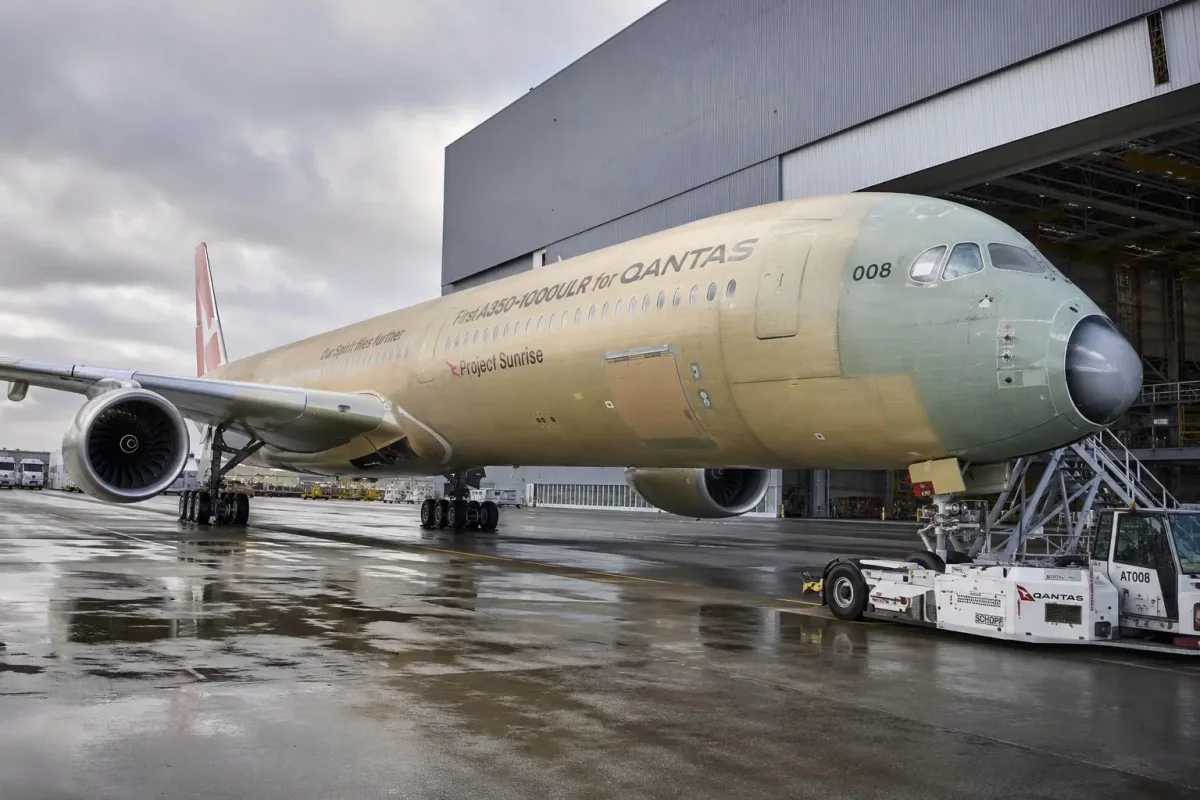
Qantas (ASX:QAN) has achieved a significant milestone in its Project Sunrise initiative, as an Airbus A350-1000ULR completed a record-breaking 23,075-kilometer flight lasting 24 hours and 24 minutes. The test, which took off from Melbourne and landed in Toulouse, France, demonstrates the aircraft's ability to operate non-stop routes like Sydney to London. However, the focus now shifts from engineering validation to commercial execution, as the airline's strategy relies heavily on selling premium seats at premium prices.
Record-Breaking Flight
The A350-1000ULR, configured with 238 seats, flew 164 minutes longer than the planned Project Sunrise customer mission and surpassed Boeing's 2005 distance benchmark by 6.8%. Airbus test pilot Xavier Pepin confirmed the tank was filled to validate all necessary parameters during the mission. This was a development test rather than certification, testing fuel management, cabin conditions, and crew-rest systems.
Premium Cabin Focus
The aircraft allocates 41.2% of its capacity to premium cabins, with 98 seats in first, business, and premium economy combined. This is a significant shift from Qantas's other long-haul aircraft. For comparison, the 787-9 has 70 premium seats (29.7% of total) and the A380 has 144 premium seats (29.7% of total). The Project Sunrise A350-1000ULR carries only two more passengers than the 787-9 but adds 28 premium seats, increasing premium seating by 40% while total seats rise just 0.8%. Economy seating falls 15.7%. Qantas management is betting that the time savings from non-stop flights will command higher fares, particularly on routes like Sydney-London, which currently see roughly 20% higher fares than one-stop alternatives.
Market Performance
Qantas shares closed at A$10.11 on Thursday, down 3.0%, underperforming the S&P/ASX 200, which lost 0.78% to 8,967.70. The stock also lagged in the week ended July 24 and the period from July 24 to July 30. The tape shows no sustained rerating from endurance alone.
Economic Targets
Qantas targets more than A$400 million in annual EBIT once all 12 aircraft operate, representing more than 67% of FY25 Qantas International EBIT of A$596 million. The premium RASK advantage was 9% in H1 FY26, and management expects the Perth-London fare premium to be about 20%. However, weak premium uptake would quickly dilute the return, as the extra fuel and lower seat density leave fewer economy passengers to absorb costs.
Timeline and Risks
The first aircraft is due in April 2027, with ticket sales beginning in February. Daily Sydney-London flights are planned from October 2027, subject to certification and approvals. CEO Vanessa Hudson said the nonstop service will save up to four hours. Key risks include premium fares missing benchmarks, certification or delivery delays, fuel spikes, airspace closures, and passenger fatigue. The next earnings catalyst is Qantas FY26 results on August 27.