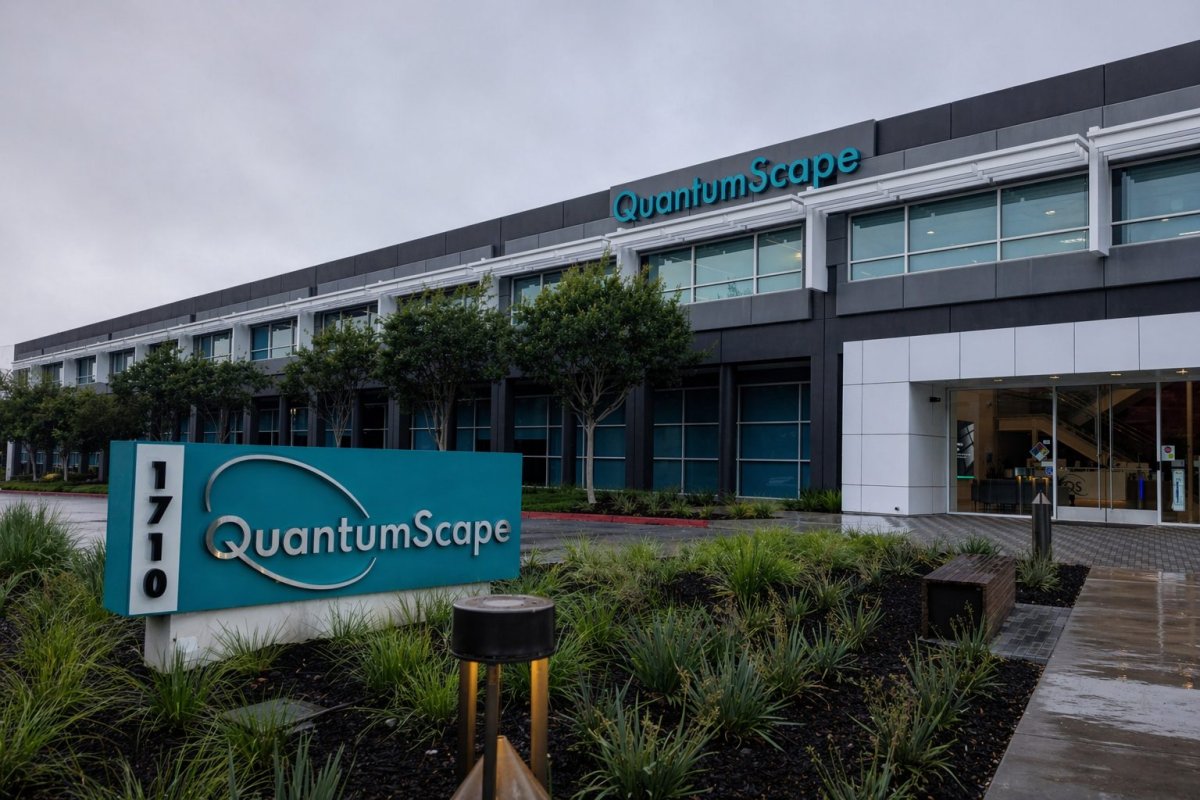
Shares of QuantumScape (QS) experienced a volatile trading session on Thursday, swinging sharply after the solid-state battery developer released its first-quarter update and revealed plans to target AI data centers as a new growth market.
The stock opened at $9.65, briefly touched an intraday high of $10.03, before plunging to $7.17 by mid-morning, ultimately closing below the previous day's level. The dramatic price action underscores the high stakes for the company as it transitions from years of research and development into pilot production and customer trials.
Operational Milestones and New Partnerships
In its quarterly letter to shareholders, QuantumScape announced the completion of its Eagle Line pilot production facility during the first quarter, with initial batches of QSE-5 cells now being produced. The company aims to ramp up output in the second quarter. Solid-state batteries, which replace the liquid electrolyte found in conventional lithium-ion cells with a solid material, promise improvements in safety, charging speed, and energy density.
On the automotive front, QuantumScape reported progress with its joint development partner, Volkswagen's PowerCo, moving toward field testing. The company shipped cells to an automotive joint-development partner during the quarter. Additionally, another top-10 global automaker completed hands-on evaluation and has transitioned to a joint development agreement. This follows last year's restructuring of the QuantumScape-Volkswagen joint venture into a licensing arrangement, which authorizes PowerCo to produce up to 40 gigawatt-hours of cells annually using QuantumScape's technology, with the potential to double to 80 GWh upon meeting certain technical milestones.
Expanding Beyond Automotive
CEO Siva Sivaram highlighted AI data centers as a "natural fit" for the company's technology, pointing to the industry's shift toward 800-volt direct current systems. He also noted "strong customer interest" from military, aerospace, and government sectors. Analyst Jed Dorsheimer of William Blair commented that the expansion into "hot sectors" like on-rack AI data centers, as well as space and drones, has broadened the company's addressable market, with drones presenting the most immediate opportunity.
Financial Performance
QuantumScape reported a first-quarter net loss of $100.8 million, narrowing from a loss of $114.4 million in the same period last year. Adjusted EBITDA, a key operating metric for the company, came in at a loss of $63.2 million. Capital expenditures totaled $10 million during the quarter. The company maintained its full-year guidance, forecasting an adjusted EBITDA loss of $250 million to $275 million and capital expenditures between $40 million and $60 million.
Customer billings, QuantumScape's preferred metric that tracks invoices issued to clients and partners rather than GAAP revenue, reached $11 million for the quarter. The company ended March with $904.7 million in liquidity.
Industry Context and Challenges
QuantumScape is not alone in the race to commercialize next-generation batteries. Competitors like Solid Power continue to develop solid-state technology for electric vehicles, while SES AI focuses on lithium-metal and lithium-ion batteries for applications ranging from EVs to drones, robotics, and energy storage.
Despite years of investment, large-scale manufacturing of solid-state batteries has yet to materialize. QuantumScape is collaborating with Murata Manufacturing and Corning to scale up production of its ceramic separator. Sivaram noted that each automaker will require a different cell format, adding complexity to the manufacturing process.
Evercore ISI analyst Chris McNally pointed to "glimmers of progress" this quarter after a quiet start to the year. He also highlighted that approximately 18.9% of QuantumScape's tradable shares are sold short, a factor that could continue to fuel volatility even as the company achieves technical milestones.