Rigetti Computing (RGTI) heads into a holiday-shortened trading week after one of its most dramatic rallies to date. The quantum computing company's stock closed Friday at $26.42, surging 19.87% on the day and approximately 48% from the prior week's close of $17.85. In after-hours trading, the shares eased slightly to $25.86, a modest pullback following a week of exceptionally heavy volume.
The catalyst for this surge was Rigetti's May 21 letter of intent with the U.S. Department of Commerce, outlining a potential award of up to $100 million over three years to accelerate superconducting quantum computing research and development. It is important to note that a letter of intent is a preliminary agreement; final contracts have yet to be signed.
While the broader market provided a tailwind, it was minimal. On Friday, the Nasdaq Composite rose just 0.19% and the S&P 500 gained 0.37%. Rigetti's nearly 20% move was clearly driven by the federal quantum funding news, which investors viewed as a transformative catalyst for the sector.
Rigetti CEO Subodh Kulkarni stated that the investment would help the company address "key scaling bottlenecks" and move closer to "utility-scale quantum computing"—systems powerful enough to solve practical problems beyond laboratory demonstrations. Quantum computers leverage qubits, which can exist in multiple states simultaneously, but achieving stability at scale remains a significant technical challenge.
The funding is part of a broader U.S. government initiative. Reuters reported that Washington will take $2 billion in equity stakes across nine quantum-computing companies. IBM is set to receive $1 billion for a quantum chip venture, GlobalFoundries $375 million, and D-Wave, Rigetti, and Infleqtion each approximately $100 million. Commerce Secretary Howard Lutnick said the investments would advance "American quantum capabilities."
Analysts at TD Cowen identified Rigetti as one of the three primary beneficiaries of the Commerce Department's quantum investments, alongside D-Wave Quantum and GlobalFoundries. They noted the move "underscores the strategic value" of the sector, a crucial endorsement for a market that has struggled to determine whether quantum stocks are policy-backed hardware plays or long-dated science projects.
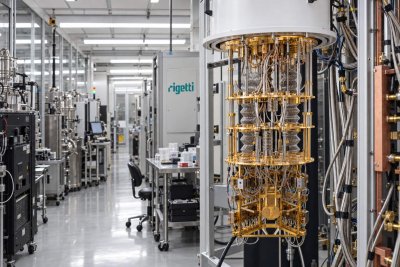
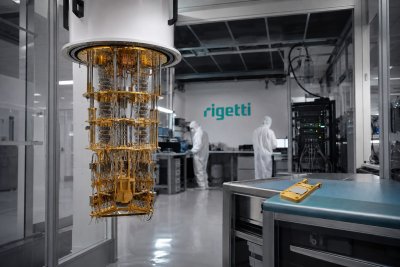
Rigetti's financial performance explains why this funding is so critical. The company reported first-quarter revenue of $4.4 million, an operating loss of $26.0 million, and cash, cash equivalents, and available-for-sale investments of $569.0 million as of March 31. It also made its 108-qubit Cepheus-1-108Q system generally available through Rigetti QCS, Amazon Braket, Microsoft Azure Quantum, and qBraid.
However, the upside case carries a clear risk. Rigetti's filings indicate that the Commerce Department deal still requires definitive agreements. The contemplated government stake would come through new common shares, with the implied issuance price based on the lowest of several closing prices and a 15% discount. This dilution means existing shareholders will own a smaller portion of the company when new shares are issued.
The week ahead begins slowly. Nasdaq is closed Monday, May 25, for Memorial Day, so Tuesday will be the first regular session for investors to price the deal after the weekend. The key question is whether the rally will hold, fade, or spread to other quantum computing peers.