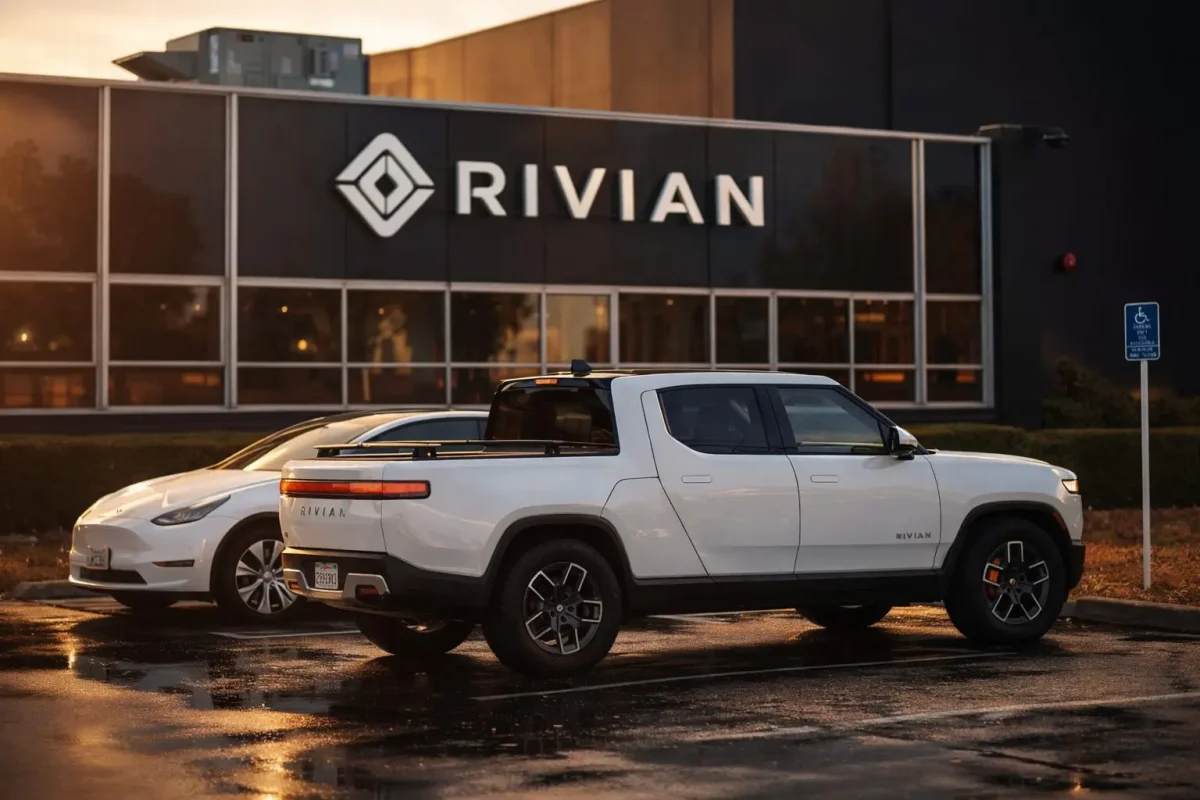
Shares of Rivian Automotive declined in Friday trading, reflecting investor apprehension following the electric vehicle manufacturer's announcement of pricing details for its forthcoming R2 SUV. The stock dropped 2.8% to close at $14.86, as the market digested the starting price point and the phased rollout strategy for the critical new model.
Pricing and Launch Strategy Under Scrutiny
The initial R2 variant available to consumers will be a high-performance trim priced at $57,990, with deliveries commencing this spring. This entry point is notably higher than the $45,000 base model that Rivian had previously signaled, which is now not expected to reach the market until late 2027. A Premium trim is scheduled to follow later in 2026 at $53,990, with a rear-wheel-drive Standard version slated for the first half of 2027 at $48,490. This staggered launch, beginning with the most expensive configuration, has introduced concerns about the company's ability to attract the mainstream audience it targets in the near term.
The Crucial Pivot to Volume
The R2 represents Rivian's strategic pivot from a low-volume luxury automaker to a high-volume mass-market player. The company is projecting that the smaller, more affordable SUV will boost its total deliveries by approximately 53% in 2026, aiming for a range of 62,000 to 67,000 vehicles. This growth is essential for reversing a decline seen in 2025, when deliveries fell to 42,247 units. A key factor in that downturn was the expiration of the $7,500 federal electric vehicle tax credit for Rivian's vehicles, which dampened consumer demand.
Analysts note that Rivian's pricing now positions it closer to premium trims of Tesla's dominant Model Y, which starts at $39,990 for its Standard version and reaches $57,490 for the Performance edition. Rivian is betting that its distinctive design, advertised range, and brand appeal will justify the price premium for consumers.
Financial Pressure and Capital Constraints
The margin for error in this launch is exceptionally thin given Rivian's financial position. For the full year 2025, the company reported a net loss of $3.65 billion on revenue of $5.39 billion. Furthermore, Rivian anticipates capital expenditures for the current year to be between $1.95 billion and $2.05 billion. As of the end of December, the company held $3.58 billion in cash and cash equivalents. A planned $2 billion investment from Volkswagen, tied to a joint technology partnership, is not scheduled to be received until 2026, adding to the near-term cash pressure.
Analyst Perspectives and Market Risks
Wall Street opinions on the stock's reaction are mixed. Some analysts, like Cantor Fitzgerald's Andres Sheppard, maintain that the R2 launch remains the "most material catalyst" for Rivian shares this year, suggesting the recent dip may be a temporary setback. Others express more caution. Barclays analyst Dan Levy highlighted that while Rivian holds over 100,000 R2 reservations, many were placed when the federal tax credit was still applicable, creating a potential demand cliff. D.A. Davidson's Michael Shlisky argued that Rivian may need to execute "the best midsize EV launch in five years" to succeed, given the lack of tax incentives and its limited physical sales and service footprint.
Manufacturing and Execution Hurdles
Additional execution risks shadow the production plan. Rivian has shifted initial R2 manufacturing from its planned new facility in Georgia to its existing plant in Normal, Illinois. The Georgia site is now expected to come online for R2 production by 2028. This change may help accelerate the launch but also introduces complexity. Furthermore, every R2 will come equipped with hardware for Autonomy+, Rivian's subscription-based advanced driver-assistance system, representing a future software revenue stream but also adding to upfront unit costs.
The central question for investors is whether Rivian can successfully translate the R2's potential into the scale and profitability they have long awaited. The company's latest pricing reveal has intensified the market's demand for swift, cost-effective evidence that its growth strategy is viable, particularly as broader support for electric vehicles faces political and economic headwinds. The coming quarters will be critical in determining if the R2 can drive Rivian toward sustainable operations or if the challenges of scaling in a competitive market will prove too great.