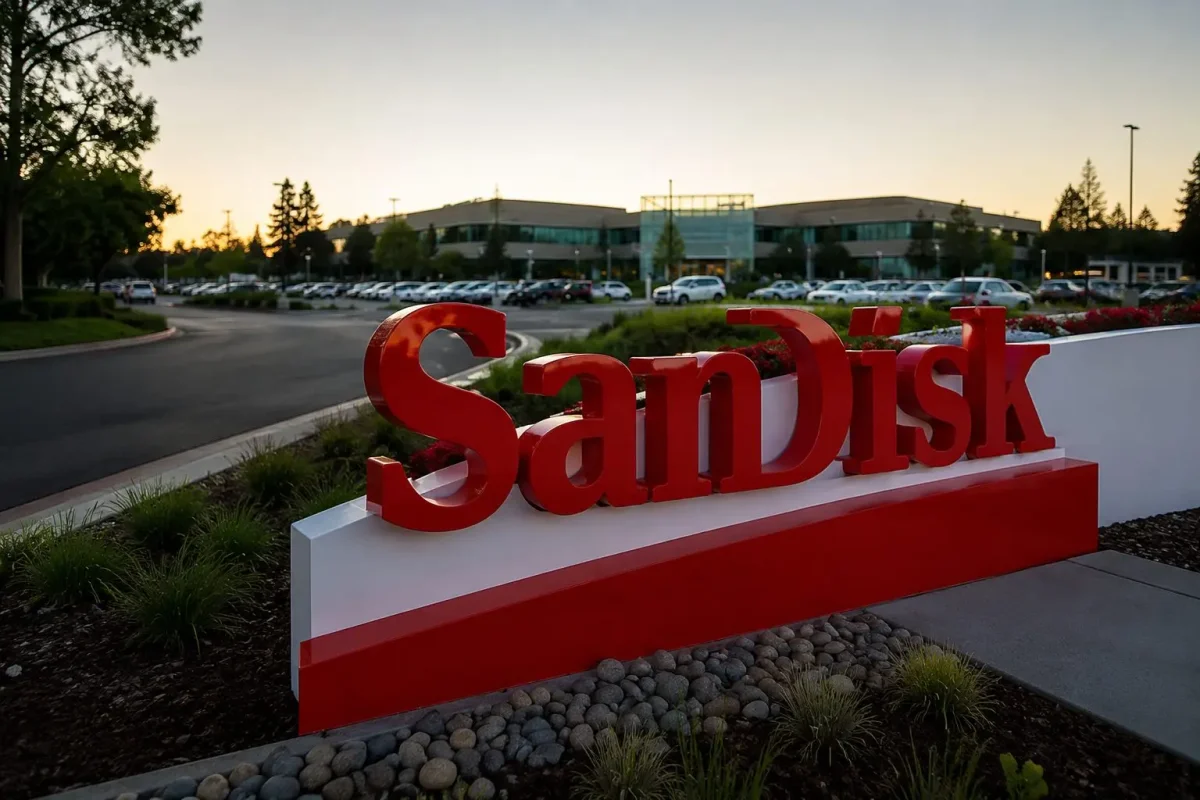
Milpitas, California-based flash-memory giant Sandisk Corporation (NASDAQ: SNDK) saw its market capitalization plunge by approximately $22.6 billion on Wednesday, a decline that amounts to roughly 3.6 times the portion of its long-term order book expected to convert into revenue over the next twelve months. The stock closed down 8.1% at $1,615, trimming the company's valuation to about $253.6 billion.
At the heart of the investment thesis lies the comparison between market cap erosion and the contracted revenue pipeline. As of April 3, Sandisk reported $41.6 billion in remaining performance obligations (RPOs) — customer contracts that have been signed but not yet recognized as revenue. However, only 15% of that total, or about $6.2 billion, is anticipated to materialize within the coming year. The vast majority of these obligations are longer-dated, extending beyond a 12-month horizon.
The selloff was not confined to Sandisk alone. The broader memory and semiconductor sector also faced headwinds. Micron Technology (NASDAQ: MU) fell approximately 8% on Wednesday, while the Roundhill Memory ETF shed roughly 7%. The PHLX Semiconductor Index closed 16.5% below its June 22 peak. “We are seeing fatigue in tech and doubts about the longer-term staying power of the chips,” noted David Russell, an analyst at TradeStation. “We’ve priced in years of growth.”
Sandisk’s disclosed order book of $41.6 billion stems from its first three customer contracts. Evercore ISI estimates that when including two newer, undisclosed deals, the total minimum commitment could reach roughly $62 billion, equivalent to 24.5% of the company’s current market capitalization. The disparity between the $41.6 billion and $62 billion figures underscores the opacity surrounding the full scope of Sandisk’s contractual protections.
The timing of the selloff is particularly significant given Sandisk’s rapidly expanding data-center business. Fiscal third-quarter revenue hit $1.47 billion, a staggering 233% sequential increase and a 645% year-over-year jump. Gross margins climbed to 78.4%. Such a high base makes the company acutely sensitive to shifts in flash pricing or customer mix, amplifying earnings volatility.
Evercore analyst Amit Daryanani remains bullish, raising his price target to $3,100. He projects fiscal 2027 revenue of $47.8 billion and earnings per share of $212.78, implying a forward price-to-earnings multiple of just 7.6 times. Daryanani models that more than one-third of Sandisk’s 2027 memory volumes will be under long-term contracts, with gross margins exceeding 80%. These figures are his own estimates and not official company guidance.
The wide gap between Sandisk’s trailing P/E of 56.2 times and the forward multiple of 7.6 times encapsulates the core debate. Bulls argue that earnings will surge, making the current valuation inexpensive. Bears caution that the forward estimates are overly optimistic if memory demand decelerates.
Another disconnect exists in the contract figures. Sandisk’s filing listed $511 million in contract liabilities as of April 3, primarily from customer advances. In contrast, Evercore’s estimate suggests that guarantees and prepayments across all five deals exceed $11 billion. The filing captures payments already on the books, while Evercore’s figure encompasses broader analyst-estimated financial protections.
CEO David Goeckeler has emphasized that the new contracts aim to dampen the industry’s notorious boom-bust cycles. “The bane of this industry has been the boom-bust cycle,” Goeckeler told Reuters in April. “We want to get out of that. We want consistent, predictable economics.” The agreements include price floors and caps, as well as penalty payments from customers that fail to meet commitments.
However, the contracts carry their own risks. Sandisk has warned that production shortfalls, poor yields, or supply-chain disruptions could lead to lower prices, reduced shipments, damages, or early termination. Customer guarantees may only partially compensate for lost sales, depending on when a breach occurs. Long-term contracts mitigate some demand risk but do not eliminate delivery or price risk.
Premarket trading on Thursday reflected continued selling pressure. Western Digital (NASDAQ: WDC) fell 7.2%, and Seagate Technology (NASDAQ: STX) slipped 5.8%. Nasdaq 100 futures were down 0.7% at 7:13 a.m. Eastern, suggesting the sector remains a crowded trade under stress.
Sandisk is scheduled to release fiscal fourth-quarter results on August 5, followed by its investor day on August 13. The company has guided for revenue between $7.75 billion and $8.25 billion and adjusted earnings of $30 to $33 per share. Investors will be looking for an updated contract total, a clearer revenue conversion timeline, and details on the $6 billion buyback program. For now, the $41.6 billion order book is substantial, but the speed at which it turns into revenue will be the critical metric to monitor.