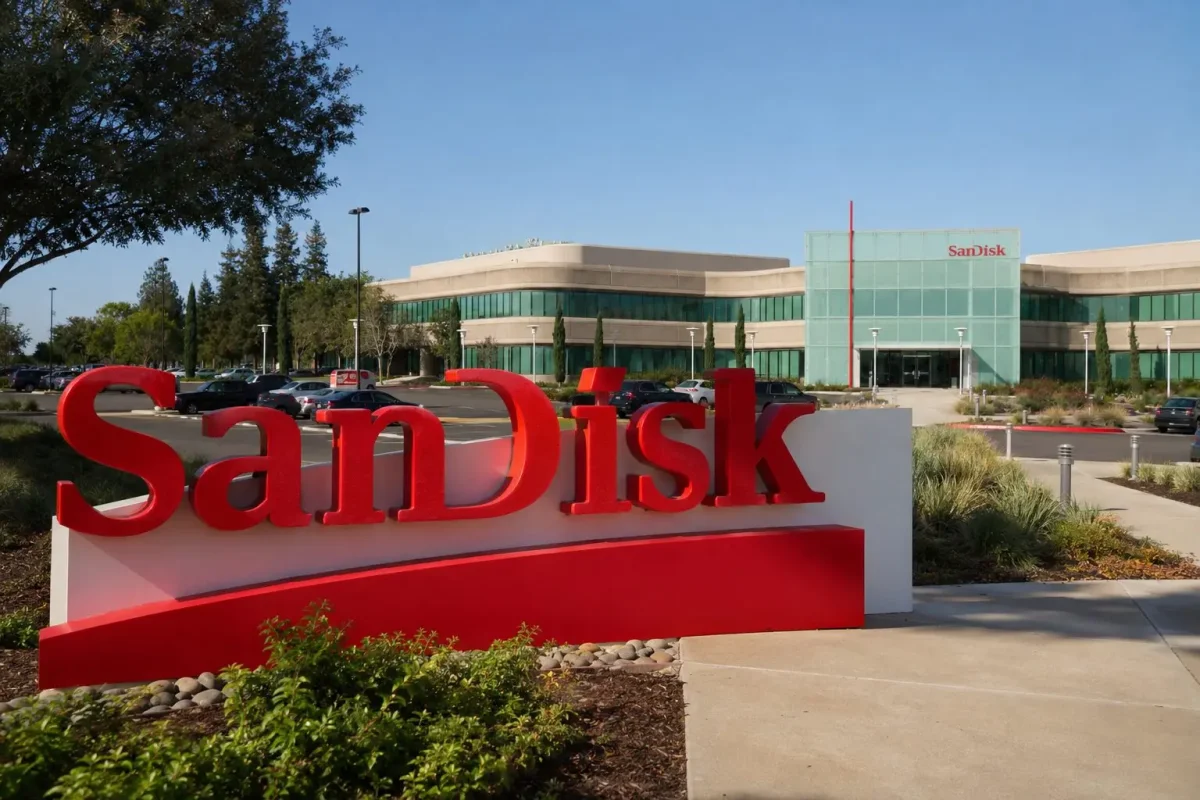
Sandisk (NASDAQ:SNDK) experienced a sharp decline of 13% on Monday afternoon, with shares trading around $1,669. The drop came despite a significant price target upgrade from Evercore ISI analyst Amit Daryanani, who doubled his target to $3,100 from $1,400. Daryanani argued that investors were underestimating the sustainability of Sandisk's earnings and free cash flow in the coming years.
Revenue Recognition Concerns
However, the bullish case faced headwinds from the company's latest SEC filing. As of April 3, Sandisk reported $41.6 billion in remaining performance obligations (RPO), representing contracted revenue yet to be recognized. Only about 15% of that, or $6.24 billion, is expected to convert to revenue within the next 12 months. This gap between total backlog and near-term revenue recognition highlights the challenge of translating large contract wins into immediate financial results.
Broader Semiconductor Sector Weakness
The broader chip sector is also under pressure, with the Philadelphia Semiconductor Index declining over 11% from its June high. U.S. semiconductor funds experienced net outflows of approximately $11 billion in the week ending June 24, marking the largest weekly exodus this century, following nearly $12 billion in inflows over the prior two weeks. “We’ve never seen this kind of extreme earnings growth. But the question then becomes, how long can we expect this to continue,” noted Steve Sosnick, chief market analyst at Interactive Brokers Group (NASDAQ:IBKR).
Sandisk's Recent Performance
Sandisk, a leading manufacturer of NAND flash memory for solid-state drives, reported fiscal third-quarter revenue of $5.95 billion, nearly doubling from the previous quarter. Data-center sales surged 233% to $1.47 billion, with gross margins reaching 78.4%. For the current quarter, the company guided revenue between $7.75 billion and $8.25 billion. CEO David Goeckeler described the results as a “fundamental inflection point.”
Technological Advances
The company is also advancing its technology with the new BiCS10 chip, now sampling, which offers 59% higher bit density than BiCS8 and interface speeds up to 33% faster. CTO Alper Ilkbahar emphasized the design's focus on “faster interface speeds, higher bit density and improved power efficiency.” These innovations, combined with long-term contracts, form part of a bullish thesis highlighted by Pythia Research in a Seeking Alpha note.
Wall Street Divergence
Analyst estimates vary significantly based on different earnings bases. Goldman Sachs (NYSE:GS) uses normalized calendar 2026 earnings of $110 per share with a 20x multiple, yielding a $2,200 target. Evercore ISI projects fiscal 2027 earnings of $212.78 at roughly 15x, for a $3,100 target. Bernstein's base case stands at $243 for fiscal 2027, implying a $3,000 target. Evercore expects more than a third of fiscal 2027 bit output to come from new deals with gross margins above 80%.
At Monday's close, Sandisk trades at about 15.2x Goldman's 2026 estimate and 7.8x Evercore's 2027 figure. The valuation gap suggests investors are pricing in execution risk rather than paying up for distant earnings.
Contract Structure and Risks
Sandisk's new business model agreements span one to five years, with built-in price floors, caps, and penalties for buyer cancellations. “We want consistent, predictable economics,” CEO Goeckeler told Reuters in May. Despite these protections, the company acknowledges risks including volatile demand, production delays, and supply chain disruptions. An oversupply of NAND or a slowdown in data-center spending could pressure margins on non-contracted sales.
Peer Comparison
Sandisk trades at a higher trailing P/E ratio (58.0x) compared to peers Micron Technology (NASDAQ:MU) at 21.1x and Western Digital (NASDAQ:WDC) at 32.8x. On Monday, Sandisk's 12.9% decline outpaced both Micron's 4.9% drop and Western Digital's 5.9% fall.
Upcoming Catalysts
Sandisk is scheduled to report fiscal fourth-quarter and full-year results on August 5, followed by an investor day on August 13. Investors will focus on updated RPO figures, the proportion of 2027 output under contract, and the timeline for revenue recognition from two recent deals. Simply beating earnings may not suffice to address lingering questions about demand durability.