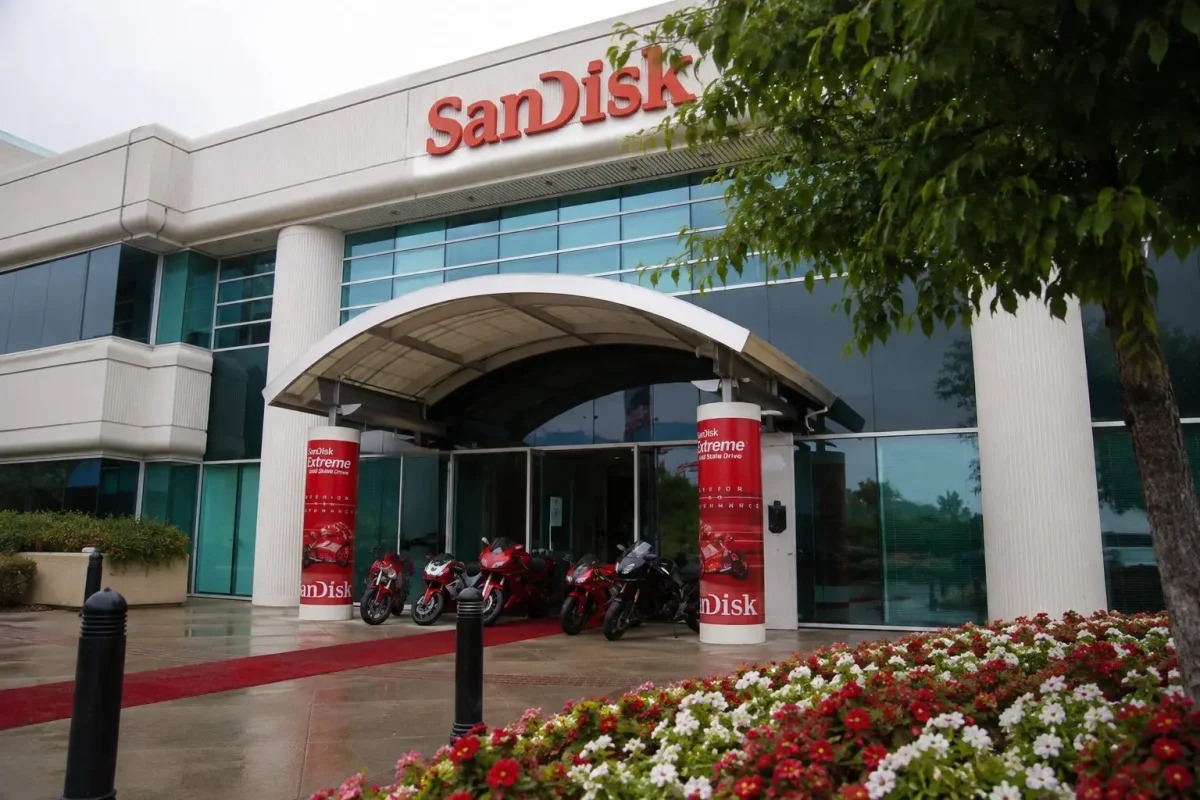
Sandisk Corporation (NASDAQ: SNDK) experienced a decline in its stock price during regular trading and continued to slide in after-hours trading on Wednesday, despite reporting preliminary fourth-quarter results that exceeded analyst expectations. The company's shares closed the regular session at $1,350.50, down 5.4%, and fell an additional 4.2% in after-hours trading to $1,293.84.
The preliminary Q4 figures revealed revenue of $8.97 billion, surpassing consensus estimates by 5.7%, while adjusted earnings per share of $39.25 beat forecasts by 12.3%. The company also reported a robust sequential revenue increase of 51% and a gross margin of 84.6%. However, the midpoint of the company's first-quarter revenue guidance came in at $10.55 billion, which was 2.5% below Wall Street's consensus of $10.82 billion, although it still implies a 17.7% sequential rise. The adjusted EPS midpoint of $45 exceeded expectations by 0.6%.
Investors were particularly focused on the revenue bridge, which revealed that pricing contributed approximately $2.01 billion of the $3.015 billion sequential gain, while volume added only around $1.005 billion. This trend highlights that pricing power, rather than unit growth, was the primary driver of the company's recent performance. The market's reaction suggests that while the backward-looking results were strong, the forward guidance did not meet the high expectations that had been set.
Dave Mazza, CEO of Roundhill Financial, had set a high bar ahead of the earnings release, stating that "Nothing short of a big beat with a bigger guide" would be sufficient. Sandisk achieved the earnings beat but fell short on the sales midpoint, leading to the negative market response. The sentiment among analysts was largely positive before the report, with Bloomberg recording 25 buy recommendations and five holds, and no sell ratings. However, all target prices were issued prior to the results, with price targets ranging from $1,620 (Wells Fargo) to $3,050 (Susquehanna).
Datacenter revenue emerged as a standout, reaching $2.98 billion, a twofold increase from the previous quarter. The segment's share of quarterly sales climbed to 33.2%, up from 24.7%. Sandisk also began shipping its Stargate QLC platform for revenue. The Edge segment saw a 48% sequential increase to $5.43 billion, while the Consumer segment declined by 32% to $556 million.
In a move to mitigate potential downturns, Sandisk has secured new business model agreements with eight clients, guaranteeing a minimum revenue of $93.9 billion at floor pricing. These contracts have a weighted average term of more than four years, representing 4.6 times projected fiscal 2026 sales. Additionally, the company has a remaining share repurchase authorization of $15.5 billion, and in Q4, it spent $4.5 billion on buybacks, approximately 89% of its adjusted free cash flow.
The broader storage sector also felt the pressure. Western Digital (NASDAQ: WDC) reported adjusted EPS and revenue that surpassed forecasts but saw its shares drop 10% in after-hours trading. This suggests that investors in the storage sector now demand results that significantly exceed consensus expectations. July was a challenging month for Sandisk, with a 47% decline, even after a 23% gain on July 30. The upcoming Investor Day on August 13 is expected to focus on fiscal 2027 supply, contract conversion, and price floors.
Chief Executive David Goeckeler stated that Sandisk is positioned to "generate growing and durable free cash flow." However, investors require proof that pricing strength will be sustained. The company's results are still provisional, as the Form 10-K has not been finalized. Risks include rapid shifts in NAND pricing, delays in customer rollouts, reduced AI investment, execution issues, and Kioxia-related supply disruptions. At present, the results indicate robust demand and significant contractual safeguards, but the market remains cautious about the sustainability of pricing-driven growth.