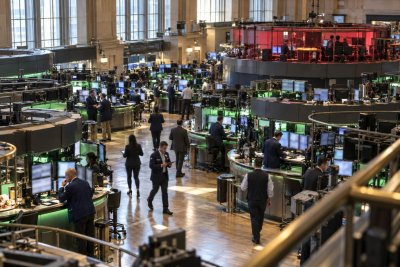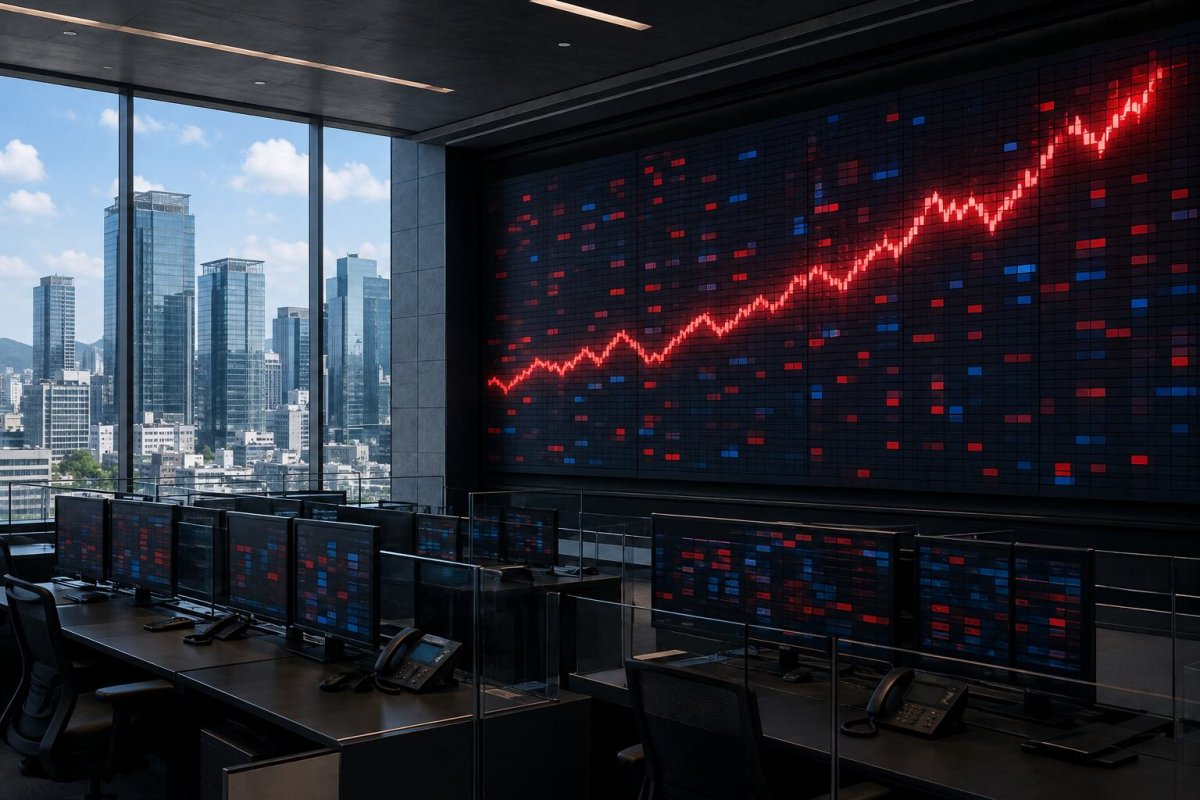
South Korea's benchmark KOSPI index climbed sharply on Monday, reaching 6,949.54 by 1:36 p.m. KST, up 262.33 points, or 3.92%, from Friday's close. The surge, however, masked a concerning divergence beneath the surface: while the index rallied, 441 stocks on the KOSPI were declining, against 421 advancers, with 49 unchanged, according to live market data.
This split suggests that Monday's gain was not a broad-based market advance but rather a forceful repricing of large-cap semiconductor stocks. The index's rise was driven primarily by heavyweight chipmakers, with Samsung Electronics (KRX:005930) up 3.91% and SK hynix (KRX:000660) gaining 5.4% by mid-morning, as reported by Yonhap.
Intraday Movements and Trading Flows
The KOSPI opened at 6,910.78, already 3.34% above Friday's close, and traded within a session range of 6,867.91 to 6,963.58. Trading volume was robust, with 169.2 million shares worth KRW 13.58 trillion changing hands by 1:36 p.m.
Retail investors were net sellers, offloading a net KRW 4.3691 trillion, while foreign investors bought KRW 1.4289 trillion and institutions added KRW 1.7205 trillion. This institutional and foreign demand was heavily concentrated in the top chip names, reinforcing the narrow nature of the rally.
U.S. Chip Rally Sets the Tone
The Seoul market was playing catch-up with Friday's U.S. semiconductor surge. The Philadelphia Semiconductor Index closed 3.37% higher on September 4, with Micron Technology (NASDAQ:MU) up 6.10%, Sandisk Corp. (NASDAQ:SNDK) soaring 11.90%, and Advanced Micro Devices (NASDAQ:AMD) adding 4.69%. Wall Street was closed Monday for Labor Day, leaving Friday's close as the latest reference point.
Local media also linked the chip optimism to OpenAI's announcement of its new Astra model, which began a phased rollout on September 3. While a product launch bolsters the narrative of sustained compute demand, it does not directly quantify future memory spending.
Goldman's 12,000 Target: A Test of Earnings and Breadth
Timothy Moe, chief Asia-Pacific equity strategist at Goldman Sachs (NYSE:GS), reiterated a 12,000 target for the KOSPI, implying a 72.7% upside from Monday's intraday level. His projection is based on estimated profit growth of 360% in 2026 and 35% in 2027, and a forward earnings multiple of 7.5 times, compared to the current 5.3 times—roughly half the seven-year average.
Moe acknowledged risks, including China's expanding memory capacity and political hurdles to U.S. data-center construction, which could undermine both earnings and multiple expansion. The ambitious target requires not only sustained memory profits but also a re-rating of the market's valuation.
What to Watch
Monday's close will provide the first test. A nearly 4% gain with negative breadth would confirm a semiconductor-led rebound, while a broader advance with sustained foreign buying and a close near session highs would indicate the rally is spreading beyond the two dominant chipmakers. The KOSPI regular session runs until 3:30 p.m. KST, so all figures are intraday.