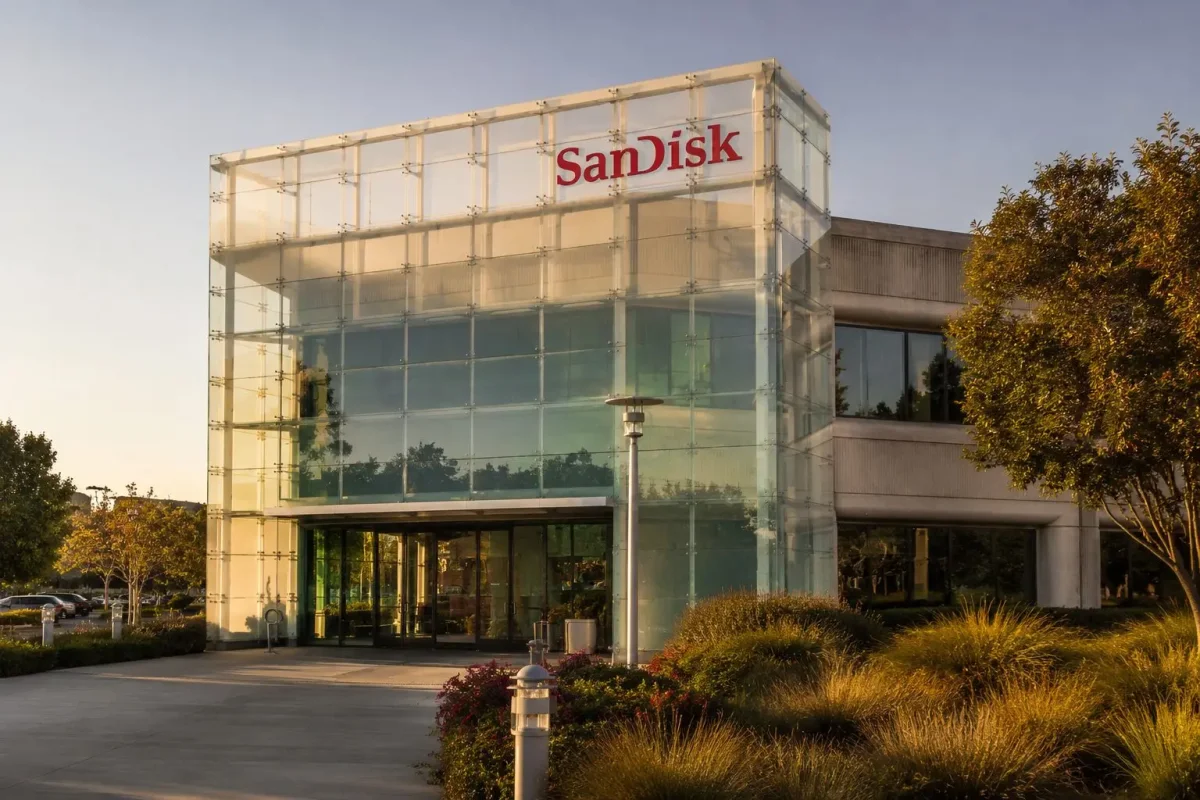
SanDisk Corporation (SNDK) saw its shares climb to near all-time highs on Friday, following a significant price target upgrade from Susquehanna Financial Group. The firm raised its target to $3,250 from $2,000, reflecting growing optimism around the company's position in the artificial intelligence (AI) memory market. By late morning on the Nasdaq, shares had gained $15.16 to reach $1,656.80, after touching an intraday high of $1,707.71 earlier in the session.
The upgrade is the latest in a series of bullish calls on SanDisk, which is increasingly viewed as a key player in the AI infrastructure space. Investors are broadening their focus beyond traditional AI processors like those from Nvidia, recognizing that memory and storage are critical components for supporting AI workloads. SanDisk, a leading manufacturer of NAND flash memory used in solid-state drives (SSDs), is benefiting from tight supply driven by robust demand from data center operators.
Long-Term Contracts and Structural Shift
A notable shift in SanDisk's business model is its move toward long-term customer contracts, which provide revenue visibility and stability. These agreements guarantee supply to buyers while setting minimum revenue commitments for SanDisk. In its latest 10-Q filing, the company reported $41.6 billion in remaining performance obligations, representing future revenue from customer agreements that have not yet been recognized, with the majority still unbilled. This approach marks a departure from the historically volatile spot-market cycles in the memory industry.
Barclays analyst Tom O'Malley recently upgraded SanDisk to Overweight from Equal Weight, doubling his price target to $2,300 from $1,200. He described memory and storage as the "most attractive vertical below accelerators" in the AI ecosystem. O'Malley noted that the sector is entering a new phase characterized by more long-term contracts, tighter supply, and clearer pricing dynamics. Barclays expects the supply-demand imbalance to persist through calendar 2027.
Strong Financial Performance
SanDisk reported its fiscal third-quarter results last month, posting revenue of $5.95 billion, a 97% increase from the prior quarter. Data-center revenue surged 233%, underscoring the strong demand from cloud and AI customers. CEO David Goeckeler described the period as a "fundamental inflection point" for the company. Looking ahead, SanDisk guided for fourth-quarter revenue in the range of $7.75 billion to $8.25 billion, with non-GAAP diluted earnings expected between $30 and $33 per share.
Mizuho's Vijay Rakesh also raised his price target on SanDisk to $1,825, while D.A. Davidson's Gil Luria increased his target on Micron Technology to $1,500. Barclays similarly raised its Micron target to $1,175, maintaining an Overweight rating. These moves reflect a broader bullish sentiment across the memory and storage sector.
Market Context and Risks
The rally in SanDisk shares has been remarkable, with the stock surging over 4,300% since its spin-off from Western Digital in February 2025, according to Barron's. Despite the steep climb, most analysts continue to rate the stock a Buy. However, the memory industry is not without risks. In its filings, SanDisk cautions about potential demand swings, price declines, tariffs, trade disputes, inflation, competitive pressures, and supply-chain disruptions. A slowdown in AI spending or a rapid increase in production capacity could challenge the sustainability of its new contract-based model.
Western Digital and Seagate are facing similar investor scrutiny as cloud buyers seek reliable storage supply rather than just low costs. Barclays noted that long-term deals linked to nearline hard-disk demand at both companies provide greater clarity compared to previous spot-heavy cycles.
Wall Street is now treating SanDisk as a key piece of data-center infrastructure rather than just another memory supplier. The next test for the company will be converting its substantial customer agreements into actual cash flow while maintaining healthy margins.