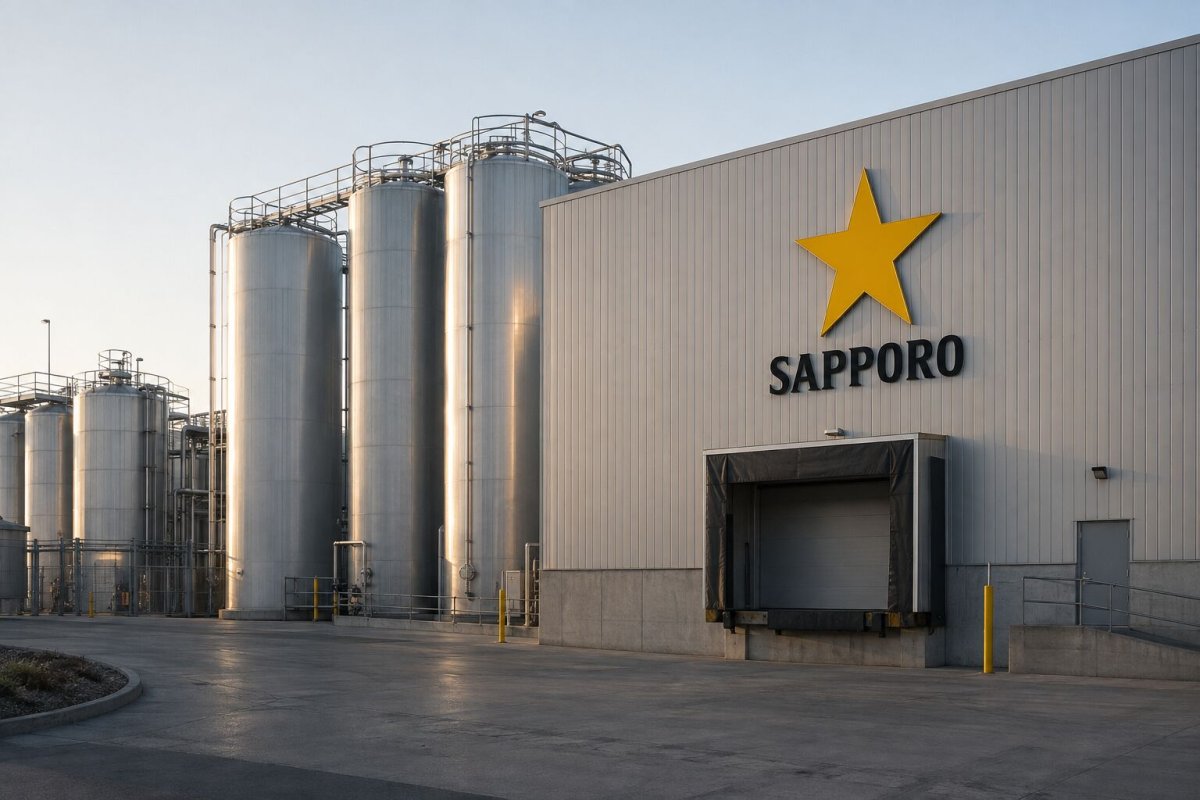
Sapporo Holdings Limited (TYO:2501) has announced a strategic shift in its North American production footprint, moving the manufacture of its US-bound nonalcoholic beer from Canada to the United States. The relocation, slated for the first half of 2027, was disclosed by Chief Strategy Officer Rieko Shofu in a Bloomberg interview published on Monday. The decision is a direct response to the 50% tariff imposed by the US on certain Canadian exports, which has significantly raised the landed cost of Sapporo's alcohol-free products.
The move, while real, has a narrow initial scope. Sapporo has not yet revealed the production volume affected, the specific US facility to be used, or the anticipated cost savings. Consequently, the primary question for investors is the magnitude of the tariff burden—estimated at JPY 1.2 billion for fiscal year 2026—that this production transfer can alleviate. This figure represents approximately 5.5% of Sapporo's group core operating profit plan of JPY 22 billion for the year.
Sapporo's shares closed at JPY 1,851 on September 7, down 0.35% at 3:30 p.m. JST, with volume of 871,100 shares, according to Yahoo Finance Japan. The Bloomberg interview was posted at 5:04 p.m. EDT, after Tokyo's market close, so Monday's share price movement does not reflect the market's reaction to the announcement.
Tariff Impact and Strategic Response
The US imposed the new tariff on August 22, and Canadian government guidance confirms that the levy applies without a CUSMA exemption to covered goods, including alcoholic beverages. This tariff has forced Sapporo to reconsider its production location to maintain competitiveness in the US market. The FY2026 management plan estimates the tariff will cost JPY 1.2 billion this year, up from JPY 0.8 billion in FY2025.
The nonalcoholic beer transfer is just one component of Sapporo's broader North American restructuring. The company is also considering adding West Coast capacity, either through building, buying, or contracting, according to Shofu. This decision could have a larger impact than the initial transfer, as it will determine capital expenditure, freight savings, and speed of expansion.
Larger US Restructuring Underway
In April, Sapporo agreed to sell the Stone brand and hospitality assets and decided to cease Sapporo- and Stone-branded production at its Escondido, California, plant by year-end. The company will continue production and sales at its Richmond, Virginia, facility. Management expects the US operation to achieve positive EBITDA in FY2026 and projects an annual earnings improvement of more than USD 10 million from FY2027.
However, the restructuring is costly. Sapporo disclosed an expected USD 23 million disposal gain and approximately USD 80 million in impairment losses and related costs, which are already included in the full-year forecast. The nonalcoholic transfer will begin in the same period when these restructuring benefits are expected to materialize, making it difficult to attribute performance improvements to specific actions.
Investor Confidence and Market Context
Sapporo enters FY2026 with some positive momentum: its namesake brand grew volume by 20% in FY2025, reaching 10 million cases a year ahead of schedule. Management targets another 8% volume increase in North America for FY2026. Yet, group core operating profit is forecast to decline 12% to JPY 22 billion in 2026, largely due to planned growth spending. The company also noted no clear recovery in the US beer market when setting its plan.
The headline price-to-earnings ratio is misleading this year, as Sapporo forecasts JPY 296 billion in net profit, but JPY 290 billion comes from an after-tax gain related to bringing outside capital into its real-estate business. The operating case rests on beer margins, not the one-off gain.
Investors will be looking for more specifics: the production destination, transition costs, affected case volume, and confirmation of positive US EBITDA and the FY2027 savings. Until then, the move is a sensible tariff defense with an unquantified earnings contribution.