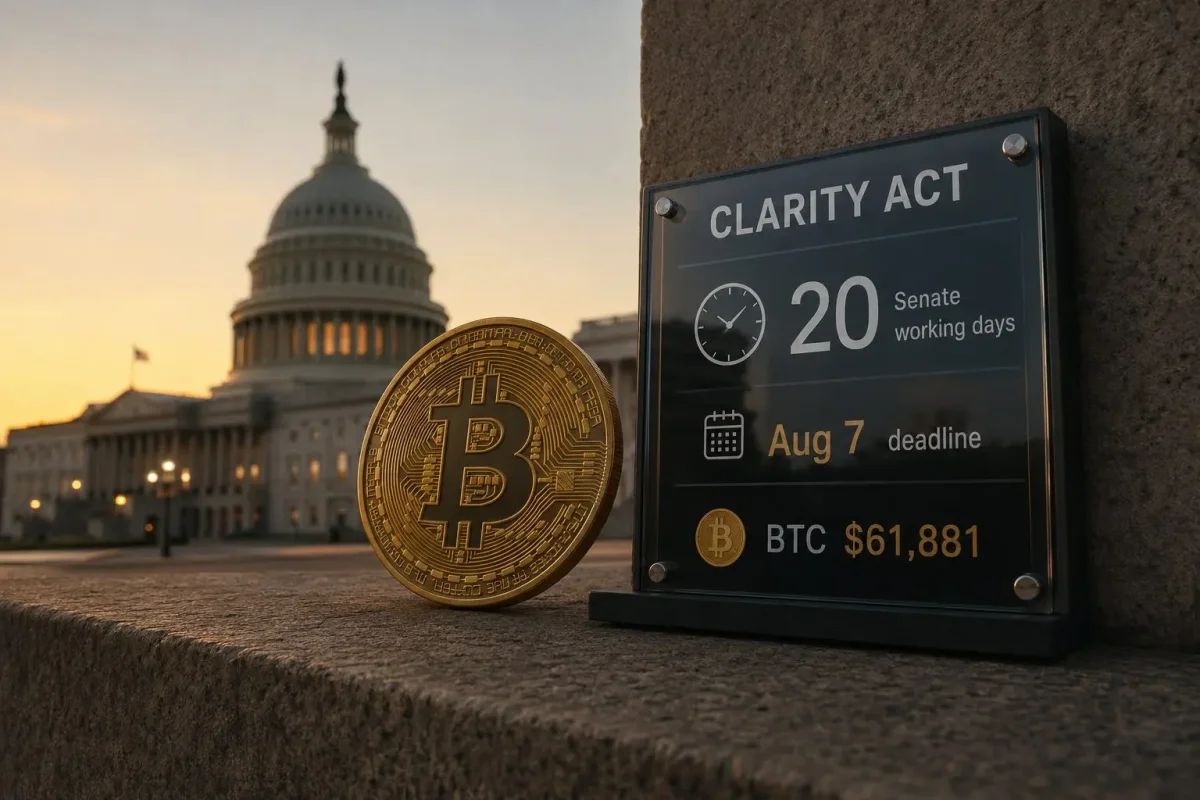
The Senate's CLARITY Act, a comprehensive digital asset regulatory proposal, is drawing attention for its potential to expand bank revenue opportunities in cryptocurrency services while simultaneously addressing risks associated with stablecoin deposits. The legislation, which has been in development for months, outlines a framework that could allow banks to offer custody, staking, and lending services, potentially creating new income streams for larger financial institutions.
Dual Impact on Banks
The bill presents a dual scenario for the banking sector. On one hand, major banks with robust compliance systems could benefit from fee-based crypto services such as custody, staking, and lending. On the other hand, smaller community banks may face significant challenges, as the legislation's provisions on stablecoin rewards could threaten their low-cost deposit bases. Rebeca Romero Rainey, CEO of the Independent Community Bankers of America (ICBA), warned that as much as $1.3 trillion could exit community banks, potentially reducing lending capacity by $850 billion. These figures, while advocacy projections, highlight the stakes involved.
Federal Reserve data provides context: deposits at small banks represent 6.7% of total commercial bank deposits, and their credit accounts for 6.1% of all outstanding bank loans. Under the Fed's definition of small banks (excluding the top 25), these ratios rise to 23.0% and 18.1%, respectively, indicating the potential scale of impact.
Stablecoin Reward Ban and Deposit Risks
Central to the debate is Section 10404, which would ban rewards paid solely for holding stablecoins, including any yield that mimics deposit interest. This provision aims to shield bank deposits from unregulated yield offerings. However, activity-based rewards tied to transactions, liquidity, governance, staking, or loyalty programs would still be permitted, allowing crypto platforms to retain user acquisition incentives.
The estimates of deposit outflows vary widely. A working paper by Nigrinis projects a 25.9% decline in deposits and a potential $1.5 trillion drop in lending, based on stablecoins offering yields comparable to the federal funds rate. In contrast, a study by Charles River Associates, commissioned by Coinbase, suggests the impact would be below 1%, with up to 6.8% in an extreme scenario. These divergent figures make Section 10404 the key valuation pivot in the bill.
Industry Reactions and Proposed Amendments
Romero Rainey has called for a unified regulatory framework, stating, "If we're going to be doing the business of banking, let's apply the rules and regulations of banking." She advocates restricting payment stablecoins to payment purposes only. Meanwhile, Rob Nichols, head of the American Bankers Association, proposes more limited changes—what he calls "tiny, surgical edits"—to tighten regulations around issuer affiliates, exchanges, and intermediaries.
The draft also includes Section 10401, which authorizes banks to engage in lawful crypto custody, staking as part of custody, lending, payments, brokerage, and node services. This could introduce fee flexibility for larger banks with strong compliance systems. Additionally, a joint rulemaking requirement orders the SEC, CFTC, and Treasury to establish rules within one year, though this may postpone clarity on business models and disclosures.
Market Reactions and Price Moves
On Friday, crypto-linked stocks and tokens declined, while major bank stocks showed mixed performance. Coinbase Global (NASDAQ:COIN) fell 10.6% to $146.26, partly due to its third consecutive quarterly loss and lower trading volumes. Circle Internet Group (NYSE:CRCL) dropped 2.6% to $62.61, reflecting its direct exposure to USDC reserve earnings and reward policies. AAVE token fell 6.1% to $93.41, and Bitcoin slipped 3.0% to $62,924. In contrast, JPMorgan Chase (NYSE:JPM) rose 0.3% to $351.79, while Goldman Sachs (NYSE:GS) declined 0.7% to $1,018.38.
The market's reaction was not seen as a definitive signal on CLARITY, as broader crypto market weakness also played a role. Lobbying over the 616-page merged text, published on July 22, has intensified. The Senate Banking Committee approved its section by a 15-9 vote in May. The S&P 500 climbed 1.05% over the week, and the Nasdaq Composite gained 1.59%.
Legislative Outlook
The legislative window is tight. Senators return on Monday, August 3, but the scheduled vote concerns H.R. 6500, not CLARITY. A state work period begins August 10, and as of Friday evening, no CLARITY floor vote had been scheduled. The bill's future remains uncertain, but its provisions could significantly reshape the intersection of banking and cryptocurrency.
Stani Kulechov, founder of Aave, interpreted the banking provisions as a "big TAM expansion for crypto," referring to total addressable market. However, regulators would likely impose operational limits. The coming weeks will be critical as stakeholders push for amendments and the Senate weighs the potential benefits and risks of integrating crypto into the traditional banking system.