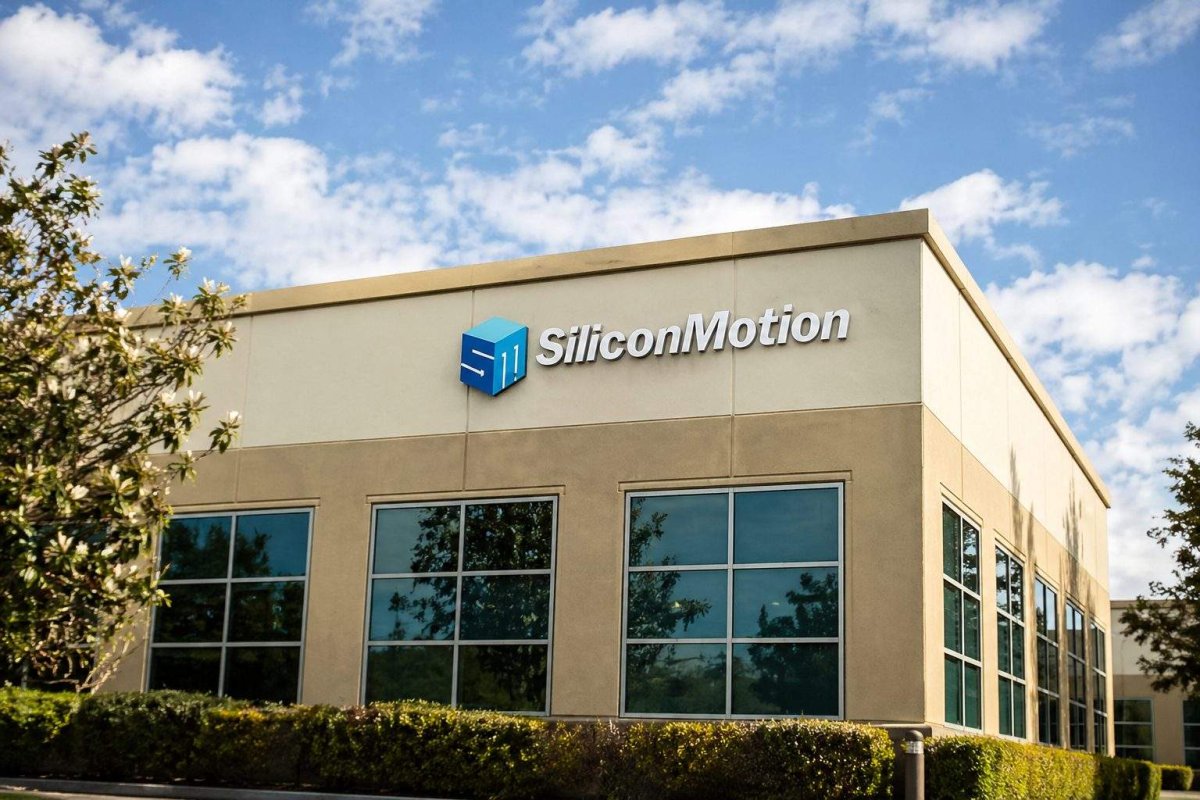
Silicon Motion Technology Corporation (NASDAQ: SIMO) saw its U.S.-listed shares close at $153.46 on Friday, marking an 8.1% gain as the market anticipates the release of first-quarter financial results after the bell on April 28. The stock's upward momentum was fueled by the company's confirmation of its quarterly dividend and growing investor enthusiasm for AI-driven storage demand.
The NAND flash controller specialist announced that it will pay a $0.50 per American Depositary Share (ADS) dividend on May 21 to shareholders of record as of May 7. This payout is part of the company's annual dividend policy of $2.00 per ADS, which has been maintained despite the cyclical nature of the memory chip market.
Management's guidance from February set expectations high, projecting first-quarter revenue in the range of $292 million to $306 million. This represents a year-over-year increase of 76% to 84%, driven by what CEO Wallace Kou described as a "significantly stronger-than-seasonal start" to 2026. The company also forecasted a non-GAAP operating margin of 16% to 18% for the quarter.
Wall Street analysts surveyed by MarketBeat expect Silicon Motion to report earnings of $1.28 per share on revenue of $299.53 million for the quarter. The stock currently carries 11 buy ratings and one hold, though the average price target of $132.50 sits below Friday's closing price, suggesting the recent rally has outpaced some analyst expectations.
The broader semiconductor sector has been riding a wave of enthusiasm for artificial intelligence infrastructure spending. The Philadelphia SE Semiconductor Index recently reached a record high, pushing its year-to-date gain above 47%. "The AI build-out race is still on," noted Angelo Kourkafas of Edward Jones in comments to Reuters, highlighting the sustained demand for chips that power AI workloads.
Silicon Motion's role in the storage ecosystem is critical but indirect. The company designs NAND flash controllers—the chips that manage data storage and access inside solid-state drives (SSDs). These components are essential for PCs, servers, smartphones, and data center storage systems. While the company does not manufacture memory chips like Micron Technology (NASDAQ: MU) or sell drives like Western Digital (NASDAQ: WDC), its fortunes are closely tied to the storage cycle. Investors have increasingly grouped Silicon Motion with other data-storage stocks benefiting from rising AI server and enterprise storage demand.
The company's fourth-quarter results provided a benchmark for its trajectory. Net sales jumped 46% year-over-year to $278.5 million, while non-GAAP earnings per diluted ADS came in at $1.26. CEO Kou noted that SSD controller sales to clients climbed more than 25% sequentially, partly driven by demand for PCIe 5 controllers, which enable faster storage devices.
However, risks remain. Silicon Motion has cautioned that customer orders are not locked in by contract, meaning volumes and timing can shift. The company also faces potential headwinds from trade friction, supply-chain disruptions, component price volatility, and geopolitical tensions between Taiwan and China. These factors are material for a company so deeply embedded in the global electronics supply chain.
With U.S. markets closed for the weekend, Tuesday's earnings release will be the next critical catalyst. If the company delivers a beat, the stock could continue its upward trajectory. But if results merely meet expectations, investors may begin to question whether the 2026 storage rebound is already priced into the shares.