Shares of SK hynix's US-listed American Depositary Receipts (ADRs) climbed 7.05% to $198.63 on Wednesday, a headline-grabbing move that underscores robust investor appetite for AI memory exposure. However, beneath the surface lies a critical valuation gap that new buyers must carefully consider.
At a snapshot taken early Thursday, the ADR (ticker: SKHY) was trading at roughly a 44% premium to the dollar value of the underlying Korean ordinary shares. Each depositary share represents one-tenth of an SK hynix ordinary share. With the Seoul-listed stock at KRW 1,847,000 and the exchange rate at approximately KRW 1,336.92 per dollar, one-tenth of a share translates to about $138.15—against the ADR's $198.63 close, that's a 43.8% premium.
This premium is not a fleeting anomaly. Even using Wednesday's Korean close of KRW 1,856,000 and the same exchange rate, the underlying value would be $138.83, implying a 43.1% premium. The gap persists regardless of the one-day timing difference, indicating a structural divergence rather than a momentary blip.
The premium can narrow in several ways: the ADR could fall, the Korean shares could rise, the won could strengthen against the dollar, or a combination of these. This makes the ADR's next move partly a convergence trade, even if the fundamental thesis for SK hynix remains bullish.
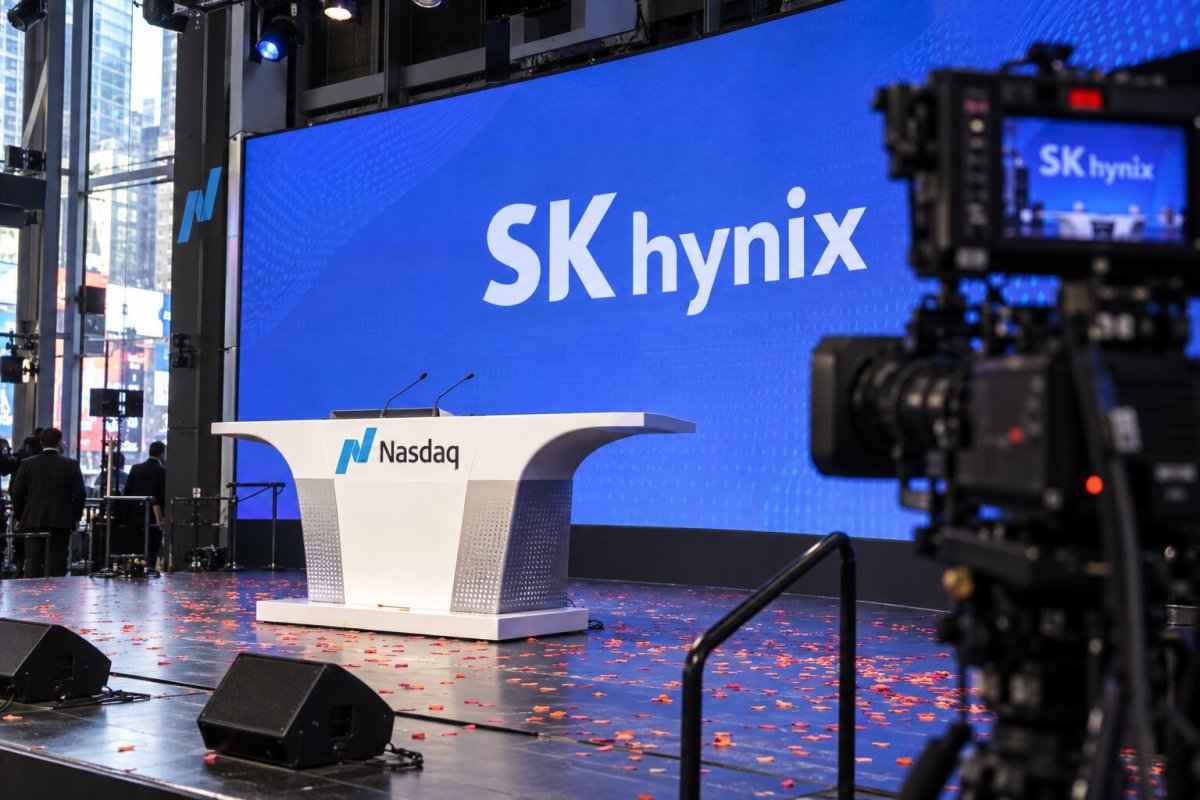
Why is the premium so wide? SKHY is a relatively new security, having begun trading on Nasdaq in July 2026. This gives US investors direct dollar access to a company whose primary listing is in Korea. Differences in trading hours, currency exposure, custody and settlement mechanics, and uneven access to the two markets can all create short-term dislocations. Strong US demand for AI-memory names can amplify these effects.
But an ADR does not own extra factories, patents, or cash flow. Each SKHY share still represents the stated fraction of the Korean ordinary share. A sponsored depositary program creates a mechanism linking the instruments over time, but it does not guarantee a costless, instant arbitrage or that the premium will vanish on a schedule.
The business catalyst behind the rally is real. At its 2026 Future Forum this week, SK hynix outlined a broader AI-memory strategy spanning system-level co-design, high-bandwidth memory (HBM), DRAM, CXL, SSDs, high-bandwidth flash, and 3D memory. This supports the view of SK hynix as more than a commodity memory supplier. However, the forum did not announce a new customer order, revenue forecast, or capital-spending target.
Notably, the Korean shares rose 3.51% on September 9, while SKHY gained 7.05%. This divergence suggests that US-specific demand contributed to Wednesday's move, not that the ADR is entitled to a permanently higher claim on the same company. Capital returns strengthen the underlying case: in August, SK hynix announced a KRW 40 trillion repurchase and cancellation covering about 24.07 million shares, or 3.3% of shares outstanding. The company cited KRW 69 trillion of net cash at the end of the second quarter and reiterated a plan to return more than 50% of cumulative 2025-2027 free cash flow to shareholders. Further details are expected with third-quarter results.
For SKHY investors, three checks matter now. First, compare SKHY with one-tenth of the live Korean share price translated at the current USD/KRW rate, not just SKHY's own previous close. Second, watch third-quarter guidance for evidence that HBM demand and capital returns justify higher estimates. Third, separate currency gains from business gains. Until the premium narrows materially, SKHY is both an AI-memory investment and a bet that US access will remain unusually expensive.
